










From Algorithms to Intelligence: Inside the AI Revolution
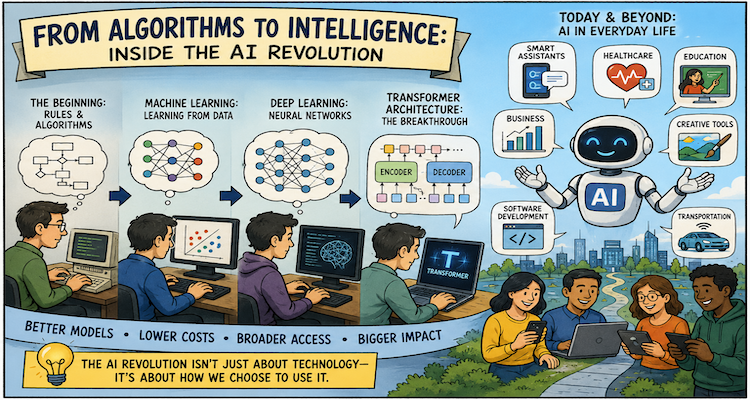
Artificial intelligence did not arrive as a single invention. It emerged through decades of progress in statistics, computing, machine learning, neural networks and increasingly powerful hardware. What has changed in the past few years is the scale and accessibility of those technologies: AI systems can now generate text and images, write and analyze code, interpret language, recognize patterns and assist with increasingly complex tasks.
The more important story, however, is not simply that machines can do more. It is that the economics and architecture of AI have changed enough to move artificial intelligence from specialized software into a general-purpose technology used across work, products, research and everyday life. Stanford’s 2025 AI Index found that the cost of querying a model performing at approximately GPT-3.5’s level on a major language benchmark fell from $20 per million tokens in November 2022 to $0.07 by October 2024 a more than 280-fold decline.
That combination of capability, falling costs and broad accessibility is what makes the current AI transition different from many earlier waves of automation.
Key Takeaways
- Modern AI evolved from rule-based systems toward models that learn patterns from enormous amounts of data.
- The Transformer architecture helped make large-scale language models substantially more practical and scalable.
- Falling inference costs are making advanced AI accessible to more businesses, developers and consumers.
- AI can produce impressive outputs while still being unreliable, making evaluation and human oversight essential.
- The biggest transformation may be AI becoming an adaptable layer inside ordinary software rather than a standalone tool.
- The AI revolution is increasingly about deployment, economics and trust not just model performance.
The Long Road From Algorithms to AI
Early computer programs generally followed explicit instructions: programmers specified the rules, and the machine executed them.
That approach works well when a problem can be described precisely. It becomes much harder when the task involves recognizing an object in an image, understanding natural language or predicting what a user might want.
Machine learning changed the relationship between software and rules. Instead of programming every decision, developers could train systems to identify patterns in data. Neural networks pushed this approach further by allowing models with many layers to learn increasingly complex representations.
The result was a fundamental shift in how software could be built.
Rather than asking, What rules should we write?, developers increasingly began asking, What can a sufficiently capable model learn from data?
That distinction is at the heart of modern AI.
The Architecture That Changed the Direction of AI
One of the most important developments in the modern AI story came in 2017 with the publication of Attention Is All You Need, a research paper that introduced the Transformer architecture.
The researchers proposed an architecture based entirely on attention mechanisms rather than the recurrent or convolutional structures commonly used for sequence processing at the time. The approach demonstrated strong results in machine translation while offering important advantages in parallelization and training efficiency.
Transformers subsequently became a foundation for many large language models.
The importance of the Transformer was not that it suddenly created intelligence. It provided a more scalable way of processing relationships between pieces of information, particularly in sequences such as language.
That distinction matters.
Today’s AI systems are not simply gigantic databases of answers. They are trained statistical models that learn patterns from their training data and use those learned representations to generate outputs.
This helps explain both their remarkable flexibility and their weaknesses.
Why Scale Became So Important
Modern AI progress has been driven by several forces working together: larger datasets, more computing power, improved algorithms, specialized AI hardware and increasingly sophisticated training methods.
Stanford’s 2025 AI Index reported that the training compute used for notable AI models had been doubling approximately every five months, while training dataset sizes were doubling approximately every eight months. The report also found continuing improvements in hardware performance, price efficiency and energy efficiency.
Scale alone does not guarantee useful intelligence. But larger and better-trained models have demonstrated increasingly broad capabilities across language, vision, coding and other tasks.
This created an important feedback loop.
Better models attracted more users. More users created demand for cheaper and faster inference. Falling costs encouraged more applications. Those applications generated new investment and experimentation.
The AI industry therefore became not only a research competition but also an infrastructure and deployment competition.
The Economics of AI Are Changing
One of the least appreciated parts of the AI revolution is the declining cost of using capable models.
Stanford’s AI Index found that inference the cost of querying a trained AI model fell dramatically between late 2022 and late 2024. For a model achieving a GPT-3.5-equivalent score on the MMLU benchmark, the reported cost declined from $20 to $0.07 per million tokens.
This does not mean every AI application is inexpensive. Advanced models, large workloads, data processing, system integration and specialized infrastructure can still be costly.
But the broader direction is significant.
When a technology becomes substantially cheaper, developers can use it in places where it previously made little economic sense.
AI can therefore move from a premium capability to an embedded feature.
Search engines can summarize information. Productivity software can assist with documents. Development environments can help generate code. Customer-service systems can classify and respond to requests. Businesses can use models to extract information from large collections of documents.
The revolution is partly happening because AI is becoming infrastructure.
From Generating Answers to Performing Work
Generative AI made the technology visible to the public because the interface became remarkably simple: ask a question, provide instructions and receive an output.
But the more consequential shift is happening underneath that interface.
AI systems can increasingly be connected to databases, software tools, APIs and business processes. That makes them useful not only for generating content but also for assisting with workflows.
Consider a conventional software process. A person might read an email, identify the request, look up information, enter data into another system and prepare a response.
An AI-enabled workflow can potentially assist with several of those steps.
That does not mean the machine should automatically control the entire process. In high-stakes settings, errors can have financial, legal, safety or reputational consequences.
The more useful question is therefore not simply, Can AI perform this task?
It is:
Where can AI perform part of the task reliably enough to create value, and where should humans remain responsible for the decision?
That is a much more practical way to understand AI adoption.
Intelligence Does Not Mean Reliability
The language surrounding AI can sometimes blur an important distinction: impressive performance is not the same thing as dependable judgment.
AI systems can produce convincing answers that contain errors. Their reliability can vary according to the task, data, context and evaluation method.
The U.S. National Institute of Standards and Technology’s AI Risk Management Framework emphasizes characteristics such as validity and reliability, safety, security, transparency, explainability, privacy and fairness. NIST also stresses that these characteristics must be considered in the context in which an AI system is used.
This becomes particularly important as AI moves into consequential environments.
A system that occasionally produces an incorrect marketing paragraph may create inconvenience. A system used to support medical, financial, legal, infrastructure or security decisions presents a different level of risk.
NIST’s Generative AI Profile also highlights risks arising from complex AI value chains, including third-party datasets, models and software components. Problems can therefore originate outside the organization directly deploying an AI system.
The practical lesson is straightforward: AI systems need evaluation, monitoring and appropriate human oversight rather than blind trust.
The Real Revolution May Be Invisible
The most visible part of AI is the chatbot.
The deeper transformation may be much less noticeable.
AI is increasingly becoming a layer inside software rather than a separate destination. It can sit behind a search interface, assist a programmer, classify documents, analyze images, recommend actions or help employees navigate information.
That changes the nature of software itself.
Traditional software generally follows predefined logic. AI-enabled software can interpret less-structured information and respond to it probabilistically.
This creates opportunities, but it also introduces a new engineering responsibility: software teams must think about evaluation and uncertainty in addition to conventional correctness.
For developers and businesses, that means AI adoption cannot be reduced to purchasing an AI subscription. The difficult work often lies in deciding which tasks should be automated, determining what data the system can access, testing its outputs, establishing safeguards and measuring whether it actually improves the process.
What Comes Next Is Less Certain
The direction of AI development is clear in some respects and uncertain in others.
Capability is improving. Costs have fallen sharply. AI is being integrated into more products and workflows. Governments and organizations are also developing frameworks for managing its risks. NIST, for example, continues to develop and update its AI risk-management resources as the technology evolves.
What remains uncertain is how quickly individual industries will reorganize around these capabilities.
Some jobs may be substantially automated. Others may change through AI-assisted workflows. New roles may emerge around system design, evaluation, oversight and integration. The effects will probably differ considerably across occupations rather than following a single universal pattern.
It is also uncertain how far today’s systems can progress toward more general forms of reasoning and autonomous operation. Current capabilities should not automatically be treated as evidence of human-like understanding or general intelligence.
That distinction is important because the AI revolution is already significant without requiring exaggerated predictions about what machines will eventually become.
Conclusion
The AI revolution is best understood not as the sudden appearance of machine intelligence, but as the convergence of decades of research, scalable computing, new model architectures, abundant data and rapidly falling costs.
Algorithms became machine-learning systems. Machine-learning systems became increasingly capable models. Those models became accessible through simple interfaces and programmable services. Now they are beginning to disappear into the software people already use.
That may be the most consequential stage of the transformation.
The defining question is no longer whether artificial intelligence can perform impressive demonstrations. It is whether organizations can turn those capabilities into reliable, economically useful systems while understanding where the technology fails.
The next phase of AI will therefore be measured not only by bigger models or better benchmarks, but by how intelligently humans choose where to use them.
This content is published for informational or entertainment purposes. Facts, opinions, or references may evolve over time, and readers are encouraged to verify details from reliable sources.