










How AI Is Transforming the Way We Live and Work
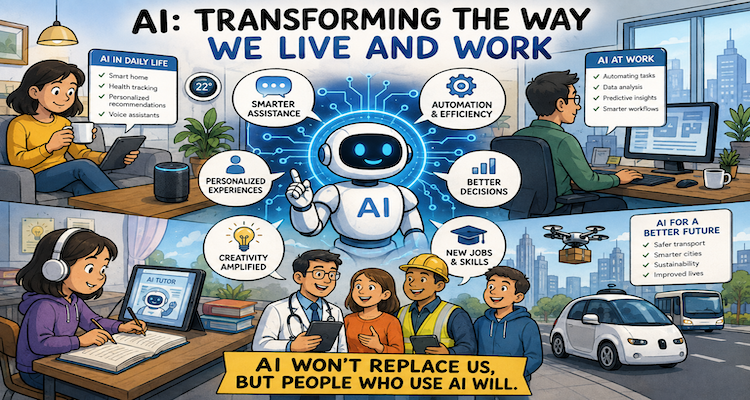
Artificial intelligence is moving from a technology people experiment with to an infrastructure increasingly woven into everyday life and professional work. It is helping people search for information, draft and edit content, analyze data, write software, automate routine processes and make decisions faster. At the same time, its effects are uneven: some workers are gaining useful assistance, some jobs are becoming more exposed to automation, and many organizations are still figuring out where AI genuinely adds value.
The scale of that shift is becoming clearer. Stanford HAI’s 2026 AI Index reports that 88% of surveyed organizations said they used AI in at least one business function in 2025, while generative AI was used in at least one function by 70%. The same report estimates that consumer value from generative AI in the United States reached $172 billion annually by early 2026.
The important story, however, is not simply that AI is becoming more common. It is that AI is changing how tasks are performed and that distinction may matter more than the technology itself.
Key Takeaways
- AI is increasingly becoming a layer of everyday digital services rather than a standalone technology people deliberately seek out.
- Workplace AI is strongest when it assists structured, measurable tasks, while complex judgment still requires meaningful human involvement.
- Research suggests AI can raise productivity, but the gains vary substantially by worker, task and level of experience.
- The biggest employment effect may be job transformation rather than wholesale replacement, according to the ILO’s 2025 global assessment.
- Workers increasingly need a combination of AI literacy, technical skills and human abilities such as communication and critical thinking.
- The real advantage may go to people and organizations that redesign workflows around AI rather than simply adding AI tools to existing routines.
AI Is Moving Into the Background of Everyday Life
For many people, AI no longer arrives with an obvious label.
It can sit behind search results, recommendation systems, navigation, spam filtering, translation, photo enhancement, customer-service systems and personalized digital services. Generative AI has added another layer: people can now interact directly with systems that produce text, images, software code, summaries and other forms of content.
Stanford’s 2026 AI Index estimates that generative AI reached 53% adoption within three years, a faster diffusion rate than the personal computer or the internet achieved over comparable periods. Adoption remains highly uneven between countries, however, meaning the benefits of AI are not being distributed equally.
That distinction matters. A technology can become globally important without becoming equally accessible to everyone.
Access to reliable internet, computing resources, digital skills, language support and affordable AI services can determine who benefits. For households, this can influence how people learn, communicate, organize information and complete everyday tasks. For businesses, the same differences can affect productivity and competitiveness.
At Work, AI Is Changing Tasks Before It Changes Entire Jobs
The workplace transformation is more complicated than the familiar question, “Will AI take people’s jobs?”
Most jobs contain many different tasks. An accountant, programmer, teacher, marketer or customer-service representative may spend part of the day researching, writing, checking information, communicating with people, analyzing data and making decisions.
AI can assist with some of those tasks without replacing the entire occupation.
The International Labour Organization’s 2025 assessment found that one in four workers globally are in occupations with some degree of generative-AI exposure. Yet the ILO concluded that transformation is more likely than complete job redundancy because human input remains necessary for many tasks. Clerical occupations remain particularly exposed, while exposure has also expanded into some professional and technical roles.
This creates a more useful way to think about AI at work: the unit of change is often the task, not the job title.
A software developer may use AI to generate boilerplate code and investigate bugs. A marketer may use it to produce initial drafts and analyze campaign information. A manager may use it to summarize documents. A researcher may use it to organize information before independently checking the evidence.
The human role does not necessarily disappear. It can move toward defining the problem, evaluating the output, making judgments and taking responsibility for the result.
Productivity Gains Are Real but They Are Not Automatic
One of the strongest arguments for workplace AI is productivity.
A widely cited NBER study examined 5,179 customer-support agents after the introduction of a generative-AI conversational assistant. Researchers found an average productivity increase of 14%, with substantially larger gains among novice and lower-skilled workers and little effect among the most experienced workers.
That finding is important because it shows both the potential and the limitation of AI.
AI did not produce the same benefit for everyone. The value depended partly on the worker’s starting point and the nature of the work.
Stanford’s 2026 AI Index similarly reports that productivity gains are strongest in structured, measurable tasks where outputs can be monitored easily. It cites reported gains ranging from roughly 14–15% in customer support to larger gains in some software-development and marketing studies, while noting that more complex reasoning tasks can produce smaller gains.
This suggests that organizations should be cautious about treating AI as a universal productivity multiplier.
Replacing a slow manual process with an AI-assisted workflow can produce measurable benefits. Asking an AI system to make poorly defined decisions, however, can simply move the problem somewhere else—often into verification and correction.
The New Workplace Skill Is Knowing What to Delegate
The most valuable AI skill may not be writing clever prompts.
It may be knowing which parts of a job should be delegated to a machine and which should remain under human control.
Consider a simple workflow:
- AI gathers and organizes information.
- A worker checks the important facts.
- AI produces a first draft or analysis.
- The worker evaluates the result.
- The final decision remains accountable to a person.
This model treats AI as an assistant rather than an unquestioned authority.
That distinction becomes especially important because generative AI can produce convincing but incorrect information. Speed is useful only when accuracy remains within acceptable limits.
Pew Research Center’s 2025 survey of U.S. workers illustrates the gap between usefulness and trust. Among workers who had used AI chatbots at work, 40% said the tools were extremely or very helpful for doing things more quickly, while 29% said they were highly helpful for improving work quality.
The difference is revealing: AI can make a task faster without automatically making the result better.
AI Is Also Changing What Employers Expect
As AI becomes more capable, organizations are likely to place greater value on employees who can combine domain knowledge with AI literacy.
The World Economic Forum’s Future of Jobs Report 2025, based on responses from more than 1,000 companies, estimated that nearly 40% of skills required on the job could change by 2030. It identified AI, big data and cybersecurity among the fastest-growing technical skill areas, while emphasizing that human capabilities such as creative thinking, resilience, flexibility and agility remain important.
This points toward a hybrid model of work.
A strong employee may increasingly be someone who understands the business problem, knows how to use AI tools, can identify when an output is unreliable, communicates effectively with colleagues and customers, and understands the consequences of a decision.
Technical knowledge alone may not be enough. Neither will AI familiarity without professional judgment.
The Benefits Will Not Be Distributed Evenly
AI’s transformation of work also creates a distribution problem.
Workers with access to good tools, training and supportive employers can use AI to increase their capabilities. Workers without those resources may face disruption without receiving comparable opportunities to adapt.
The ILO’s 2025 analysis found that one in four workers globally are in occupations with some GenAI exposure, but only 3.3% of global employment falls into its highest exposure category. It also found substantial differences between countries and demographic groups.
Meanwhile, Pew’s research shows that workplace AI adoption is far from universal. In its February 2025 survey, 63% of U.S. workers said they did not use AI much or at all in their jobs, while 16% said at least some of their work was done with AI. Among workers who had used workplace AI chatbots, research, editing and drafting were the most common applications.
So the AI transition is not happening at one speed.
Some people are already redesigning their workflows around AI. Others have little reason or opportunity to use it. That gap could become an important factor in future productivity and career mobility.
What AI Means for Everyday Life
Outside work, the same transformation is taking place more quietly.
AI can reduce the effort required to find information, translate text, organize ideas, create media or interact with digital services. For students, it can function as a tutoring or brainstorming aid. For families, it can help organize information and routine tasks. For creators, it can lower the technical barrier to producing certain forms of content.
But convenience creates a new responsibility: deciding when assistance becomes dependence.
If people routinely accept machine-generated answers without checking them, the technology can reduce effort while also reducing opportunities to develop knowledge and judgment. Stanford’s 2026 AI Index notes emerging concerns that heavy reliance on AI may carry longer-term learning penalties in some settings.
That does not mean people should avoid AI. It means the most valuable use of AI may be augmentation rather than substitution of thinking.
Use the machine to accelerate the parts of a task that benefit from speed. Keep humans engaged where understanding, context, judgment and accountability matter.
The Next Phase Is About Redesign, Not Just Adoption
The first phase of AI adoption was largely about experimentation: people trying chatbots, generating images, summarizing documents and testing what the technology could do.
The more consequential phase is workflow redesign.
Organizations are now beginning to integrate AI into multiple business functions. Stanford’s 2026 AI Index reports that 88% of surveyed organizations used AI in at least one business function in 2025, while generative AI was used in at least one function at 70%. At the same time, AI-agent deployment remained in the single digits across nearly all business functions, suggesting that autonomous systems are still at an earlier stage than basic AI adoption.
That distinction matters.
Installing an AI tool is relatively easy. Redesigning a process so that people and AI complement each other is much harder.
It requires organizations to decide which tasks should be automated, which require review, how errors will be detected, what information can safely be provided to AI systems, how employees will be trained, and who remains accountable when something goes wrong.
The companies that handle those questions well may gain more from AI than companies that simply deploy the largest number of tools.
Conclusion
AI is transforming the way people live and work, but the transformation is less about machines suddenly replacing humans and more about changing the structure of everyday tasks.
The evidence so far points to a mixed picture: measurable productivity gains in some forms of work, rapidly expanding organizational adoption, growing exposure across occupations, and significant uncertainty about how those changes will affect different workers.
That makes AI literacy increasingly important—but AI literacy should mean more than knowing how to operate a chatbot.
It means understanding what AI is good at, recognizing where it can fail, knowing what to delegate, checking what comes back, and retaining human judgment where the consequences matter.
The defining advantage in the AI era may therefore belong neither to people who reject the technology nor to those who automate everything. It may belong to people who understand where human capability and machine capability work better together.
This content is published for informational or entertainment purposes. Facts, opinions, or references may evolve over time, and readers are encouraged to verify details from reliable sources.