










The New Intelligence: How AI Is Moving From Answers to Action
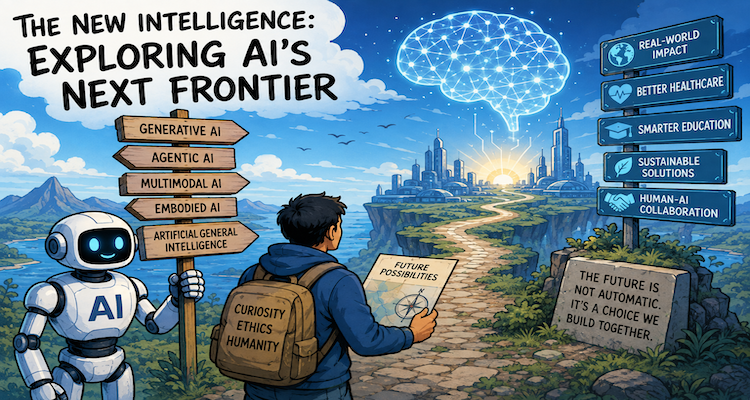
Artificial intelligence is entering a phase where the most important question is no longer whether a model can generate an answer. It is whether AI can reason through a problem, use tools, work across different kinds of information, and complete useful tasks with limited human intervention.
That shift is already visible. Stanford’s 2026 AI Index reports that frontier AI capabilities continued to advance rapidly in 2025, including reasoning, multimodal understanding, science and agentic systems. AI agents also improved substantially on computer-use evaluations, although they still fail on a meaningful share of structured tasks.
This suggests that the next frontier of AI is not simply a larger chatbot. It is a more capable form of machine intelligence that can combine reasoning, memory, tools, perception and action.
But there is an important catch: capability is advancing faster than reliability and governance. The emerging AI landscape is therefore defined by two simultaneous developments machines becoming more capable of doing complex work, and organizations struggling to determine when they can safely trust them.
Key Takeaways
- AI is shifting from generating responses toward completing longer, multi-step tasks.
- Reasoning and inference-time computation are becoming important ways to improve AI performance.
- AI agents are advancing, but real-world reliability remains uneven across tasks.
- Multimodal systems increasingly combine text, images, audio, video and other information.
- Businesses are experimenting with agents faster than many organizations can establish effective governance.
- The next AI frontier may depend as much on reliability and control as raw model capability.
From Chatbots to Systems That Act
The first major wave of generative AI made natural-language interaction dramatically easier. A user could ask a question, request code, summarize a document or generate an image without learning a specialized interface.
The emerging wave changes the unit of interaction.
Instead of asking an AI to perform one isolated step, users can increasingly delegate a sequence of tasks. An agent may interpret an objective, decide which tools are required, retrieve information, manipulate software, evaluate intermediate results and continue working toward an outcome.
OpenAI describes this transition as a move from short, self-contained interactions toward delegated, longer-horizon work involving tool calls and interaction with external environments.
That distinction matters because many economically valuable activities are not single questions. They are workflows.
Preparing a report can involve collecting documents, comparing information, analyzing data, writing a draft and checking the result. Software development can involve understanding a repository, modifying code, running tests and fixing failures. Customer operations can require retrieving records, interpreting policies and taking several actions before a case is resolved.
AI that can participate across those steps has a different economic role from AI that simply generates text.
The Rise of the Reasoning Layer
Another important frontier is reasoning.
Modern AI systems increasingly use additional computation during inference to work through difficult problems rather than immediately producing an answer. Research into test-time scaling shows that giving models more inference-time computation can improve performance on difficult reasoning tasks, although the effectiveness depends on the model, task and method used.
This creates an important change in how AI performance can be improved.
For years, the dominant story was largely about making models bigger and training them on more data and computation. The emerging picture is more complicated. Some improvements can come from allowing a system to spend more computational effort on a particular problem.
That does not mean that more “thinking” automatically produces better answers.
Research has also documented cases where increasing reasoning length can reduce performance on particular tasks.
The practical lesson is important: intelligence cannot be measured simply by how long an AI reasons. Effective systems need mechanisms for deciding when additional computation is useful, when to verify an answer and when to stop.
The Jagged Frontier
One of the most revealing characteristics of current AI is its unevenness.
Stanford’s 2026 AI Index describes a “jagged frontier” in which advanced AI systems can perform exceptionally well on some demanding tasks while failing at seemingly simple ones. The report notes, for example, that leading systems can reach very high performance on difficult mathematics and scientific evaluations while still struggling with certain basic perceptual tasks.
This is more than an interesting technical curiosity.
For businesses and individuals, it changes how AI should be used.
A system that performs extremely well on a benchmark should not automatically be trusted with every task surrounding that benchmark. A model may produce sophisticated software while making an elementary factual mistake. It may analyze a complex document while misunderstanding a visual detail. It may complete several steps successfully and then fail at the final action.
The frontier is therefore not a straight line from “less intelligent” to “more intelligent.”
It is a patchwork of strengths and weaknesses.
That makes evaluation increasingly important. Stanford reports that some AI benchmarks are becoming saturated so quickly that they can lose their usefulness as measures of progress.
The next generation of evaluation will need to measure not only whether an AI can produce a correct answer, but whether an entire AI system can reliably accomplish a real objective.
Multimodal Intelligence Changes the Interface
Another frontier is the disappearance of the assumption that AI primarily works with text.
Modern systems increasingly process combinations of language, images, audio, video and other forms of information. Stanford’s technical assessment now tracks progress across language, vision, video, speech, reasoning, robotics and agentic systems rather than treating language models as an isolated category.
This matters because human work is inherently multimodal.
A technician may need to interpret a photograph and a maintenance manual. A doctor may work with medical images and clinical records. An engineer may combine diagrams, specifications and sensor readings. A business analyst may need spreadsheets, presentations, emails and databases.
An AI system capable of connecting these information types can become more deeply embedded in workflows.
But multimodality also creates additional opportunities for error. A system can misunderstand one input and propagate that mistake through the rest of its reasoning chain. The more information an AI can access, the more important it becomes to understand where its conclusions came from.
Business Adoption Is Moving Ahead Carefully
The business case for this new generation of AI is becoming clearer, but adoption remains far from complete.
McKinsey’s 2025 global survey found that 62% of respondents said their organizations were at least experimenting with AI agents, while 23% reported scaling an agentic AI system somewhere in the enterprise. Yet most organizations remained in experimentation or pilot stages rather than broad enterprise-scale deployment.
Stanford’s 2026 AI Index similarly reports widespread organizational AI adoption while describing AI-agent deployment as still relatively early across individual business functions.
That gap between experimentation and scaling is significant.
An AI prototype can demonstrate that something is technically possible. Enterprise deployment requires something harder: predictable performance, security, permissions, monitoring, integration with existing systems, accountability and a clear economic benefit.
In other words, the next AI race is not simply a race to build smarter models.
It is a race to build dependable systems around them.
The Control Problem Becomes More Important
As AI systems gain the ability to take actions rather than merely provide information, governance becomes a technical requirement rather than an administrative afterthought.
IBM’s 2026 Institute for Business Value study of 2,000 technology executives found that only 11% of respondents said they were completely prepared for the scale of AI-agent deployment. The study also reported that many technology leaders were accountable for systems they did not fully control.
The challenge can be understood simply.
A chatbot that produces an incorrect answer creates one kind of problem. An AI system that can access databases, send messages, modify records or execute workflows can create a much larger one.
This makes permissions, audit trails, human approval, monitoring and system boundaries increasingly important.
Gartner has also warned about the potential for “agent sprawl” as organizations deploy growing numbers of autonomous systems. Its April 2026 research suggested that governance could become a major organizational challenge as the number of agents increases.
The implication is straightforward: autonomy without control is not necessarily progress.
What the New Intelligence May Actually Mean
The phrase “artificial intelligence” can make the technology sound like a single capability. In practice, the emerging frontier looks more like a stack.
At the foundation are increasingly capable models. Around them sit reasoning mechanisms, memory, retrieval systems, tools, software interfaces, specialized models and verification processes. Above that sits the workflow in which the AI operates.
The intelligence of the overall system may therefore depend less on one spectacular model and more on how effectively these components work together.
This is particularly important for companies deciding where to invest.
Instead of asking only, “Which AI model should we use?”, a more useful question is:
What work should the AI be trusted to perform, under what conditions, with what evidence and with what level of human oversight?
That question moves the discussion from technology demonstrations to operational intelligence.
The Next Frontier Is Reliability
AI capability is clearly advancing. Stanford’s 2026 AI Index describes continued acceleration across multiple dimensions and reports significant progress in agentic systems, reasoning and scientific applications.
Yet the same evidence points toward a less comfortable conclusion: capability alone does not determine usefulness.
The most valuable AI systems will need to know when they are uncertain, verify important results, operate within defined permissions and recover when something goes wrong.
That is why the next frontier may not be artificial intelligence in the narrow sense.
It may be reliable intelligence.
The transition from answering questions to taking action could make AI far more consequential for workplaces, businesses and everyday life. But it also raises the standard by which AI should be judged. A system that can act independently must be evaluated not only by what it can accomplish when everything goes right, but by how it behaves when information is incomplete, instructions conflict or its own reasoning goes wrong.
The defining question of the next AI era may therefore shift from “How intelligent is the model?” to “How much responsibility can the system reliably handle?”
That is where the real frontier begins.
This content is published for informational or entertainment purposes. Facts, opinions, or references may evolve over time, and readers are encouraged to verify details from reliable sources.