










When Machines Learn: From Hand-Coded Rules to Systems That Learn
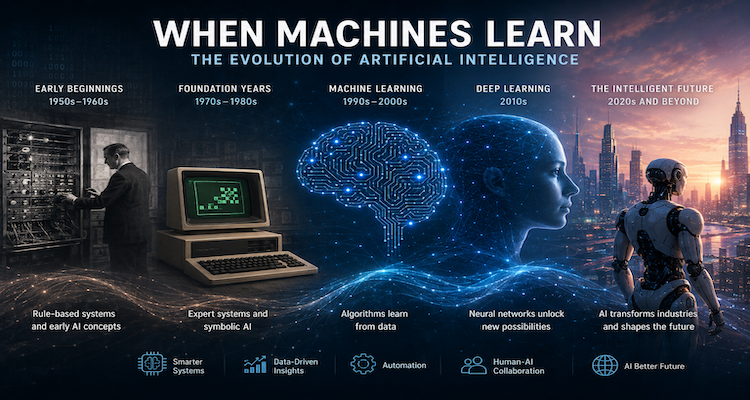
Artificial intelligence did not begin with chatbots, image generators, or machines that can write software. Its earliest ambitions were much simpler and, in some ways, more difficult: could a machine represent knowledge, solve problems, recognize patterns, or imitate aspects of human reasoning?
In 1950, Alan Turing reframed the question of machine intelligence around whether a computer could convincingly participate in what he called the “imitation game.” Six years later, researchers gathered at Dartmouth and formally established artificial intelligence as a field of research.
What followed was not a straight march toward smarter machines. AI moved through periods of optimism and disappointment, from hand-written rules and expert systems to statistical machine learning, neural networks, deep learning, reinforcement learning and, eventually, transformer-based generative systems.
The most important change across that history is not simply that computers became more powerful. The machines increasingly moved from being programmed with instructions about what to do toward systems that learn patterns from data and experience.
Key Takeaways
- AI evolved from explicitly programmed rules toward systems that learn representations and patterns from data.
- Periods of disappointment showed that impressive demonstrations did not automatically translate into useful general intelligence.
- Deep learning became practical when algorithms, large datasets and powerful GPUs converged.
- Transformers changed AI by making large-scale processing of relationships within sequences far more practical.
- Modern AI can perform remarkably well on some difficult tasks while remaining unreliable on others.
- The next phase of AI is therefore as much about reliability and governance as raw capability.
The Question That Started the Field
The intellectual roots of AI predate the phrase itself. But a defining milestone came in 1950, when British mathematician Alan Turing published Computing Machinery and Intelligence in the journal Mind. Instead of trying to settle the philosophical question “Can machines think?”, Turing proposed the imitation game as a way of examining machine behavior.
Six years later, the Dartmouth Summer Research Project on Artificial Intelligence gave the emerging discipline its name. John McCarthy and other researchers proposed that aspects of learning and intelligence might be described precisely enough for machines to simulate them. Dartmouth identifies the 1956 workshop as the birth of AI as a formal research field.
The early vision was ambitious. Researchers believed that reasoning, language, problem solving and other elements of intelligence could potentially be represented computationally.
But the machines of the period had a fundamental limitation: they had very little computing power and very little data compared with today’s systems.
That shaped the first generation of AI.
When Intelligence Meant Rules
Early AI research relied heavily on symbolic reasoning. Instead of learning from millions of examples, a programmer could encode facts, rules and relationships into a system.
This approach worked surprisingly well in constrained environments.
A machine could be taught rules for a particular problem and then use logical operations to reach a conclusion. Expert systems later extended this idea by storing specialized knowledge for areas such as chemistry and medical diagnosis. Stanford’s historical review of AI describes expert systems as one of the important directions of early AI research.
The strength of symbolic AI was also its weakness.
If humans could clearly define the rules of a problem, a machine could often reason through them. But the real world is full of ambiguity, exceptions, incomplete information and patterns that are difficult to express as explicit instructions.
Recognizing a photograph, understanding ordinary language or navigating an unpredictable environment cannot easily be reduced to a giant collection of “if this, then that” statements.
AI eventually needed another way to learn.
The Long Detour Through AI Winters
The history of AI is also a history of overconfidence.
Early successes encouraged predictions that increasingly capable machines were close. But practical progress repeatedly failed to match expectations. Systems that looked impressive in laboratories could struggle when confronted with the complexity of real-world environments.
By the 1980s, enthusiasm and funding declined. Stanford’s One Hundred Year Study on Artificial Intelligence describes this period as an “AI winter,” noting problems including excessive reliance on symbolic logic and insufficient grounding of systems in real-world data and uncertainty.
This period matters because it established a lesson that remains relevant today:
A machine performing brilliantly within a defined test does not necessarily mean it possesses broadly useful intelligence.
That distinction would become increasingly important as AI benchmarks became more sophisticated.
From Programming Intelligence to Learning From Data
The next major shift was machine learning.
Instead of explicitly specifying every rule, researchers increasingly designed algorithms that could adjust themselves based on examples.
Neural networks became particularly important. Frank Rosenblatt’s perceptron, developed in the late 1950s, provided an early computational model inspired by biological neurons and became an important foundation for later neural-network research.
For decades, however, neural networks struggled to deliver their full promise.
The breakthrough required more than better algorithms.
Three ingredients increasingly came together:
- Large datasets
- More powerful computing hardware
- Improvements in neural-network techniques
Graphics processing units, or GPUs, became particularly important because they could perform many mathematical operations in parallel.
That combination helped turn neural networks from an interesting research direction into a practical technology.
The Deep-Learning Breakthrough
One of the clearest milestones arrived in 2012.
Alex Krizhevsky, Ilya Sutskever and Geoffrey Hinton developed a large deep convolutional neural network for image recognition. Their system, known as AlexNet, trained on roughly 1.3 million high-resolution images and achieved a substantial improvement over previous ImageNet results. The researchers also relied on GPUs to make training practical.
The significance went beyond one image-recognition competition.
The result demonstrated that sufficiently large neural networks, trained with large datasets and accelerated by modern hardware, could dramatically improve performance on difficult perception tasks.
That helped accelerate investment and research in deep learning.
AI was becoming less about manually describing intelligence and more about discovering useful representations from data.
When Machines Began Learning Through Experience
Another important development came through reinforcement learning.
Rather than simply being shown the correct answer for every example, a system can interact with an environment, receive feedback and improve its strategy.
AlphaGo offered a striking demonstration.
In 2016, DeepMind’s AlphaGo defeated European Go champion Fan Hui in a five-game match. It combined deep neural networks with tree search and learned from both human games and self-play. Nature described the achievement as the first time a computer program had defeated a professional player in an even game on a full 19-by-19 Go board.
The subsequent AlphaGo Zero research pushed the idea further. It learned Go through reinforcement learning from the game’s rules and self-play, without relying on human game data, eventually defeating the earlier AlphaGo system.
This was a conceptual milestone.
The machine was no longer merely following a collection of human-authored instructions. Under defined conditions, it could discover strategies that humans had not explicitly taught it.
The Transformer Changes the Scale
The next major transition came from language and sequence modeling.
In 2017, researchers introduced the Transformer architecture in the paper Attention Is All You Need. The architecture relied on attention mechanisms rather than recurrent or convolutional structures for sequence transduction. The researchers demonstrated strong results in machine translation while making the architecture substantially more parallelizable.
That technical change became foundational to the modern generative-AI era.
Large models could be trained on enormous amounts of data and learn statistical relationships across text and, increasingly, other forms of information. The result was a new generation of systems capable of generating language, code, images and other content.
The important historical progression is therefore easy to miss:
Rules → learning from examples → deep representation learning → learning through interaction → large-scale multimodal models.
Each stage did not completely replace the previous one. Instead, researchers accumulated techniques and combined them in increasingly powerful systems.
AI Has Become Broadly Useful but Not Uniformly Intelligent
The current AI era can make the history look inevitable. It was not.
Today’s systems can summarize documents, generate software, analyze images, translate languages, answer questions and assist with scientific and business tasks. But capability remains uneven.
The 2026 Stanford AI Index illustrates this “jagged” nature of modern AI. Some frontier systems have reached or exceeded human performance on demanding scientific, mathematical and coding evaluations, while other seemingly simple tasks remain unreliable. The report also notes that AI-agent performance on computer-use tasks has improved substantially but still leaves meaningful failure rates.
This matters because the evolution of AI should not be understood as a simple climb from “dumb” machines to “smart” machines.
A better description is that machines have become increasingly capable in specific, measurable ways while remaining uneven in how reliably those capabilities transfer across situations.
That is why a system can solve a difficult mathematical problem and still make an elementary factual mistake.
The Business Shift: From Experiment to Infrastructure
AI has also crossed an important economic boundary.
It is no longer confined primarily to research laboratories or specialized technology companies. Stanford’s 2026 AI Index reports that 88% of surveyed organizations used AI in at least one business function in 2025, while generative AI was used in at least one business function by 70% of organizations.
That does not mean organizations have successfully automated large portions of their operations. The same report notes that deployment of AI agents remained in the single digits across nearly all business functions.
This distinction is crucial.
Adoption of AI tools is not the same as autonomous AI.
A company allowing employees to use an AI assistant is fundamentally different from giving an AI system authority to make decisions, interact with customers, change databases or execute business processes without close supervision.
The evolution of AI is therefore entering a new stage in which integration, reliability, evaluation and accountability may matter as much as model size.
The New Problem: Knowing What Machines Still Get Wrong
As AI systems become more capable, measuring their limitations becomes harder.
Stanford’s 2026 AI Index reports that capability benchmarks are being saturated increasingly quickly, while responsible-AI evaluation has not kept pace. It also records 362 documented AI incidents in 2025, compared with 233 in 2024.
The lesson is not that AI is failing.
It is that progress creates a measurement problem.
If an evaluation becomes too easy for advanced systems, a high score tells us less about how those systems behave in unfamiliar conditions. A model can excel on one benchmark while failing in another environment.
That makes independent evaluation, transparent testing and human oversight increasingly important.
The evolution of AI is therefore becoming less about asking only, “How powerful is the model?”
A more useful question is:
“Where is it reliable, where does it fail, and what happens when people trust it?”
Where the Evolution Leads Next
The next chapter of AI is unlikely to be defined by one single invention.
Progress will probably come from the interaction of better models, specialized systems, larger and better datasets, improved reasoning techniques, AI agents, robotics, new hardware and increasingly sophisticated evaluation.
But the historical record offers a warning against assuming that technical progress automatically produces general intelligence.
AI has advanced because researchers repeatedly changed how machines approach problems: from rules to learning, from handcrafted features to learned representations, from fixed strategies to self-improvement, and from narrow models to systems capable of handling multiple forms of information.
The same pattern may continue.
The machines of the future may become more capable not because they suddenly “think” like people, but because engineers discover better ways for machines to learn, reason, interact with environments and communicate uncertainty.
Conclusion
The history of artificial intelligence is not a straight line from simple computers to intelligent machines. It is a cycle of ambitious ideas, disappointing limitations, technical breakthroughs and revised expectations.
Turing changed the question of machine intelligence. Dartmouth gave the field its name. Symbolic systems demonstrated the power of explicit reasoning. Machine learning shifted the emphasis toward data. Deep learning showed what large neural networks could accomplish with modern computing. AlphaGo demonstrated the power of learning through self-play. Transformers helped make today’s generative-AI systems possible.
The defining story is therefore not simply that machines became smarter.
Machines learned to learn.
And as AI enters its next phase, the most important measure of progress may no longer be how impressive a machine can appear, but how reliably its learned capabilities can be used in the real world.
This content is published for informational or entertainment purposes. Facts, opinions, or references may evolve over time, and readers are encouraged to verify details from reliable sources.