










AI Unleashed: How Artificial Intelligence Is Redefining What Technology Can Do
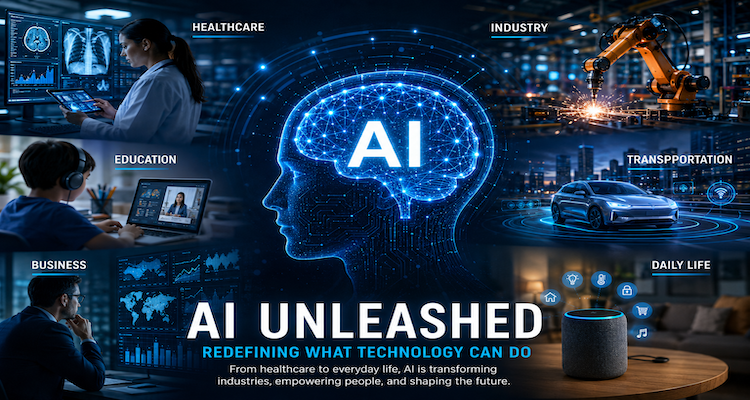
Artificial intelligence is moving beyond the role of a tool that answers questions, generates images or summarizes documents. The more consequential shift is that AI systems are increasingly being connected to software, data, workflows and other tools so they can perform sequences of actions rather than simply produce an answer.
That change is redefining what technology can accomplish.
The 2026 Stanford AI Index reports that AI capabilities continued to accelerate in 2025, while organizational adoption reached 88% among surveyed organizations. At the same time, agent deployment remained relatively early across most business functions. The gap between what AI can demonstrate in controlled evaluations and what organizations can safely depend on in the real world is therefore becoming one of the defining technology questions of the moment.
The important story is not that AI has suddenly become capable of everything. It is that the boundary between software that responds and software that acts is becoming increasingly important.
Key Takeaways
- AI is shifting from generating outputs toward completing multi-step tasks through tools, software and connected workflows.
- Frontier models are improving rapidly, but their abilities remain uneven and surprisingly unreliable on some ordinary tasks.
- Businesses are adopting AI at scale, yet autonomous AI agents remain much less mature than general-purpose AI assistants.
- AI is becoming a research instrument, helping scientists generate hypotheses, analyze complex systems and accelerate discovery.
- The next technology bottleneck may be reliability, governance, energy and infrastructure rather than raw model intelligence.
- The most valuable AI systems are likely to augment human judgment rather than eliminate the need for it.
The Big Shift: From Answers to Actions
For years, much of the public experience of AI revolved around prompts and responses. A person asked a question, supplied a document or requested an image, and the AI returned an output.
That model is changing.
Agentic AI systems can be designed to break a larger objective into steps, use software tools, retrieve information, write or execute code, evaluate intermediate results and continue working toward a goal. The significance is not simply that an AI model can generate better text or code. It is that the model can become one component inside a larger operating system for accomplishing work.
Research from METR illustrates why this matters. Its measurements of frontier AI agents show that the length of tasks they can complete with a given probability of success has been increasing over time. METR’s current evaluation, updated in May 2026, focuses heavily on software engineering, machine learning and cybersecurity tasks and warns that its measurements should not be interpreted as evidence that AI can automate entire jobs.
That distinction is crucial.
An AI that can complete a two-hour technical task is not automatically equivalent to a professional who can manage an eight-hour workday filled with context, interruptions, judgment, communication and accountability.
The frontier is therefore moving, but it remains uneven.
AI’s Strange New Capability Curve
One of the most interesting characteristics of modern AI is what researchers sometimes describe as a “jagged” capability frontier.
A system can perform extremely difficult mathematical reasoning yet fail at something that appears trivial to a human. Stanford’s 2026 AI Index highlights this contrast: an AI model achieved gold-medal-level performance at the International Mathematical Olympiad, while the leading model correctly read analog clocks only about half the time in the cited evaluation. AI agents also improved substantially on OSWorld, a benchmark involving real computer tasks, but still failed a significant share of attempts.
This changes how AI should be evaluated.
Raw intelligence is only one part of usefulness. A technology becomes dependable when it combines capability with consistency, context, controllability and predictable failure modes.
That is why the next phase of AI competition is unlikely to be determined entirely by who has the biggest model.
Cost, reliability, speed, specialized performance and the ability to integrate AI into real workflows increasingly matter.
From Productivity Tool to Work Infrastructure
AI adoption is already moving beyond experimentation.
The OECD reported in January 2026 that 20.2% of firms across OECD countries with available data reported using AI in 2025, up from 14.2% in 2024 and 8.7% in 2023. Adoption was particularly high among large companies: 52% reported AI use compared with 17.4% of small firms.
Stanford’s broader organizational data points to an even faster expansion of generative AI, reporting that 88% of surveyed organizations used AI in 2025 and that generative AI was being used in at least one business function at 70% of organizations. Yet agent deployment remained in the single digits across nearly all business functions.
That combination tells an important story.
AI has moved rapidly into the workplace, but the transition from “employee uses an AI assistant” to “AI independently operates a business process” is much less mature.
For companies, this means the competitive advantage may increasingly come from redesigning workflows rather than simply purchasing access to an AI model.
A marketing team, for example, could use AI to draft content. A more advanced system might research a subject, prepare multiple versions, analyze performance data, update a content calendar and recommend what should be produced next. The difference is not merely better writing. It is workflow orchestration.
That is where AI begins to resemble infrastructure.
The Scientific Laboratory Is Becoming More Computational
AI’s impact may become even more significant in fields where progress depends on navigating enormous amounts of information.
The 2026 AI Index reports that AI-related scientific publications in the natural sciences reached roughly 80,150 in 2025, a 26% increase from the previous year. AI is increasingly being used across biology, chemistry, physics and astronomy.
Biology offers an especially revealing example.
AI systems such as AlphaFold demonstrated that machine learning could attack problems that had challenged researchers for decades. The AlphaFold Protein Database has since become a widely used scientific resource, with Google DeepMind reporting more than three million researchers using it across more than 190 countries.
The emerging generation of systems is going further. In 2026, Google DeepMind described its Co-Scientist system as a multi-agent research system designed to generate, debate and refine scientific hypotheses. Such systems do not eliminate the experimental process; hypotheses still need to be tested in the physical world.
That distinction reveals something important about AI’s role in science.
The machine does not need to replace the scientist to transform scientific progress. It can expand the number of possibilities researchers can explore before committing scarce laboratory time and resources.
AI therefore has the potential to compress parts of the discovery cycle without removing the need for human validation.
Healthcare Shows Both the Promise and the Boundary
Medicine provides another example of AI’s changing role and perhaps an even stronger warning against excessive optimism.
The 2026 AI Index reports broad adoption of AI-generated clinical notes, with physicians in several hospital systems reporting substantial reductions in time spent documenting visits. It also reports growing use of AI in scientific discovery and clinical workflows.
But healthcare also exposes the difference between an impressive demonstration and a dependable system.
The same Stanford analysis notes that many clinical AI studies rely on exam-style questions rather than real patient data. One review cited by the report found that only 5% of more than 500 clinical AI studies examined used real clinical data.
That is why the strongest near-term applications are often narrow and supervised.
An AI system that drafts a clinical note for a physician to review has a very different risk profile from a system that independently decides a patient’s diagnosis or treatment.
The lesson extends far beyond healthcare: the more consequential the decision, the more important verification and human oversight become.
The New Bottleneck Is Trust
As AI becomes more capable, reliability becomes more valuable.
Stanford’s 2026 AI Index reports that hallucination rates in a new evaluation varied dramatically among leading models, ranging from 22% to 94%. It also found that responsible-AI benchmarking has not kept pace with capability benchmarking, while documented AI incidents increased from 233 in 2024 to 362 in 2025.
This creates a paradox.
AI systems are becoming powerful enough to perform tasks that matter, at precisely the moment organizations need stronger evidence that those systems can be trusted to perform them consistently.
NIST’s Generative AI Profile recommends treating risk management as part of the AI lifecycle rather than something added after deployment. Its framework emphasizes identifying, evaluating and managing risks associated with generative AI systems. NIST is also revising its broader AI Risk Management Framework and released a 2026 concept note addressing trustworthy AI in critical infrastructure.
For businesses, this means AI governance is no longer simply a compliance exercise.
It becomes an engineering problem.
Organizations need to know what a system is allowed to do, what information it can access, how its actions are logged, when a human must intervene and what happens when the model is wrong.
Intelligence Still Needs Physical Infrastructure
There is another limit that is easy to overlook when AI is discussed entirely through software.
AI requires enormous physical infrastructure: chips, data centers, electricity, cooling systems, networks and increasingly complex supply chains.
The International Energy Agency reported in April 2026 that data-center electricity demand rose 17% in 2025, while electricity consumption from AI-focused data centers grew even faster. The IEA expects total data-center electricity consumption to double by 2030, with AI-focused data-center power use potentially tripling.
Efficiency is improving, but demand is growing at the same time.
This creates a less glamorous but highly consequential part of the AI race. The future of AI will depend not only on algorithms but also on whether societies can build enough computing capacity, electrical infrastructure and energy supply to support widespread deployment.
In other words, the AI revolution is partly a power-grid story.
What “Unleashed” Really Means
The most useful way to understand AI’s next phase is not to ask whether machines will become “smarter than humans.”
That question is too broad to guide practical decisions.
A more useful question is: Which tasks can machines now perform reliably enough to become part of real systems?
The answer is expanding.
AI can increasingly write and inspect software, analyze enormous datasets, generate scientific hypotheses, summarize complex information, interact with digital tools, support professionals and coordinate sequences of tasks. But its limitations remain equally important: unreliable outputs, uneven reasoning, limited context, weak understanding of real-world consequences and dependence on human-designed infrastructure.
The technology is therefore not becoming universally capable at the same rate.
Instead, the frontier is becoming wider.
That creates an unusual opportunity for businesses, researchers and individuals. The biggest gains may come not from replacing an entire profession with AI, but from redesigning the parts of work that consume time without requiring uniquely human judgment.
The Technology Race Is Becoming a Systems Race
The first era of generative AI rewarded access to powerful models.
The next era will increasingly reward the ability to build reliable systems around them.
That means connecting models to proprietary data, software tools, organizational knowledge, security controls, evaluation systems and human decision-makers. It means measuring whether AI actually improves outcomes rather than assuming that model capability automatically translates into productivity.
It also means recognizing that AI’s greatest value may emerge through collaboration.
A scientist can explore more hypotheses. A developer can examine more implementation options. A business can automate repetitive coordination. A doctor can spend less time documenting and more time engaging with patients. A student can receive explanations tailored to a difficult concept.
The human role does not disappear in these examples. It changes.
The emerging advantage belongs to people and organizations that know what should be delegated, what must be verified and where human judgment remains essential.
Conclusion
AI is redefining technology not because it has become an all-purpose replacement for human ability, but because software is beginning to reason, generate, interact with tools and participate in workflows at a scale that was previously difficult to achieve.
The most important transformation may therefore be architectural rather than theatrical.
AI is moving from being an application people open to becoming a capability embedded inside the applications, businesses, laboratories and systems they already use.
That shift will create enormous opportunities but only where capability is matched with reliability, governance and practical judgment.
The real meaning of “AI unleashed” is not machines doing everything.
It is technology becoming capable of doing more of the work between a human intention and a real-world result.
This content is published for informational or entertainment purposes. Facts, opinions, or references may evolve over time, and readers are encouraged to verify details from reliable sources.