









The Digital Revolution Is Changing More Than Technology
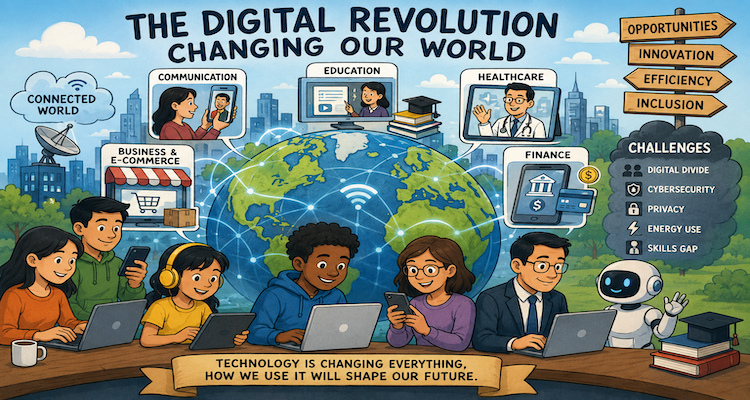
The digital revolution is no longer something happening mainly inside technology companies. It is embedded in how people communicate, work, learn, shop, travel, manage money, access services and make decisions. The smartphone, cloud computing, high-speed networks and artificial intelligence have turned computing from a specialized tool into an everyday layer of modern life.
The scale of that transformation is visible in global connectivity. The International Telecommunication Union estimated that 5.5 billion people 68% of the world’s population were online in 2024. Yet 2.6 billion people remained offline, showing that technological progress and digital inclusion are advancing at very different speeds.
That tension captures the real story of the digital revolution. Technology is expanding what people and organizations can do, but its benefits depend on access, skills, infrastructure, trust and the ability to use these tools effectively.
Key Takeaways
- Digital technology has moved from specialized infrastructure into the basic fabric of everyday life.
- Internet access is expanding, but billions of people remain excluded from the digital economy.
- Artificial intelligence is accelerating the shift from digital tools toward systems that can perform increasingly complex tasks.
- The workplace is changing as employers place greater value on both technological and human skills.
- Digital transformation also creates new demands for energy, cybersecurity, privacy, skills and responsible governance.
From Devices to Digital Infrastructure
The first phase of the digital revolution was easy to see: personal computers, mobile phones and eventually smartphones changed how people interacted with information.
The deeper transformation has been less visible. Computing has moved into the infrastructure behind everyday activities.
Cloud platforms allow businesses to access computing resources without owning all the physical hardware themselves. Digital payment systems allow transactions to happen almost instantly. Online platforms connect consumers with businesses across borders. Streaming services have changed how entertainment is distributed. Digital government systems increasingly allow citizens to access services without visiting physical offices.
Connectivity has therefore become more than a convenience. It is an economic and social foundation.
The World Bank describes reliable and affordable connectivity as increasingly important for access to education, finance, health care, markets and employment. But access remains unequal, particularly in rural and low-income communities.
The digital revolution has consequently created a paradox: technology can reduce barriers to opportunity while inadequate access to technology can reinforce them.
Work Is Becoming a Technology Partnership
Technology has changed the workplace long before generative AI appeared.
Email replaced much physical correspondence. Enterprise software transformed accounting and inventory management. Video conferencing reduced the need for some business travel. E-commerce changed retail operations. Automation moved repetitive tasks from people to machines.
AI is now pushing that transformation into areas once considered primarily human.
Generative AI can assist with drafting, coding, translation, research, customer support and information analysis. But the important workplace change is not simply that machines can perform individual tasks. It is that the boundary between human work and software-assisted work is becoming less rigid.
The World Economic Forum’s Future of Jobs Report 2025 estimates that employers expect 39% of workers’ existing skill sets to be transformed or become outdated between 2025 and 2030. It also identifies AI, big data and cybersecurity among the technology skill areas expected to grow rapidly, while creative thinking, resilience and adaptability remain important.
This suggests that the central workplace question may not be whether technology replaces people.
In many occupations, the more immediate question is which workers and organizations learn to combine technology with judgment, communication, creativity and domain knowledge most effectively.
Artificial Intelligence Is Changing the Digital Layer
Earlier generations of digital technology primarily helped people retrieve, process or transmit information.
AI adds another capability: systems can increasingly generate, classify, summarize, predict and interact with information.
That changes the nature of digital tools.
A conventional software application usually waits for a person to select an operation. AI systems can interpret natural-language instructions and produce outputs that previously required several manual steps.
The World Bank’s Digital Progress and Trends Report 2025 identifies four foundations needed for countries to benefit from AI: connectivity, compute, context and competency. In other words, AI depends not only on algorithms but also on infrastructure, computing capacity, relevant data and people with the skills to use the technology.
This is important because AI is sometimes discussed as though access to a powerful model alone is enough to create transformation.
It is not.
A school without reliable connectivity cannot fully benefit from digital learning. A business without appropriate data may struggle to integrate AI effectively. A country without sufficient technical skills may remain dependent on technologies developed elsewhere.
The AI era therefore does not eliminate the digital divide. In some circumstances, it can make the foundations of that divide even more important.
The Digital Economy Is Reshaping Business
For businesses, digital transformation has changed competition in several fundamental ways.
A small company can reach customers through online platforms without building a traditional physical distribution network. Software allows organizations to automate administrative processes and analyze large amounts of information. Digital advertising allows businesses to target audiences with greater precision than many traditional advertising methods.
The economic importance of technology is reflected in the performance of the ICT sector. The OECD reported that the ICT sector across OECD countries grew by an average of 6.3% annually between 2013 and 2023 about three times the growth rate of the broader economy in the countries analyzed.
But digital transformation is not automatically equal.
Larger organizations often have greater access to capital, specialized talent, data and computing resources. Smaller businesses may face higher barriers to adopting advanced systems.
That means technology can simultaneously lower the cost of entering some markets while increasing the advantage held by organizations with sophisticated digital capabilities.
Education and Knowledge Are Becoming More Accessible and More Complicated
Digital technology has dramatically expanded access to information.
A person with an internet connection can access educational courses, scientific publications, tutorials, public databases, news organizations and professional communities from almost anywhere.
AI adds another layer by making information easier to interact with. Instead of searching through many pages, users can ask questions in ordinary language and receive synthesized explanations.
But easier access to information does not automatically produce better knowledge.
The internet also makes misinformation easier to distribute, while AI systems can produce convincing but incorrect information. Digital literacy therefore increasingly means more than knowing how to operate a device. It includes understanding sources, evaluating evidence, protecting personal information and recognizing uncertainty.
The ability to use technology effectively is becoming a form of literacy in its own right.
The Hidden Cost: Energy and Infrastructure
Digital services may appear weightless because much of the experience happens on screens. The physical infrastructure behind them is anything but weightless.
Data centers require electricity for computing, networking and cooling. As AI systems and other data-intensive services expand, their infrastructure requirements are becoming increasingly significant.
The International Energy Agency estimates that global data-center electricity consumption could more than double from 2024 to around 945 terawatt-hours by 2030. AI is identified as an important driver of that growth.
This creates a less visible dimension of the digital revolution.
Every digital service depends on physical infrastructure: semiconductor manufacturing, servers, data centers, telecommunications networks, electricity generation and cooling systems.
The future of digital technology will therefore depend partly on whether societies can expand computing capacity while managing its energy, environmental and infrastructure requirements.
The Unfinished Digital Revolution
The most important fact about the digital revolution may be that it is unfinished.
In 2024, 68% of the world’s population was online, but one-third remained offline. The difference is even sharper between high-income and low-income economies: ITU estimated internet use at 93% in high-income countries compared with 27% in low-income countries.
Access is only one part of the problem.
People also need affordable connections, suitable devices, digital skills, relevant content and enough confidence to use digital services safely.
The next stage of technological development will therefore be measured not only by how powerful computers become, but by how broadly their capabilities can be used.
That is particularly important as AI becomes integrated into education, business, government and everyday software.
What Technology Changes Next Matters Less Than How We Use It
The digital revolution has already changed the world. The more important question now is what societies choose to do with the infrastructure they have created.
Technology can make services faster, businesses more productive and information more accessible. It can also widen inequalities, create new security and privacy risks, consume significant resources and disrupt established forms of work.
Those outcomes are not predetermined.
They depend on decisions about education, infrastructure, competition, privacy, cybersecurity, energy, accessibility and regulation.
The strongest digital economies will not necessarily be the ones that adopt every new technology first. They may be the ones that develop the skills, institutions and infrastructure needed to use technology responsibly and broadly.
Conclusion
The digital revolution has moved beyond the arrival of computers and smartphones. It is now changing the underlying systems through which people work, communicate, learn, trade and access services.
Artificial intelligence is accelerating that transition, but it is not replacing the foundations that made digital transformation possible. Connectivity, computing infrastructure, data, skills and trust remain essential.
The defining challenge of the next phase is therefore not simply technological progress. It is making that progress useful, accessible and sustainable.
The real measure of the digital revolution will not be how much technology society produces. It will be how effectively people can use it to create opportunity without allowing access, skills and power to become concentrated in the hands of only a few.
The information presented in this article is based on publicly available sources, reports, and factual material available at the time of publication. While efforts are made to ensure accuracy, details may change as new information emerges. The content is provided for general informational purposes only, and readers are advised to verify facts independently where necessary.