









Beyond Innovation: The Next Era of Technology
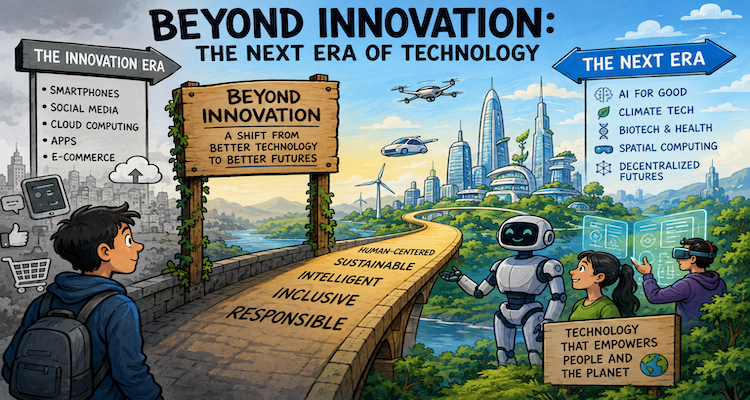
Technology is entering a phase in which the hardest problems are no longer solved by inventing another impressive device or software feature. The more consequential challenge is making powerful technologies work together reliably, affordably and at scale.
Artificial intelligence illustrates the shift. The 2026 Stanford AI Index reports that 88% of surveyed organizations used AI in at least one business function in 2025, while AI agents were still deployed only in the single digits across most functions. At the same time, data-centre electricity demand rose 17% in 2025, according to the International Energy Agency.
That contrast reveals something important about the next era of technology: progress will increasingly depend on infrastructure, energy, physical systems, security, materials and governance not simply better algorithms.
Key Takeaways
- Technology’s next phase is shifting from isolated innovation toward interconnected systems that can operate reliably at scale.
- AI is moving from generating answers toward performing tasks, but reliability remains a significant constraint.
- Energy and computing are becoming inseparable as expanding AI infrastructure increases electricity demand.
- Robotics, quantum computing, advanced materials and biotechnology are broadening the technology frontier beyond software.
- Countries are increasingly treating emerging technologies as strategic infrastructure tied to economic competitiveness and security.
- The winners may be determined less by invention alone than by the ability to deploy technology responsibly and efficiently.
The Innovation Race Is Becoming a Systems Race
For much of the digital era, technological progress could be understood through individual breakthroughs: faster processors, smartphones, cloud computing, search engines or increasingly capable software.
That model is becoming less useful.
The next generation of technology depends on multiple layers working together. AI needs chips, data centres, networks, electricity, cooling systems and increasingly sophisticated software infrastructure. Robotics needs AI, sensors, batteries, manufacturing capabilities and physical environments designed for machines. Quantum computing requires specialized hardware, error correction and entirely new approaches to cybersecurity.
The World Economic Forum’s 2026 list of emerging technologies illustrates this broader frontier. Its selection includes everything-to-grid energy, direct lithium extraction, passive radiative cooling materials, precision fermentation, quantum simulation for drug discovery, world models and lattice-based cryptography.
The significance is not that every technology on such a list will become commercially dominant. It is that innovation is increasingly occurring at the boundaries between disciplines.
The next era will therefore be less about asking, “What new technology can be invented?” and more about asking, “What combination of technologies can solve a difficult real-world problem?”
AI Is Moving From Software Feature to Operating Layer
Artificial intelligence remains one of the strongest forces behind this transition.
The 2026 AI Index shows that AI capability has advanced rapidly across language, reasoning, coding, robotics and agentic systems. On OSWorld, a benchmark for computer-use tasks, AI-agent performance rose from roughly 12% to 66.3%, although systems still failed approximately one in three attempts.
That distinction matters.
An AI system that can generate a useful answer is fundamentally different from one expected to execute a multistep process, interact with software, recover from errors and complete a task without constant human intervention.
The technology is moving toward the second model, but the evidence also shows why organizations cannot simply assume that capability equals reliability.
This creates a new engineering problem: building systems around AI that can observe, verify, escalate uncertain decisions and maintain human oversight.
In other words, AI’s next chapter may be less about chatbots and more about dependable infrastructure for work.
The Physical World Is Becoming the Next Technology Frontier
For years, much of the technology industry operated inside screens. The next wave increasingly has to function outside them.
Robotics is an obvious example. Stanford’s 2026 AI Index reports that robots perform extremely well in controlled environments but succeed in only about 12% of real household tasks. The gap demonstrates how difficult it is to transfer digital intelligence into unpredictable physical environments.
That gap is likely to shape development for years.
A household is far less predictable than a laboratory. Objects move, lighting changes, surfaces vary and instructions are often ambiguous. A robot that performs perfectly in a structured demonstration may struggle when confronted with the ordinary messiness of daily life.
This is why technologies such as world models are attracting attention. The World Economic Forum describes world models as systems designed to learn underlying dynamics of physical environments from multimodal data, potentially helping AI reason about situations it has not directly encountered.
The important shift is from machines that process information to machines that increasingly understand and interact with environments.
Energy Could Become One of Technology’s Biggest Constraints
The digital economy has often made computing appear almost weightless. AI is exposing the physical reality underneath it.
The IEA reported that global data-centre electricity demand increased 17% in 2025, while electricity consumption from AI-focused data centres grew even faster. The agency projects that total data-centre electricity consumption could double by 2030, with AI-focused data-centre power use potentially tripling.
This creates an unusual technological feedback loop.
More capable AI requires more computing. More computing requires more infrastructure. More infrastructure requires electricity, cooling, grid connections and hardware. Those requirements, in turn, create demand for better energy technologies.
The IEA says technology companies accounted for around 40% of corporate renewable power-purchase agreements signed in 2025 and notes growing momentum around nuclear, geothermal and energy-storage technologies.
This means energy technology is no longer merely an environmental or utility-sector issue. It is becoming part of the competitive architecture of computing.
A future data centre may therefore be judged not only by the number of processors it contains, but also by how efficiently it uses power and how intelligently it interacts with the electricity grid.
Materials and Supply Chains Are Becoming Technology Stories
Another defining feature of the next era is that software progress increasingly depends on physical materials.
Advanced chips require specialized manufacturing. Batteries depend on critical minerals. Data centres require transformers, power equipment and cooling infrastructure. New energy systems require materials and supply chains capable of supporting deployment at scale.
The IEA has identified shortages and bottlenecks involving transformers, gas turbines, advanced chips and other infrastructure as constraints on the expansion of data centres.
Meanwhile, the World Economic Forum’s 2026 emerging-technology list includes direct lithium extraction, which could alter how lithium is recovered from brines, and passive radiative cooling materials that can reduce surface temperatures without consuming electricity.
These developments point toward a broader lesson: the next technological advantage may come from making scarce resources easier to obtain, use or manage.
Governments Are Treating Technology as Strategic Infrastructure
Technology is also becoming more closely connected to national economic strategy.
A recent example came from South Korea, which on August 12, 2026 unveiled a technology strategy focused on seven areas beyond its established strengths in semiconductors and AI. The program covers small modular reactors, fusion and renewable energy, quantum technology, space and aviation, advanced biotechnology, and critical minerals and materials.
The strategy includes targets such as a domestic 100-qubit quantum processor by 2029, a lunar mission by 2030 and commercialization goals for small modular reactors and brain-computer interfaces. These are government targets rather than guaranteed technological outcomes, so they should be understood as strategic ambitions, not predictions of what will necessarily be achieved.
The broader pattern is more important than any individual target.
Countries increasingly view technological capability as connected to energy security, industrial competitiveness, supply-chain resilience and national security. That makes technology policy less about supporting isolated startups and more about building complete ecosystems.
The Hardest Problem May Be Trust
Technical capability alone does not determine whether a technology succeeds.
AI provides a useful warning. Stanford’s 2026 AI Index documents a widening gap between rapid technical progress and responsible-AI measurement. It reports 362 documented AI incidents in 2025, compared with 233 in 2024.
The challenge becomes more significant as technology moves into consequential environments.
A software assistant making an incorrect recommendation is one problem. An autonomous system controlling machinery, an AI-supported medical process or a security system making a high-impact decision creates a much higher burden of reliability and accountability.
That is why governance, auditing, cybersecurity and transparent evaluation are becoming engineering requirements rather than after-the-fact policy concerns.
The World Economic Forum similarly identifies accountability, auditing and assumption-testing as important considerations as world-model systems move into consequential operational settings.
The next era of technology will therefore require a different definition of progress. A system that is more capable but impossible to understand, verify or control may be less valuable than a slightly less capable system that organizations can confidently deploy.
What Comes After the Innovation Race?
The phrase “next era of technology” can easily become an excuse for futuristic speculation. The evidence suggests a more practical interpretation.
Technology is entering an integration era.
AI is becoming embedded in business processes. Computing is becoming increasingly dependent on energy infrastructure. Robotics is connecting digital intelligence with physical environments. Quantum technologies are influencing cybersecurity and scientific research. Biotechnology is combining computation with biology. Advanced materials are addressing constraints that previously appeared unrelated to software.
The common thread is not novelty. It is integration.
This also changes what technological leadership means. A company may possess an excellent AI model but struggle with energy costs, deployment reliability, cybersecurity or organizational adoption. A country may produce world-class research but lack the manufacturing capacity or supply chains needed to commercialize it.
Innovation remains essential. But invention is only the beginning.
Conclusion
The next era of technology is unlikely to be defined by a single breakthrough. It will be defined by whether breakthroughs can be connected into systems that work reliably in the real world.
That requires better AI, but also better chips, energy systems, materials, robotics, cybersecurity, scientific infrastructure and governance. It requires businesses to measure practical outcomes rather than demonstrations, and governments to think beyond individual technologies toward resilient ecosystems.
The most important question is therefore no longer simply what technology can do.
It is whether society can build the infrastructure, institutions and trust required to make increasingly powerful technology useful at scale.
That is where innovation becomes something more consequential: technological capability translated into durable real-world value.
The information presented in this article is based on publicly available sources, reports, and factual material available at the time of publication. While efforts are made to ensure accuracy, details may change as new information emerges. The content is provided for general informational purposes only, and readers are advised to verify facts independently where necessary.