










The Age of Intelligent Machines
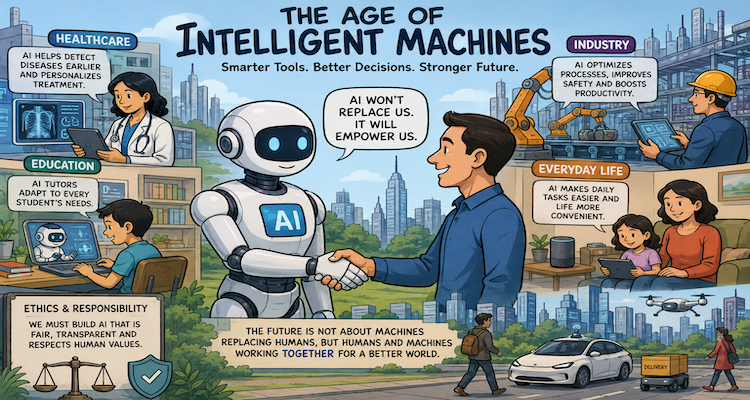
Artificial intelligence is moving from a tool people consult to a technology increasingly capable of interpreting information, generating content, writing software, controlling systems and assisting with physical work. That shift is changing what “automation” means. Machines are no longer limited to repeating a precisely programmed sequence; increasingly, they can respond to less structured situations.
The scale of that change is visible in both software and robotics. Stanford’s 2026 AI Index reports that organizational AI adoption reached 88% in its survey, while generative AI was being used in at least one business function by 70% of organizations. At the same time, the International Federation of Robotics recorded 542,000 industrial robots installed worldwide in 2024, more than twice the level a decade earlier.
The important question is therefore no longer simply whether machines are becoming more capable. It is how people, businesses and institutions should adapt as intelligence becomes increasingly embedded in software, machines and everyday systems.
Key Takeaways
- AI is becoming cheaper and more accessible, lowering the barrier for businesses and individuals to use advanced machine intelligence.
- Intelligent machines combine software reasoning with physical systems, expanding automation beyond traditional factory robots.
- Rapid capability gains do not mean AI is consistently reliable; accuracy, robustness and context remain important limitations.
- Businesses are adopting AI quickly, but autonomous AI agents remain much less mature than general AI adoption.
- Robotics shows that intelligent automation is already changing physical industries, particularly manufacturing, logistics and healthcare.
- The central challenge is shifting from making machines capable to making their deployment reliable, accountable and useful.
From Programmed Machines to Intelligent Systems
Traditional automation generally worked best when the environment was predictable. A machine could be instructed to perform a defined sequence repeatedly, producing the same result with remarkable consistency.
Artificial intelligence introduces a different model. Instead of specifying every possible response, developers can build systems that learn patterns from data and generate outputs based on what they have learned.
That distinction matters.
An industrial robot welding the same component thousands of times is highly automated, but its task can remain relatively constrained. An AI system that interprets a customer request, summarizes a document, generates computer code or analyzes an image is operating in a much less structured environment.
The combination of these capabilities is producing a broader category of intelligent machines: systems that can perceive information, interpret it, make decisions within defined boundaries and produce an action or recommendation.
This does not mean machines have acquired human-like understanding. It means the range of tasks that can be partially automated has expanded.
Intelligence Is Becoming Cheaper to Deploy
One of the less visible developments behind the AI boom is falling cost.
Stanford’s 2025 AI Index found that the inference cost for a system performing at roughly the level of GPT-3.5 on the MMLU benchmark fell from $20 per million tokens in November 2022 to $0.07 by October 2024—a more than 280-fold decline. The report also documented substantial improvements in smaller models.
The significance is larger than a cheaper chatbot.
When a technology becomes substantially cheaper to run, organizations can experiment with more use cases. Tasks that previously required expensive computing resources can become economically viable at much larger scale.
This helps explain why AI is moving into customer service, software development, research, administration, marketing, data analysis and other business functions.
It also changes the competitive landscape. Access to AI capability is becoming less dependent on owning enormous computing infrastructure. Smaller models and more efficient systems can allow organizations to deploy intelligence closer to where the work actually happens.
The Physical World Is Joining the AI Shift
The story of intelligent machines is not confined to software.
Robotics is increasingly connecting perception, computation and physical action. Modern robotic systems can use cameras, sensors, machine-learning models and sophisticated control systems to operate in environments that would be difficult to manage with traditional fixed automation alone.
The scale of industrial robotics illustrates how far automation has already progressed. According to the International Federation of Robotics, 542,000 industrial robots were installed globally in 2024, while the worldwide operational stock reached approximately 4.66 million units. Asia accounted for 74% of new industrial robot deployments that year.
Service robotics is expanding as well. The IFR reported that sales of professional service robots grew 9% in 2024, with transportation and logistics representing the largest application group. Medical robotics also recorded significant growth.
This creates an important distinction between two technological trends.
AI gives machines greater ability to process information and make decisions within defined parameters. Robotics gives those decisions a physical presence.
Together, they create the possibility of automation that can operate in environments rather than simply execute fixed instructions.
The Workplace Will Change Before It Disappears
The most common question surrounding intelligent machines is whether they will eliminate jobs.
The evidence points to a more complicated transition.
AI can automate portions of a job without automating the entire occupation. A programmer may use AI to generate and review code while still making architectural decisions. A customer-service employee may use AI to summarize a customer’s history and suggest a response while remaining responsible for the interaction. A factory worker may supervise automated equipment rather than manually perform every operation.
Stanford’s 2026 AI Index reports that the labor-market effects of AI are appearing unevenly, with particularly notable effects in hiring pipelines and among younger workers in exposed occupations. The report also emphasizes that AI-agent deployment remains early despite widespread organizational AI adoption.
That distinction is important.
The first phase of intelligent automation is often task substitution rather than complete occupational replacement. Organizations may need fewer hours of human labor for certain activities while demanding more judgment, oversight, communication, technical knowledge or domain expertise elsewhere.
The result could be neither a fully automated workplace nor a workplace untouched by automation. It could be a workplace in which the boundaries of individual jobs change repeatedly.
Capability Is Not the Same as Reliability
Rapid improvement in AI performance can create the impression that intelligent machines are becoming dependable general-purpose workers.
That conclusion would be premature.
The National Institute of Standards and Technology emphasizes that AI systems need to be valid and reliable for their intended use. Systems that are inaccurate, unreliable or poorly generalized to new circumstances can increase risks and reduce trustworthiness.
This is one of the defining tensions of the intelligent-machine era.
A system may perform exceptionally well on a benchmark yet fail in a particular real-world situation. An AI model may generate a convincing answer that contains an error. A robotic system may work effectively in a controlled environment but struggle when conditions change.
The practical question therefore is not simply, “Can the machine do this?”
It is, “Under what conditions can the machine do this reliably enough for the consequences of failure to be acceptable?”
That is a much harder engineering and management problem.
Businesses Are Moving From Experimentation to Integration
AI adoption is increasingly becoming an organizational issue rather than an isolated technology experiment.
Stanford’s 2026 AI Index reports that 88% of surveyed organizations had adopted AI, while generative AI was being used in at least one business function by 70%. However, deployment of AI agents remained in the single digits across nearly all business functions.
That gap reveals something important.
Companies may be comfortable using AI to assist employees without being equally comfortable giving AI systems broad authority to act independently.
This suggests that the next stage of adoption will depend heavily on workflow design.
Organizations will need to decide which tasks should remain human-controlled, which can be delegated to AI, where approvals are required, how errors are detected and who remains accountable when an automated system makes a consequential mistake.
The competitive advantage may therefore come less from simply possessing an AI model and more from integrating AI intelligently into business processes.
The New Infrastructure Behind Machine Intelligence
Intelligent machines require more than algorithms.
They depend on computing infrastructure, data, sensors, networks, software platforms and increasingly specialized hardware.
Stanford’s 2026 AI Index highlights the enormous scale of AI infrastructure, including thousands of data centers in the United States and continuing dependence on advanced semiconductor manufacturing.
This creates another dimension to the intelligent-machine transition.
AI may look digital to the user, but its physical foundation is extensive. Every automated decision consumes computing resources somewhere. Every advanced model depends on hardware, electricity, networking and data infrastructure.
As intelligent systems become embedded in more products and services, infrastructure becomes part of the strategic technology question.
The companies and countries able to secure computing capacity, advanced chips, energy and technical talent may have advantages that extend far beyond individual AI applications.
What Intelligent Machines May Change Next
The most consequential development may not be a single humanoid robot or a particular AI model.
It may be the gradual disappearance of the boundary between software and machines.
A software system can already interpret information and generate an action. A robot can already perform physical tasks. As these capabilities become more closely connected, machines can potentially move through a wider cycle:
Perceive → interpret → decide → act → evaluate → adjust.
The more reliable that cycle becomes, the more useful intelligent machines can be in environments that are too variable, expensive or dangerous for conventional automation.
But the pace of adoption will probably vary dramatically between industries.
A warehouse with structured environments may be easier to automate than a busy public space. A software workflow may be easier to delegate than a medical decision. A factory process with measurable outputs may be easier to optimize than a job requiring nuanced human relationships.
That means the age of intelligent machines will not arrive everywhere at the same speed.
It will emerge unevenly, shaped by economics, reliability, regulation, infrastructure, risk and public acceptance.
The Real Shift Is in Human Responsibility
The rise of intelligent machines changes the role of people as much as it changes the machines themselves.
When software can produce an answer, humans must decide whether the answer deserves trust.
When a robot can perform a task, someone must determine whether the environment is safe enough for autonomous operation.
When an AI system makes a recommendation, an organization must decide who is responsible for acting on it.
These questions become more important as systems become more capable.
The challenge is therefore not simply to build machines that can do more. It is to establish the technical and institutional conditions under which machines can do more without creating unacceptable risks.
That requires better testing, clearer accountability, appropriate human oversight, stronger cybersecurity, transparent evaluation and realistic expectations about what AI can and cannot do.
Conclusion
The age of intelligent machines is not defined by a moment when machines suddenly become “smart.” It is being built incrementally through cheaper AI, increasingly capable models, expanding robotics, growing business adoption and deeper integration between digital systems and the physical world.
The evidence already shows that this transition is substantial. AI is becoming more accessible, organizations are incorporating it into business functions, and millions of robots are operating across industrial and service environments.
But capability alone will not determine the success of intelligent machines.
The defining advantage may belong to organizations that understand where machine intelligence genuinely helps, where human judgment remains essential and how to build systems that can be trusted when the environment becomes unpredictable.
The important question for the years ahead is therefore not whether machines will become more intelligent. It is whether humans will become equally sophisticated in deciding how that intelligence should be used.
This content is published for informational or entertainment purposes. Facts, opinions, or references may evolve over time, and readers are encouraged to verify details from reliable sources.