










Artificial Intelligence and the Future of Human Potential
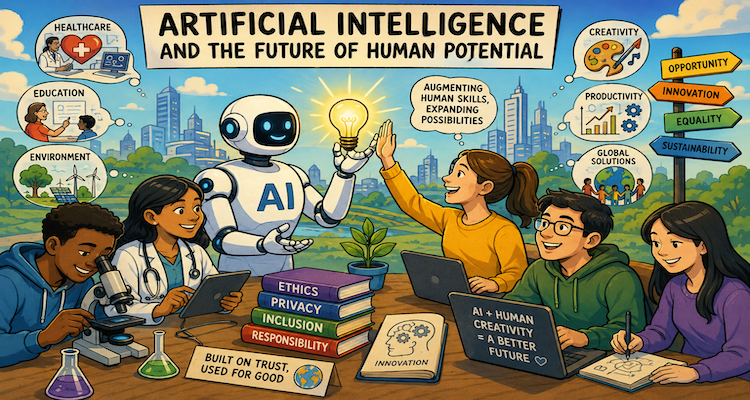
Artificial intelligence is becoming capable of doing more than answering questions. It can write and debug software, analyze information, generate images and video, assist with scientific research, and increasingly complete multi-step tasks. The important question is therefore shifting.
The debate is no longer only about whether machines can perform particular tasks. It is about what people can accomplish when some of those tasks become easier, faster, or partly automated.
That distinction matters because AI’s most consequential effect may not be replacing human ability, but changing where human ability is spent. Recent evidence suggests that AI can raise productivity and help less-experienced workers perform closer to the level of more experienced colleagues. At the same time, the technology remains unreliable in important forms of reasoning, and its benefits depend heavily on human skills, training, judgment, and the way organizations deploy it.
Key Takeaways
- AI can increase individual productivity, particularly when it complements rather than replaces human expertise.
- Less-experienced workers may gain disproportionately when AI makes expert knowledge easier to access.
- Rapid AI progress does not eliminate the need for human judgment because important reasoning and reliability gaps remain.
- The skills that matter increasingly include problem-solving, creativity, communication, data interpretation, and AI literacy.
- AI exposure is widespread, but most affected occupations are more likely to be transformed than completely eliminated.
- Human potential will depend increasingly on how effectively people combine AI capabilities with distinctly human judgment.
AI Changes the Economics of Human Ability
One of the most revealing findings about generative AI has come not from a futuristic laboratory but from an ordinary workplace.
Researchers Erik Brynjolfsson, Danielle Li and Lindsey Raymond studied 5,179 customer-support agents after the introduction of an AI conversational assistant. The researchers found a 14% average increase in productivity, measured by issues resolved per hour. The improvement was substantially larger among novice and lower-skilled workers, while experienced workers saw much smaller effects.
The result is important because it suggests that AI does not necessarily create value simply by doing a worker’s job.
It can also distribute knowledge.
A less-experienced employee traditionally has to accumulate expertise through training, observation and repeated practice. An AI assistant can provide suggestions, information and examples during the work itself. In the study, the researchers found evidence consistent with the AI system helping newer workers adopt practices associated with more capable colleagues.
That points toward a broader possibility: AI could reduce some of the time required to move from knowing the basics to performing at a higher level.
But that should not be confused with eliminating the need for expertise. An AI-generated recommendation still needs to be interpreted, checked and applied to the situation at hand.
The Productivity Gain Is Not the Same as Human Progress
It is tempting to equate faster work with greater human potential.
They are not identical.
If AI allows an employee to complete a report in half the time, the result is genuinely useful only if the saved time is used productively. An organization could use it to increase output, reduce repetitive work, give employees more time for customers, or simply demand twice as much work.
The technology creates capacity. People and institutions determine what happens with that capacity.
This distinction is becoming more significant as AI becomes cheaper and more accessible. Stanford’s 2025 AI Index reported that the cost of querying a model with performance comparable to GPT-3.5 on the MMLU benchmark fell by more than 280-fold between November 2022 and October 2024.
Lower costs make advanced AI available to more businesses, developers, students and individuals. But access alone does not guarantee better decisions or better outcomes.
The competitive advantage may increasingly come from knowing where AI should be used, where it should not be used, and how its output should be evaluated.
AI Is Powerful and Still Uneven
The idea of AI as an all-purpose digital expert is still ahead of the evidence.
Stanford’s 2026 AI Index reports that frontier AI systems have made substantial gains across demanding evaluations. Some models now reach or exceed human baselines in areas including advanced scientific questions and competition mathematics. Yet the same report describes a striking form of “jagged intelligence”: systems can perform exceptionally on sophisticated tasks while still failing at seemingly simple ones.
One example illustrates the problem. The 2026 report notes that a leading AI system achieved a gold-medal-level performance on the 2025 International Mathematical Olympiad, while the leading model on an analog-clock benchmark correctly read clocks only about half the time, compared with more than 90% for humans.
This unevenness matters outside laboratories.
A person may reasonably trust AI to generate several possible approaches to a problem while remaining cautious about asking it to make an irreversible decision without verification.
The difference is judgment.
Human potential is therefore unlikely to become less important simply because AI capabilities increase. In many settings, deciding whether an answer is appropriate may be harder and more valuable than producing the answer itself.
The Future of Work May Be About Tasks, Not Jobs
The most useful way to think about AI and employment is not simply “Which jobs will disappear?”
A job is usually a collection of tasks. Some can be automated. Others can be assisted. Some may become more valuable because technology makes them easier to perform at scale.
The International Labour Organization’s 2025 analysis estimates that one in four workers worldwide are in occupations with some degree of generative-AI exposure. But it also concludes that, because human input remains necessary for many tasks, transformation is more likely than complete replacement for most jobs.
This creates a more complicated future than either extreme of the debate.
A profession can survive while its daily work changes substantially.
A programmer, for example, may spend less time writing routine code and more time defining requirements, reviewing generated code, testing systems, understanding architecture and deciding what should be built. A marketing professional may spend less time producing first drafts and more time determining strategy, positioning, audience understanding and editorial quality.
The job title remains.
The distribution of human effort changes.
Human Skills Become More Valuable in Different Ways
AI is also changing the definition of a useful skill.
The OECD’s 2026 research on AI and skills finds that workers increasingly need the ability to use, analyze and interpret data, while managerial capabilities and human skills such as problem-solving, creativity and innovation remain important. The report also emphasizes that only a small share of workers will need advanced AI-specific skills such as model development.
That is a crucial distinction.
The AI economy will not consist entirely of machine-learning engineers.
Most people will interact with AI as part of another profession: teacher, designer, programmer, manager, researcher, analyst, journalist, entrepreneur, healthcare worker or technician.
The valuable combination may therefore be domain expertise + AI literacy + judgment.
Someone who understands accounting and can use AI effectively may have an advantage over someone who understands AI tools but cannot interpret financial reality. A doctor who understands both clinical practice and the limitations of AI-assisted systems may be better positioned than someone who simply knows how to operate an AI interface.
The deeper skill is not prompting alone.
It is knowing what to ask, recognizing a weak answer, supplying missing context, checking evidence and deciding what deserves human attention.
Education Has to Move Beyond Information Retrieval
This shift has consequences for education.
For generations, access to information was a major constraint. Students had to learn how to find, remember and reproduce knowledge.
AI changes the economics of that process.
When an AI system can summarize a subject, explain a concept at different levels, generate examples or provide feedback, education can spend less time treating information retrieval as the final destination.
That does not make foundational knowledge irrelevant. It may make it more important.
A student cannot reliably evaluate an explanation without enough background knowledge to recognize an error. A programmer cannot effectively review generated code without understanding what the code is supposed to do. A business leader cannot challenge an AI-generated forecast without understanding the business conditions behind it.
AI may therefore push education toward a more demanding objective: developing people who can question, connect, evaluate and create, rather than merely retrieve information.
The OECD’s recent work similarly emphasizes lifelong learning and training as central to ensuring that workers benefit from AI rather than fall behind it.
The Biggest Advantage May Belong to People Who Learn With AI
The evidence does not support a simple conclusion that AI will make everyone more capable.
The benefits are uneven.
People with better digital access, stronger foundational knowledge and more opportunities for training may be better positioned to exploit increasingly capable systems. Organizations with clear processes and good data may benefit more than organizations that simply purchase AI tools without changing how work is done.
The OECD reports that lack of skills is already a significant barrier to AI adoption, while workers who receive training are more likely to report positive outcomes from AI use.
This creates an important feedback loop.
People who learn to use AI effectively can potentially become more productive. Greater productivity can create opportunities to take on more complex responsibilities. Those responsibilities can create further opportunities to learn.
But the reverse is also possible.
Workers who receive little training may be given AI tools without understanding their limitations, becoming dependent on systems they cannot adequately evaluate.
The difference between those outcomes is not the software alone.
It is human capability surrounding the software.
What Human Potential Could Mean in an AI-Driven World
The phrase “human potential” can sound abstract, but AI makes it increasingly practical.
Consider the activities that remain difficult to automate reliably: deciding what problem is worth solving, understanding another person’s needs, setting priorities, navigating ambiguous situations, taking responsibility for consequences, building trust, interpreting context and choosing between competing goals.
These are not merely leftovers after machines take care of the technical work.
They are central parts of meaningful work.
AI can produce more options, but someone still has to decide which option deserves pursuit. It can generate an argument, but someone has to determine whether the argument is sound. It can analyze data, but someone has to decide what the analysis means for people who will live with the consequences.
That suggests a different vision of AI augmentation.
The goal should not be to make humans behave more like machines.
It should be to use machines for the parts of work they can perform efficiently while allowing people to spend more time on activities where context, responsibility, creativity and judgment matter.
The Risk of Using AI to Shrink Human Capability
There is also a less discussed danger.
If people delegate too many cognitive tasks without retaining the ability to perform or evaluate them, productivity gains could coexist with declining individual capability.
The evidence on AI’s effects is still developing, so this should not be presented as an established outcome. But it is a legitimate design question for organizations and educators.
A calculator did not make mathematical understanding obsolete. Search engines did not eliminate the need for knowledge. Similarly, AI does not have to eliminate human expertise.
The critical issue is whether AI is used as a substitute for thinking or as an instrument for thinking better.
That distinction could determine whether the technology expands human potential or merely accelerates existing workflows.
The Human Advantage Is Becoming More Deliberate
AI’s progress is changing the value of human capability, but it is not producing a simple hierarchy in which machines become capable and people become unnecessary.
The emerging picture is more nuanced.
AI is becoming better at an expanding range of cognitive tasks. It can improve productivity, help less-experienced workers and contribute to research and professional work. At the same time, frontier systems still display important reliability gaps, and the ability to use AI effectively depends on skills that remain deeply human.
The most important question, then, is not whether artificial intelligence will reach some final level of capability.
It is what people choose to do with the capabilities they gain.
If AI handles more routine cognitive work, human potential may be measured less by how quickly someone can produce an answer and more by the quality of the questions they ask, the judgment they apply, the problems they choose to solve and the responsibility they accept for the outcome.
That is a future in which AI can make people more capable but only if people remain capable of directing it.
Conclusion
Artificial intelligence is expanding the range of tasks machines can perform, but its greatest contribution to human potential may come from something less spectacular: giving people more leverage over their time, knowledge and abilities.
The evidence already shows meaningful productivity gains in some workplaces, while current research also makes clear that AI remains uneven and that human skills continue to matter.
The opportunity is therefore not simply to automate more.
It is to redesign work and learning so that automation creates room for better judgment, deeper expertise, creativity, experimentation and human connection.
AI can provide the capability.
Human beings still have to decide what that capability is for.
This content is published for informational or entertainment purposes. Facts, opinions, or references may evolve over time, and readers are encouraged to verify details from reliable sources.