










Why Forest Diversity Could Be More Important Than the Number of Trees
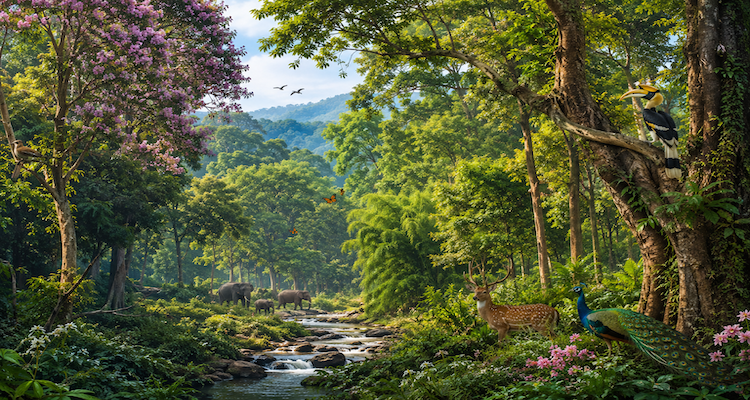
A landscape covered with trees often evokes the same reassuring image: a healthy forest quietly storing carbon, sheltering wildlife, and cooling the planet. But scientists and conservationists are increasingly recognizing that counting trees alone tells only part of the story. A forest with millions of identical trees may look lush from above, yet it can be far more vulnerable than a woodland where dozens of different species grow together.
This shift in perspective is changing how forests are studied, restored, and protected. Rather than asking only how many trees exist, researchers are paying closer attention to which trees are present and how they interact. The growing emphasis on tree diversity reflects a broader understanding that healthy ecosystems depend on variety, not just volume.
A Forest Is More Than a Collection of Trees
Trees do far more than occupy space. Each species plays a distinct role within its ecosystem. Some grow deep roots that stabilize soil and reach underground water, while others enrich the soil with nutrients through fallen leaves. Certain trees produce flowers that sustain pollinators, while others bear fruits that feed birds and mammals throughout the year.
When many species coexist, these different strengths complement one another. The result is an ecosystem that functions more efficiently and supports a wider range of life. Diverse forests often provide habitats for insects, fungi, birds, and mammals that would struggle to survive in more uniform landscapes.
This ecological cooperation is one reason biodiversity has become a central focus in environmental science. The health of a forest depends not only on how many trees stand within it but also on the relationships between the organisms that share the same environment.
Diversity Can Make Forests More Resilient
One of the strongest arguments for tree diversity is resilience.
Forests face increasing pressure from drought, rising temperatures, invasive pests, diseases, and extreme weather. When a forest consists largely of one species, a single disease or insect outbreak can spread rapidly, causing widespread damage.
History has shown how vulnerable monocultures can become. Agricultural systems and plantation forests built around one dominant species have sometimes suffered devastating losses when pests or diseases found ideal conditions to spread.
A diverse forest behaves differently. While one species may struggle under certain conditions, others may continue to thrive. This natural balance helps ecosystems recover more quickly after disturbances and reduces the likelihood of catastrophic decline.
Instead of relying on a single “winning” tree, biodiversity creates a kind of ecological insurance policy.
Climate Change Raises the Stakes
As climate patterns become less predictable, tree diversity is attracting greater attention in climate adaptation strategies.
Different species respond differently to changing temperatures and rainfall. Some tolerate heat better, while others are more resistant to flooding or prolonged dry periods. A forest containing many species is therefore more likely to retain its ecological functions as environmental conditions change.
This does not mean every diverse forest will automatically withstand climate change, but greater biological variety increases the chances that some species will adapt successfully.
For conservation planners, this insight is becoming increasingly valuable. Restoration efforts are gradually shifting away from simply planting large numbers of trees toward creating forests capable of surviving for generations.
Why Planting Millions of Trees Isn’t Always Enough
Global tree-planting campaigns have become popular responses to climate concerns. Governments, businesses, and nonprofit organizations have pledged to plant billions of trees over the coming decades.
These initiatives can provide meaningful environmental benefits when carefully planned. However, experts often emphasize that successful restoration involves more than achieving impressive planting numbers.
If newly planted forests contain only one or two fast-growing species, they may deliver fewer ecological benefits than more diverse ecosystems. Simplified forests may store carbon differently, support fewer wildlife species, and remain more susceptible to environmental stress.
The quality of restoration increasingly matters as much as the quantity.
This evolving understanding is encouraging projects to consider native species, local ecosystems, soil conditions, and long-term biodiversity rather than focusing exclusively on planting targets.
Biodiversity Benefits People Too
Tree diversity is not only an environmental concern. It has practical consequences for communities, agriculture, public health, and local economies.
Forests rich in plant diversity often help regulate water supplies by improving soil structure and reducing erosion. They can support pollinators that benefit nearby farms and provide habitats for species that naturally control agricultural pests.
Many medicines also originate from compounds found in plants. Preserving diverse forests protects genetic resources that may prove valuable for future scientific discoveries.
For communities that rely on forests for food, fuel, building materials, or tourism, maintaining biodiversity can contribute to more stable livelihoods over time.
Healthy ecosystems ultimately support healthy societies.
Cities Are Beginning to Learn the Same Lesson
The importance of diversity is not limited to natural forests.
Urban planners increasingly recognize that planting the same tree species throughout cities can create hidden risks. If disease strikes one widely planted species, entire neighborhoods may lose much of their tree canopy within a short period.
Many cities now encourage a wider mix of species in parks, streets, and public spaces. A more varied urban forest improves resilience while also creating habitats for birds and pollinating insects.
This represents a subtle but important change in urban planning. Trees are no longer viewed simply as decorative features but as living infrastructure whose diversity contributes to long-term environmental stability.
The Bigger Shift Behind the Science
Perhaps the most interesting development is philosophical rather than biological.
For decades, environmental success was often measured using simple numbers: acres restored, trees planted, or hectares protected. These metrics remain useful because they are easy to communicate and compare.
Yet ecosystems rarely function according to simple counts.
Modern ecological thinking increasingly values complexity, relationships, and interconnected systems. Diversity represents resilience because nature thrives through balance rather than uniformity.
This broader perspective is influencing fields far beyond forestry. Agriculture, urban development, conservation, and climate policy are increasingly recognizing that healthy systems depend on variety, flexibility, and cooperation instead of maximizing a single measurable outcome.
In many ways, the conversation about tree diversity reflects a larger shift in how society understands sustainability itself.
Looking Beyond the Tree Count
Tree-planting campaigns will continue to play an important role in addressing environmental challenges, but they are unlikely to achieve their full potential without equal attention to biodiversity.
The forests best equipped to support wildlife, withstand changing climates, and continue delivering ecological benefits may not necessarily be those with the greatest number of trees. Instead, they may be those where many different species coexist, each contributing unique strengths to the whole ecosystem.
That insight encourages a more thoughtful approach to conservation. Success is no longer measured solely by how many trees are planted but by whether forests are capable of thriving decades into the future.
As environmental priorities continue to evolve, one message is becoming increasingly clear: protecting nature means preserving its diversity as much as its abundance.
This content is published for informational or entertainment purposes. Facts, opinions, or references may evolve over time, and readers are encouraged to verify details from reliable sources.