










Why Abandoned Industrial Sites Are Becoming Nature’s New Research Labs
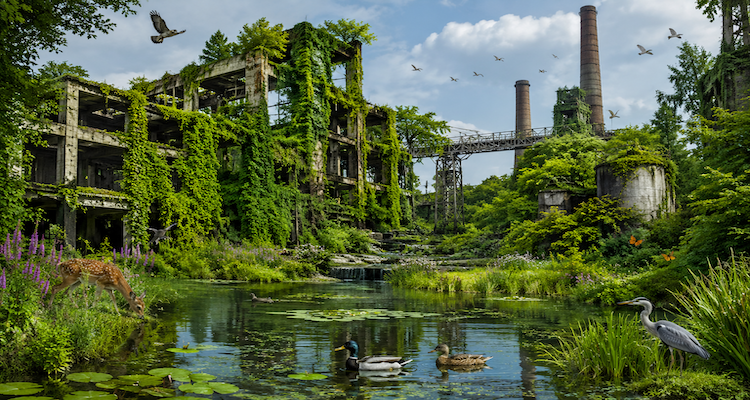
Factories, mines, and abandoned industrial complexes were once seen as symbols of environmental damage. When production stopped, many of these places were fenced off, left to decay, or earmarked for redevelopment. Yet an unexpected transformation is unfolding across parts of the world. Instead of remaining ecological dead zones, many forgotten industrial landscapes are becoming living laboratories where scientists, conservationists, and urban planners are observing nature’s remarkable ability to adapt.
This shift is changing how experts think about restoration. Rather than viewing every damaged site as land that must immediately be returned to its former state, researchers are discovering that some abandoned industrial areas are developing entirely new ecosystems. These evolving habitats are offering valuable insights into biodiversity, climate resilience, and ecological recovery sometimes in ways that carefully managed conservation projects cannot easily replicate.
Nature Doesn’t Always Return It Reinvents
The common expectation is that abandoned industrial land will eventually return to its original condition if left alone. In reality, nature often takes a different path.
Former quarries may fill with rainwater and become wetlands. Old railway corridors can develop into wildlife corridors connecting fragmented forests. Disused mines may provide stable temperatures that attract bats, insects, and microorganisms. Concrete surfaces gradually crack, allowing grasses, mosses, and shrubs to establish themselves before larger plants follow.
These environments rarely recreate the ecosystems that existed before industrial activity. Instead, they produce entirely new ecological communities shaped by altered soil chemistry, changing water conditions, and unique microclimates.
For scientists, this process offers an opportunity to observe ecological succession in real time rather than relying solely on historical models.
Why Researchers Are Paying Closer Attention
Ecological recovery traditionally focuses on restoring damaged environments to their previous condition. While that remains an important goal in many cases, abandoned industrial sites provide something different: natural experiments that unfold without intensive human management.
Researchers can study how plants colonize contaminated soils, how insects establish new food webs, and how birds and mammals adapt to landscapes that were never designed for wildlife.
These observations are becoming increasingly valuable as climate change alters habitats worldwide. Many ecosystems are already shifting beyond historical conditions, making it important to understand how species adapt to entirely new environments rather than assuming they will simply return to the past.
Industrial sites unintentionally offer a preview of that future.
Unexpected Biodiversity in Unlikely Places
Some abandoned industrial areas now support surprising levels of biodiversity.
Former extraction pits may host amphibians that benefit from isolated pools free from predatory fish. Rocky spoil heaps can create warm, dry habitats favored by reptiles and specialized plants. Disused buildings often become nesting sites for birds or shelter for bats.
In some cases, rare species have appeared precisely because these landscapes differ from surrounding environments.
This does not mean industrial damage benefits nature overall. Many active industrial operations continue to pose serious environmental challenges. However, once industrial activity ends, ecological recovery can take unexpected directions that deserve careful study rather than immediate dismissal.
The lesson is not that environmental degradation is desirable, but that ecosystems possess a remarkable capacity for adaptation under the right conditions.
Living Test Beds for Climate Adaptation
One reason interest is growing is that abandoned industrial sites often experience environmental stresses similar to those expected under future climate conditions.
Poor soils, limited nutrients, altered drainage, heat-retaining surfaces, and fragmented habitats all create demanding environments for plants and animals.
Species that successfully establish themselves under these conditions may provide clues about resilience in a warming world.
Researchers studying drought-resistant vegetation, urban biodiversity, or ecosystem restoration can observe long-term natural adaptation occurring without the costs of creating large experimental facilities.
These locations become outdoor classrooms where ecological theories meet real-world complexity.
Cities Are Beginning to See Them Differently
Urban planners increasingly recognize that abandoned industrial land is not always an empty space waiting for commercial development.
Some cities have successfully transformed former industrial districts into parks that preserve portions of their ecological evolution while providing public access.
Instead of completely reshaping these landscapes, planners sometimes incorporate existing wetlands, spontaneous forests, or wildlife habitats into redevelopment projects.
This approach reflects a broader shift in environmental thinking. Green spaces are no longer judged only by how closely they resemble traditional parks. Ecological function, biodiversity, and resilience are becoming equally important measures of success.
Industrial heritage and environmental restoration are beginning to coexist rather than compete.
A Different Way to Think About Restoration
Perhaps the most significant insight emerging from these sites is philosophical rather than scientific.
Conservation has often focused on protecting pristine landscapes or restoring ecosystems to historical baselines. But climate change, urban expansion, and shifting species distributions are making those historical conditions increasingly difficult to recreate.
Abandoned industrial sites demonstrate that recovery does not always mean returning to the past.
Instead, resilience may involve allowing ecosystems to evolve into something new while still supporting biodiversity and ecological function.
This perspective is influencing conversations about “novel ecosystems” environments shaped by both human activity and natural processes. Although the concept remains debated among ecologists, it highlights an important reality: future conservation may require managing change rather than resisting it entirely.
Challenges That Cannot Be Ignored
Despite their scientific value, abandoned industrial landscapes are not automatically safe or environmentally beneficial.
Contaminated soil, unstable structures, polluted groundwater, and lingering industrial waste remain serious concerns at many sites. Some locations require extensive remediation before they can safely support wildlife or public access.
Researchers therefore approach each site individually. Ecological potential must be balanced against environmental risks and public safety.
Responsible management means recognizing both the opportunities and the limitations of these unusual landscapes.
What These Places Reveal About Nature and Ourselves
The growing interest in forgotten industrial sites reflects more than scientific curiosity. It represents a broader shift in how society understands resilience.
Rather than seeing nature as either untouched or destroyed, researchers increasingly recognize a continuum where ecosystems constantly respond to changing conditions.
This insight extends beyond ecology. Communities rebuilding former industrial regions, businesses redeveloping unused land, and policymakers planning climate adaptation strategies all face similar questions: Should success always mean recreating the past, or can entirely new futures emerge from damaged places?
Nature appears to favor adaptation over nostalgia.
That does not erase the environmental costs of industrialization, nor does it diminish the importance of protecting intact ecosystems. Instead, it reminds us that ecological recovery is often more creative and unpredictable than conventional restoration models suggest.
As scientists continue studying these evolving landscapes, abandoned factories, quarries, rail yards, and mines may become some of the most valuable outdoor research sites of the coming decades. Their greatest contribution may not be what they once produced, but what they are quietly teaching us about resilience, biodiversity, and the surprising capacity of life to flourish in unexpected places.
This content is published for informational or entertainment purposes. Facts, opinions, or references may evolve over time, and readers are encouraged to verify details from reliable sources.