








Why Artificial Coastlines Are Creating Unexpected Marine Ecosystems
Concrete seawalls, artificial islands, offshore wind foundations, and even old shipwrecks are often seen as symbols of human expansion into the sea. They are built to protect coastlines, support cities, generate renewable energy, or improve transportation. Yet beneath the surface, many of these engineered structures are becoming something few planners originally intended: thriving habitats for marine life.
This transformation is changing how scientists, coastal planners, and conservationists think about the relationship between development and nature. While artificial coastlines can disrupt existing ecosystems, they can also create entirely new ecological communities that adapt to the conditions humans have unintentionally introduced. The result is a complex story one that challenges the assumption that every artificial structure in the ocean is purely harmful or purely beneficial.
Understanding these emerging marine communities offers valuable insight into how coastal environments may evolve as climate change, urbanization, and infrastructure development continue to reshape the world’s shorelines.
When Concrete Becomes a Reef
Natural coastlines are remarkably diverse. Rocky shores, sandy beaches, coral reefs, mangrove forests, and tidal wetlands each support unique combinations of plants and animals. Artificial coastlines, by contrast, are typically designed with engineering in mind rather than ecology.
Despite this, marine organisms rarely leave available surfaces unused.
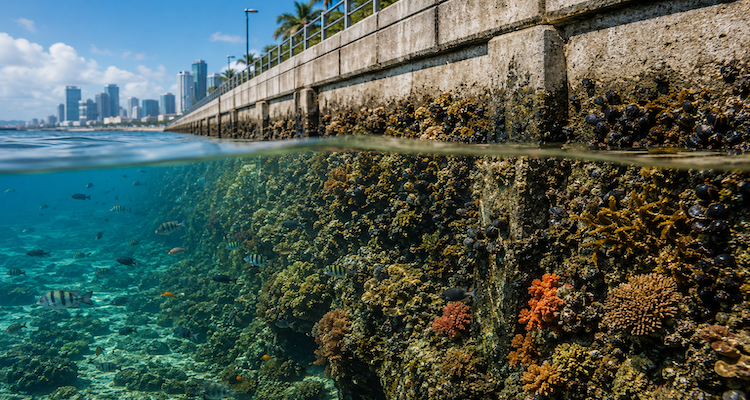
Within months of construction, underwater sections of seawalls and breakwaters often become covered with microscopic algae and bacteria. These biofilms create the foundation for larger organisms such as barnacles, mussels, oysters, sea anemones, sponges, and seaweed. Over time, fish, crustaceans, mollusks, and other species begin using these structures for shelter, feeding, or breeding.
The process resembles ecological succession on land, where barren environments gradually develop into functioning ecosystems. In the ocean, even smooth concrete can eventually host surprisingly complex food webs.
Offshore Infrastructure Is Becoming Marine Habitat
One of the most visible examples of this phenomenon comes from offshore renewable energy projects.
Wind turbine foundations anchored to the seabed introduce hard surfaces into areas that may previously have consisted mostly of sand or mud. Marine organisms quickly colonize these structures, creating habitat where relatively little previously existed.
Researchers studying offshore wind farms in parts of Europe have observed increasing biodiversity around some installations. Fish often gather near the structures, attracted by abundant food sources and shelter from predators. Restrictions on fishing within wind farm zones can also reduce human disturbance, allowing marine populations to recover in some locations.
These outcomes do not automatically make offshore infrastructure environmentally positive, but they demonstrate that engineered environments can sometimes provide ecological opportunities alongside their intended purpose.
Artificial Islands Tell a Similar Story
Large-scale coastal development projects have transformed shorelines across several parts of the world.
Artificial islands built for housing, tourism, transportation, or commercial activities dramatically alter local marine environments. Construction frequently disturbs seabeds, changes water flow, and affects nearby habitats. These impacts remain important concerns during planning and environmental assessment.
However, after construction is complete, underwater surfaces often become colonized by marine life.
Fish schools may gather around seawalls, while oysters, corals, and algae establish themselves wherever conditions allow. In some regions, divers report vibrant communities developing around structures that originally served no ecological purpose.
The ecological value of these communities varies widely depending on water quality, local species, and surrounding habitats. Artificial coastlines cannot fully replace natural ecosystems such as coral reefs or mangrove forests, but they may still become significant parts of local marine landscapes.
Not Every New Habitat Is Good News
The emergence of marine life on artificial structures is not always a conservation success story.
Some artificial coastlines can unintentionally favor invasive species. Organisms that thrive in disturbed environments may spread more rapidly along seawalls, ports, and harbors than they would across natural shorelines. Once established, invasive species can compete with native organisms and alter local food webs.
Artificial structures may also simplify habitats.
Natural rocky coastlines contain cracks, pools, overhangs, and varied textures that provide shelter for many species. Smooth concrete walls often lack this complexity, supporting fewer types of organisms than comparable natural environments.
As a result, scientists increasingly distinguish between simply attracting marine life and genuinely supporting healthy biodiversity. A structure covered in organisms is not necessarily functioning like a natural ecosystem.
Designing Coastlines with Nature in Mind
This distinction has inspired a growing movement known as ecological engineering or eco-engineering.
Rather than treating coastal infrastructure solely as construction projects, engineers are beginning to consider how designs might better accommodate marine ecosystems.
Small changes can make a meaningful difference. Adding textured surfaces, grooves, crevices, or artificial rock pools creates more varied microhabitats for marine species. Specialized concrete mixtures may encourage the settlement of oysters, corals, or algae. Some projects even incorporate habitat modules directly into seawalls and breakwaters.
The goal is not to replace natural habitats but to reduce ecological losses while making necessary infrastructure more compatible with surrounding ecosystems.
Several cities and coastal authorities are already experimenting with these approaches as part of broader climate adaptation strategies.
Climate Change Makes the Question More Urgent
Sea-level rise and stronger coastal storms are driving increased investment in shoreline protection worldwide.
Communities are constructing seawalls, flood barriers, elevated ports, and coastal defenses at unprecedented scales. Every new structure represents both an engineering solution and an ecological intervention.
If artificial coastlines are going to become more common, their environmental design becomes increasingly important.
Infrastructure built today could remain in place for decades or even centuries. Decisions about materials, shapes, and construction methods may influence marine biodiversity long after the original engineers have left the project.
This perspective shifts the conversation from choosing between development and conservation toward exploring how both objectives might be pursued together.
A New Way of Thinking About Human-Made Oceans
Perhaps the most significant insight emerging from this research is that ecosystems are often more adaptable than people expect.
Marine life does not distinguish between “natural” and “artificial” in the way humans do. Organisms respond to available habitat, water conditions, food sources, and competition. When new environments appear, many species attempt to occupy them.
That adaptability should not be interpreted as evidence that natural habitats are expendable. Coral reefs, seagrass meadows, salt marshes, and mangrove forests provide ecological functions that artificial structures cannot fully replicate.
Instead, these accidental marine communities reveal something more nuanced: human infrastructure increasingly forms part of the environments where wildlife lives. Recognizing this reality allows planners to make more informed choices that benefit both people and nature.
As coastlines continue to evolve under the combined pressures of urban growth and climate change, the challenge will not simply be building stronger defenses against the sea. It will also be designing those defenses with enough ecological intelligence to support life beneath the waves.
The next generation of coastlines may therefore be judged not only by how well they protect cities from rising seas, but also by how successfully they coexist with the marine ecosystems quietly taking shape along their foundations.
This content is published for informational or entertainment purposes. Facts, opinions, or references may evolve over time, and readers are encouraged to verify details from reliable sources.