










Why Easy Days Can Leave You More Mentally Exhausted Than Busy Ones
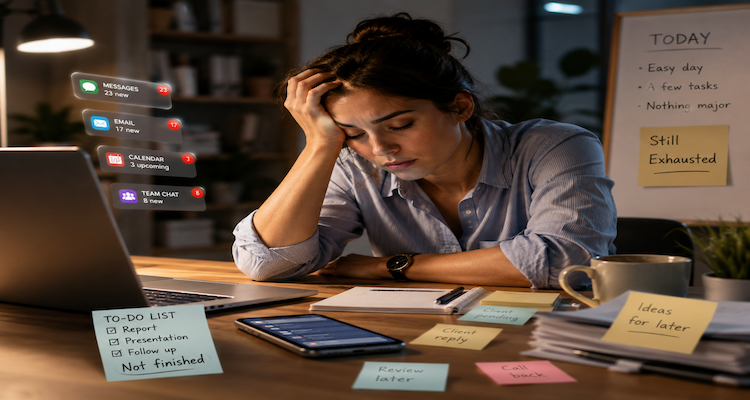
Some of the most draining days aren’t the ones packed with meetings, deadlines, or endless errands. Instead, they are the days that seem surprisingly light. You clear a few emails, attend a short meeting, scroll through your phone, maybe complete a handful of simple tasks and by evening, you feel mentally depleted despite accomplishing relatively little.
It seems contradictory, but this experience is becoming increasingly common. Many people report feeling more exhausted after “easy days” than after genuinely productive ones. The reason isn’t necessarily a heavier workload. It’s often the invisible mental demands that accompany modern life: constant decision-making, fragmented attention, and the lingering pressure to remain available at all times.
Understanding why this happens reveals an important shift in how mental energy is spent today. The biggest drain on the brain is no longer always hard work, it is often the accumulation of small cognitive demands that never seem to end.
Mental Effort Isn’t Measured by Physical Activity
People often associate exhaustion with visible effort. Long work hours, physical labor, or intense concentration are easy to recognize. Mental fatigue, however, is much harder to identify because much of it happens beneath the surface.
A day filled with interruptions can quietly consume enormous amounts of cognitive energy. Switching between messaging apps, checking notifications, responding to emails, making routine choices, and constantly deciding what deserves attention all require the brain to reset repeatedly.
These micro-decisions rarely feel significant individually, but together they create a form of mental wear that many people underestimate.
Ironically, a busy day focused on one meaningful project may require less mental switching than a seemingly relaxed day filled with dozens of unrelated activities.
The Hidden Cost of Constant Context Switching
Modern work and digital life encourage continuous multitasking. A person might begin writing a report, pause to answer a message, join a video meeting, return to the report, check social media during a break, reply to another notification, and then resume work again.
Although this pattern feels normal, every interruption forces the brain to shift context.
Research in cognitive psychology has long suggested that recovering focus after interruptions takes time and mental effort. Even brief distractions can reduce efficiency and increase perceived fatigue because the brain must repeatedly reconstruct where it left off.
An “easy day” often contains far more context switching than a busy day dedicated to a single objective.
Why Unfinished Tasks Feel Surprisingly Heavy
Another reason easy days become exhausting is that they often produce very little psychological closure.
Busy days frequently have clear milestones. A presentation gets delivered. A report is completed. A project reaches a major checkpoint.
Easy days, by contrast, may involve dozens of partially completed tasks.
You answer some emails but leave others.
You begin organizing files but don’t finish.
You research an idea without reaching a decision.
These unfinished loops remain mentally active. The brain tends to keep reminding us about incomplete responsibilities, creating a persistent sense that something still needs attention.
Even during periods of rest, those unresolved tasks can quietly occupy mental space.
Decision Fatigue Doesn’t Require Big Decisions
People often imagine decision fatigue as the result of major life choices. In reality, everyday decisions can gradually wear down mental resources.
Should I answer this message now?
Which task should I prioritize?
Is this email important?
Should I take a break?
What should I cook tonight?
Should I continue scrolling or get back to work?
None of these questions appears difficult on its own. Yet hundreds of similar choices throughout the day steadily consume attention.
Busy schedules sometimes reduce this burden because priorities are already established. Easy days often leave more room for constant self-management, requiring repeated decisions about what to do next.
That uncertainty can become mentally exhausting.
Digital Life Has Changed What an “Easy Day” Looks Like
Years ago, an easy day often meant genuine downtime.
Today, even quiet days are rarely mentally quiet.
Smartphones, collaboration platforms, streaming services, social media feeds, online shopping, digital calendars, and continuous notifications compete for attention from morning until bedtime.
Even leisure increasingly involves active mental engagement.
Watching several streaming options before choosing a movie, comparing products online, or constantly checking multiple messaging platforms all require attention and decision-making.
As a result, relaxation itself sometimes becomes another mentally demanding activity.
Productivity Without Progress Can Feel Draining
Many people finish easy days feeling busy but strangely unfulfilled.
This happens because activity is not the same as progress.
Checking notifications creates movement without meaningful accomplishment.
Responding to minor requests creates responsiveness without necessarily advancing important goals.
When people spend most of the day reacting instead of intentionally working toward something significant, they often experience what feels like “productive exhaustion.”
They worked all day, yet nothing feels complete.
This mismatch between effort and achievement can amplify feelings of mental fatigue.
The Workplace Is Quietly Changing How Energy Is Spent
Hybrid work, remote collaboration, and digital communication have transformed the nature of many jobs.
Instead of uninterrupted work blocks, employees often navigate calendars filled with virtual meetings, instant messages, collaborative documents, and multiple software platforms.
Knowledge work increasingly depends less on physical effort and more on managing attention.
Organizations are beginning to recognize that productivity isn’t simply about keeping people occupied. Sustained concentration and protected focus are becoming valuable resources in themselves.
Some companies now encourage meeting-free periods or dedicated focus hours, acknowledging that uninterrupted thinking can produce better results while reducing cognitive overload.
Rest Doesn’t Always Restore Mental Energy
Many people attempt to recover from easy-day exhaustion by doing very little.
However, passive downtime doesn’t always address the underlying cause.
If the brain has spent the day jumping between fragmented tasks, endless scrolling or additional screen time may continue the same pattern instead of interrupting it.
Activities that involve sustained attention such as reading, walking, exercising, gardening, creating art, or spending time in nature—may feel more restorative because they reduce constant cognitive switching.
The goal isn’t simply to stop working. It’s to give the brain a chance to maintain attention without continuous interruption.
A New Understanding of Mental Fatigue
Perhaps the biggest lesson is that mental exhaustion is no longer determined only by how much work people do.
Increasingly, it depends on how attention is managed.
The modern challenge isn’t always excessive workload. It’s excessive fragmentation.
Someone with a calendar full of meaningful, focused work may end the day feeling accomplished. Another person who spent the same number of hours responding to interruptions, making dozens of small decisions, and juggling unfinished tasks may feel completely drained despite accomplishing less.
Recognizing this distinction can change how people think about productivity. Rather than measuring success by busyness alone, it may be more useful to evaluate how much uninterrupted focus, meaningful progress, and mental clarity a day actually contains.
As work and digital habits continue to evolve, understanding the hidden costs of fragmented attention could become just as important as learning better time management. Protecting mental energy may ultimately depend less on doing fewer things and more on creating space to do the right things without constant interruption.
This article is provided for general informational and educational purposes. It is not medical advice, diagnosis, or a substitute for consultation with a qualified healthcare professional. Health evidence can change, and individual circumstances vary.