










Artificial Intelligence Is Reshaping Tomorrow But the Biggest Changes Are Happening Now
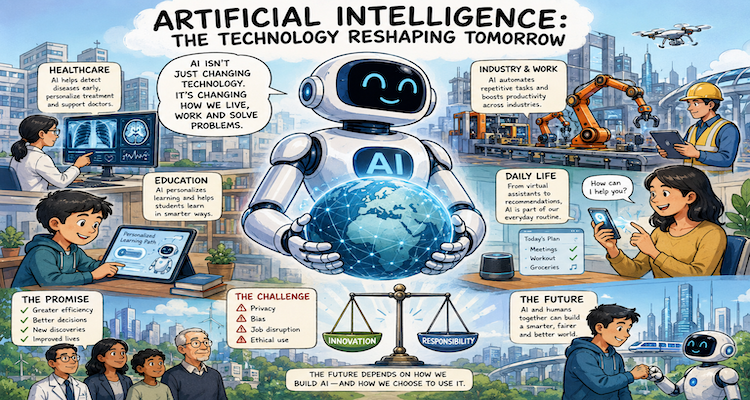
Artificial intelligence is no longer a technology waiting for the future. It is already changing how companies operate, how people learn and work, how scientists conduct research, and how digital services are built.
The more important shift, however, is not simply that AI models are becoming more capable. The deeper change is that AI is moving from a tool people consult to a technology increasingly embedded inside workflows, products, institutions, and infrastructure.
Stanford University’s 2026 AI Index reports that 88% of surveyed organizations used AI in 2025, while generative AI reached 53% population adoption within three years. At the same time, AI agents are beginning to perform multi-step computer tasks rather than merely answer questions. Yet the same evidence shows a technology with significant limitations: agents still fail a substantial share of structured tasks, benchmarks are becoming harder to interpret, and the infrastructure required to operate AI is creating new energy and supply-chain pressures.
That tension defines the next stage of AI. The future will not simply belong to systems that can do more. It will increasingly belong to organizations and societies that can decide where AI should be trusted, where humans must remain responsible, and how its growing physical and economic costs should be managed.
Key Takeaways
- AI adoption is spreading rapidly, but many organizations are still struggling to turn experiments into measurable enterprise value.
- AI agents are moving beyond conversation toward completing multi-step tasks, while reliability remains a major limitation.
- AI is becoming important to scientific discovery, medicine, education, and everyday digital services—not just software development.
- The physical infrastructure behind AI is becoming strategically important as data-center electricity demand rises.
- Human judgment remains essential because AI capability can be highly uneven across different tasks.
- The biggest transformation may come from redesigning workflows around AI rather than simply adding AI tools to existing processes.
AI Is Moving From Software Feature to Infrastructure
The first wave of generative AI was largely defined by chat interfaces. People asked questions, generated text, summarized documents, wrote code, created images, and experimented with new forms of interaction.
The next phase is more consequential because AI is increasingly being integrated into the systems people already use.
Stanford’s 2026 AI Index found that organizational AI adoption reached 88% in 2025. Generative AI was being used in at least one business function by 70% of organizations, although AI-agent deployment remained relatively early.
That distinction matters.
Using an AI assistant to write an email is one thing. Connecting AI to a company’s customer-support system, software-development process, internal knowledge base, analytics tools, and business workflows is another.
The second approach changes how work itself is organized.
McKinsey’s 2025 global survey found that nearly two-thirds of respondents said their organizations had not yet begun scaling AI across the enterprise. The companies reporting greater value were more likely to redesign workflows rather than simply introduce another AI application.
This suggests that the most important AI question for businesses may not be, Which AI tool should we buy?
It may be, Which parts of the way we work should be redesigned because AI can now perform them differently?
The Rise of AI Agents Changes the Question
Traditional software generally waits for a user instruction and follows predefined rules.
Generative AI introduced systems capable of producing flexible outputs from natural-language instructions. AI agents push the idea further: they can plan steps, interact with software environments, use tools, and attempt to complete a task.
The progress is real, but it should not be confused with dependable autonomy.
Stanford’s 2026 AI Index reports that performance on the OSWorld benchmark, which evaluates computer-use tasks, rose from roughly 12% to 66.3%. That is a substantial improvement, but it also means agents still fail roughly one in three attempts on the benchmark.
This is one of the most important realities to understand about AI’s future.
A system can be extraordinarily capable in one context and unreliable in another. The AI Index describes this as a form of “jagged intelligence”: models can perform impressively on difficult intellectual tasks while still failing at seemingly simple ones.
For businesses, that creates a practical rule: automation should be matched to the reliability required by the task.
An AI system drafting a first version of a marketing document may be useful even when it makes occasional mistakes. An AI system independently approving a financial transaction, diagnosing a patient, or changing production infrastructure requires a much higher standard of reliability and oversight.
The future of AI therefore depends as much on evaluation and governance as on raw model capability.
AI Is Changing the Economics of Work
The impact of AI on employment is unlikely to be as simple as “AI replaces jobs.”
A more immediate change is that individual tasks within jobs are being reorganized.
Writing, coding, research, customer service, data analysis, documentation, translation, design, and administrative work can all contain tasks that AI can accelerate. That does not automatically mean the entire occupation disappears. It can instead change the balance between routine execution, human judgment, communication, verification, and problem-solving.
McKinsey’s 2025 research found that AI use is widespread, but enterprise-wide financial impact remains much less common. Respondents reported benefits in individual business units, while only a minority reported measurable impact on overall EBIT.
That gap is revealing.
AI can make an individual worker faster without necessarily making an entire organization more productive. If the surrounding process remains inefficient, the productivity gain may simply create more output inside the same bottleneck.
This is why AI adoption is becoming an organizational-design problem.
Companies that treat AI purely as a productivity plug-in may capture incremental gains. Companies that rethink workflows, decision rights, training, quality control, and responsibilities have a greater opportunity to capture structural value.
Science Is Becoming an AI-Assisted Discipline
AI’s influence is also extending beyond conventional business software.
Stanford’s 2026 AI Index reports that natural-science research produced approximately 80,150 AI-related publications in 2025, a 26% increase from 2024. AI-related research now represents a growing share of scientific output across several fields.
Medicine provides another example.
The 2026 AI Index reports advances in biological modeling, virtual-cell research, clinical documentation, and AI-assisted medical systems. Some AI tools are already being used to reduce administrative workloads for clinicians, while emerging biological models are being investigated for applications involving drugs, genes, and cellular responses. But the report also emphasizes that experimental validation remains necessary for emerging scientific applications.
That distinction is crucial.
AI can accelerate scientific discovery without replacing the scientific process. A model can generate a hypothesis, identify patterns, predict molecular behavior, or prioritize experiments. Researchers still need to determine whether those predictions hold up in the physical world.
The future of AI-assisted science may therefore be less about machines independently “discovering everything” and more about compressing the time between observation, hypothesis, simulation, experimentation, and verification.
Education Faces a Different Kind of Disruption
AI is also changing what it means to learn.
Students increasingly have access to systems that can explain concepts, generate examples, provide feedback, translate material, summarize complex texts, and assist with writing or coding.
Stanford’s 2026 AI Index reports that four out of five U.S. high-school and college students use AI for schoolwork, while only about half of middle and high schools have AI policies and just 6% of teachers report that those policies are clear.
The challenge is therefore no longer simply whether students will use AI.
It is whether education systems can redesign assessment and teaching around a world in which generating a conventional answer is increasingly easy.
Skills such as verification, reasoning, source evaluation, problem formulation, experimentation, communication, and independent judgment become more important when machines can produce plausible answers in seconds.
That may eventually change the value of education itself from memorizing information toward learning how to evaluate, challenge, apply, and extend information.
AI Has a Physical Footprint
One of the easiest aspects of AI to overlook is that it is not weightless.
Every model runs on physical infrastructure: servers, processors, networking equipment, cooling systems, buildings, electricity grids, and supply chains.
The International Energy Agency estimates that data centers consumed around 415 terawatt-hours of electricity in 2024, approximately 1.5% of global electricity consumption. In its base case, global data-center electricity consumption is projected to reach around 945 TWh by 2030.
AI is an important driver of that growth, although it is not the only workload running in data centers.
The geographic concentration of these facilities creates another issue. The IEA estimates that grid constraints could put around 20% of planned global data-center capacity at risk of connection delays through 2030.
This means AI development is becoming connected to questions that historically belonged to the energy and infrastructure sectors.
Countries competing to attract AI investment will need more than talented engineers. They will also need electricity generation, transmission capacity, advanced chips, cooling systems, data centers, and resilient supply chains.
AI policy is therefore increasingly becoming infrastructure policy.
Capability Is Advancing Faster Than Confidence
There is a temptation to measure AI progress through benchmark scores alone.
But benchmarks themselves are becoming more difficult to interpret.
Stanford’s 2026 AI Index notes that some evaluations are becoming saturated quickly and that reviews have found invalid-question rates as high as 42% on some widely used benchmarks.
This does not mean AI progress is imaginary. It means that measuring progress requires greater care.
A model achieving a higher score does not automatically mean it is reliable in the real world. Nor does a strong performance on one type of reasoning establish competence across unrelated tasks.
For readers, businesses, educators, and policymakers, this distinction is essential: capability is not the same as reliability, and reliability is not the same as suitability for a particular decision.
NIST’s AI Risk Management Framework emphasizes characteristics including validity and reliability, safety, security, accountability, transparency, explainability, privacy, and fairness. Its generative-AI profile specifically addresses risks associated with the technology’s newer capabilities and applications.
As AI becomes more deeply embedded in society, these concepts will become practical requirements rather than abstract principles.
The Next Competitive Advantage May Be Judgment
The AI industry will continue competing on model capability, speed, cost, multimodal performance, reasoning, agents, and specialized applications.
But for organizations adopting AI, another competitive advantage is emerging: knowing where not to automate.
A company that uses AI everywhere without effective controls can create new vulnerabilities faster than it creates value. An organization that identifies high-value, low-risk applications and builds verification around higher-risk ones may extract more sustainable benefits.
The same principle applies to individuals.
Knowing how to ask an AI system for an answer is becoming a basic skill. Knowing whether the answer deserves to be trusted is more valuable.
That requires domain knowledge, critical thinking, source evaluation, and the ability to recognize uncertainty.
AI may therefore increase the value of human judgment even as it reduces the amount of routine work humans perform.
What Tomorrow’s AI World Could Look Like
The available evidence points toward a future that is more integrated than spectacular.
AI may become less visible as a standalone product and more embedded in ordinary systems: software development environments, search, education platforms, scientific laboratories, healthcare administration, financial services, customer support, manufacturing, logistics, transportation, and personal devices.
Some interactions will remain conversational. Others will happen automatically in the background.
The biggest change may be that people stop thinking of AI as something they “use” and begin encountering it as part of the infrastructure through which work and services operate.
But the path is not predetermined.
AI development depends on technical progress, energy availability, computing infrastructure, economics, regulation, public trust, workforce adaptation, and the ability of institutions to manage risks. The Stanford AI Index notes that national AI strategies are expanding and that AI sovereignty the effort to build greater domestic control over AI capabilities is becoming an increasingly important policy objective.
That makes AI more than a technology story.
It is becoming an economic, educational, scientific, infrastructure, and geopolitical story at the same time.
Conclusion
Artificial intelligence is reshaping tomorrow because it is already changing the systems that create tomorrow.
The most consequential shift is not simply that machines can generate better text, images, code, or answers. It is that AI is becoming capable enough to participate in increasingly complex workflows—and widespread enough to influence how organizations, researchers, educators, and individuals make decisions.
Yet the evidence also argues against simplistic predictions.
AI remains uneven. Its reliability varies by task. Many businesses are still struggling to turn experimentation into measurable enterprise value. Its infrastructure demands significant amounts of energy and computing capacity. And increasingly capable systems create new questions about responsibility, transparency, security, and human oversight.
The defining skill of the AI era may therefore not be learning how to hand everything to a machine.
It may be learning what to delegate, what to verify, what to protect, and what should remain distinctly human.
That is where the real transformation of tomorrow is likely to begin.
This content is published for informational or entertainment purposes. Facts, opinions, or references may evolve over time, and readers are encouraged to verify details from reliable sources.