










How Household Chemicals Are Quietly Reshaping Freshwater Ecosystems
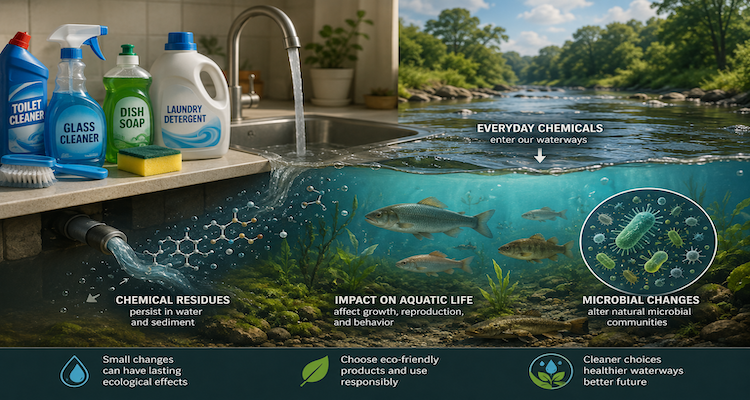
A spotless kitchen counter, freshly washed clothes, and a sparkling bathroom often symbolize a clean and healthy home. Yet every time cleaning products, detergents, cosmetics, and other household chemicals are rinsed down the drain, they begin a journey that extends far beyond the walls of our homes. Much of what disappears into sinks and showers eventually reaches rivers, lakes, wetlands, and streams, where its effects can be surprisingly complex.
Scientists have long monitored industrial pollution and agricultural runoff, but growing attention is now turning toward everyday household products. Rather than causing dramatic environmental disasters, these substances may be creating subtle, cumulative changes that influence freshwater ecosystems over months and years. The result is an emerging environmental story that connects ordinary daily habits with the health of aquatic life in ways many people rarely consider.
The Invisible Cocktail Flowing Into Waterways
Modern households use hundreds of chemical ingredients every week. Laundry detergents, dishwashing liquids, disinfectants, fabric softeners, shampoos, soaps, air fresheners, sunscreens, cosmetics, and even medications washed from our skin contribute trace compounds to wastewater.
Most wastewater treatment facilities are designed to remove harmful pathogens and large amounts of organic waste. They are highly effective at protecting public health. However, many newer synthetic chemicals including some fragrances, preservatives, surfactants, and personal care ingredients were never the primary focus when older treatment systems were developed.
This does not mean treatment plants are failing. Rather, it highlights a growing challenge: modern chemistry is evolving faster than some water treatment technologies were originally intended to address.
As a result, tiny concentrations of numerous chemicals may enter freshwater systems simultaneously, creating what researchers sometimes describe as a “chemical mixture” rather than exposure to a single pollutant.
Small Amounts Can Produce Big Ecological Effects
Many household chemicals are present in concentrations too low to cause immediate harm. Yet freshwater ecosystems operate through delicate biological relationships.
Microscopic algae feed tiny invertebrates, which nourish fish, amphibians, birds, and countless other organisms. Even modest shifts at one level can gradually influence the entire food web.
For example, some surfactants can affect how insects develop. Certain cosmetic ingredients may alter microbial communities that naturally recycle nutrients. Residues from cleaning products can influence algae growth under particular conditions.
These changes rarely make headlines because they often happen gradually rather than suddenly. Instead of mass fish deaths, ecosystems may experience slower alterations in species diversity, breeding patterns, or seasonal cycles.
Freshwater Microbes Are Among the First to Respond
When people think about river health, they often picture fish or aquatic plants. Yet microbes perform much of the invisible work that keeps freshwater ecosystems functioning.
Bacteria and fungi break down organic matter, recycle nutrients, and help maintain water quality. They form the foundation of countless ecological processes.
Research increasingly suggests that some chemical mixtures can shift microbial populations. Certain microbes may become more abundant while others decline, subtly changing how nutrients circulate through lakes and rivers.
These microbial shifts can influence everything from oxygen availability to the productivity of aquatic plants, illustrating how seemingly minor chemical changes can ripple throughout an ecosystem.
Everyday Products Are Becoming More Environmentally Complex
Household products today often contain ingredients designed for improved performance, longer shelf life, stronger fragrances, antibacterial properties, or enhanced cosmetic effects.
Each innovation can improve convenience for consumers. However, environmental scientists must continually study how these newer ingredients behave once they leave the home.
Some substances degrade quickly after entering the environment. Others persist longer or transform into entirely different compounds through sunlight, microbial activity, or chemical reactions.
This ongoing evolution means freshwater protection has become a moving target rather than a problem with a single permanent solution.
Why Wildlife Responds Differently Than Expected
One of the most surprising findings emerging from freshwater research is that species do not respond uniformly to chemical exposure.
A concentration that has little noticeable effect on one organism may influence another during reproduction, growth, or migration.
Aquatic insects, amphibians, mollusks, freshwater plants, and microorganisms each possess different biological sensitivities. Seasonal temperature changes, rainfall, water flow, and natural chemistry can further modify how chemicals behave.
This variability makes predicting ecosystem outcomes more challenging than simply measuring individual chemical concentrations.
Scientists increasingly emphasize understanding the combined interactions between organisms and multiple environmental stressors instead of studying single substances in isolation.
Climate Change Is Complicating the Picture
Freshwater ecosystems are already adapting to warmer temperatures, altered rainfall patterns, droughts, and more frequent extreme weather events.
Household chemicals do not act within a stable environment.
Lower river flows during droughts may reduce dilution, increasing the relative concentration of certain compounds. Heavy storms can overwhelm wastewater systems, allowing untreated water to enter rivers more frequently in some locations.
Warmer water temperatures may also change how chemicals break down or how aquatic organisms respond to them.
These overlapping pressures illustrate why freshwater management increasingly requires an integrated understanding of pollution, climate, and ecosystem resilience.
The Consumer Choices Few People Connect to River Health
One of the most overlooked aspects of freshwater conservation lies in consumer behavior.
Environmental conversations often focus on plastic waste or carbon emissions, yet purchasing decisions about cleaning products, cosmetics, and personal care items also shape environmental outcomes.
Many manufacturers have begun developing biodegradable formulations, phosphate-free detergents, concentrated cleaning products, and refillable packaging. Although no product is entirely impact-free, product design is becoming an important part of reducing long-term chemical loads entering waterways.
This reflects a broader shift toward considering a product’s entire life cycle from manufacturing and household use to disposal and environmental persistence.
Rather than treating pollution solely as an industrial issue, attention is expanding to include millions of small daily decisions made by households around the world.
Innovation Is Moving Beyond Traditional Water Treatment
Addressing emerging household chemicals does not depend on consumer choices alone.
Researchers are exploring advanced filtration systems, activated carbon technologies, membrane filtration, and other treatment methods capable of removing a wider range of trace compounds from wastewater.
At the same time, chemists are investigating greener alternatives that break down more readily after use without compromising product performance.
This combination of improved product design and more advanced wastewater treatment may prove more effective than relying on either approach independently.
What This Means for the Future of Freshwater
Freshwater ecosystems have always been dynamic, but today’s environmental challenges are increasingly defined by accumulation rather than catastrophe.
The gradual introduction of thousands of everyday chemicals represents a new kind of ecological pressure one that is diffuse, difficult to observe directly, and closely tied to modern lifestyles.
The encouraging news is that awareness is growing across science, industry, and public policy. Better monitoring, improved chemical design, and advances in wastewater treatment are expanding our ability to understand and reduce long-term environmental impacts.
Perhaps the most important lesson is that environmental stewardship no longer begins only at factories or power plants. It also starts in kitchens, bathrooms, and laundry rooms, where ordinary routines connect unexpectedly with the rivers and lakes that sustain both wildlife and communities.
As research continues, one message is becoming increasingly clear: protecting freshwater ecosystems is not simply about preventing major pollution events it is about recognizing how countless everyday actions collectively shape the natural world.
This content is published for informational or entertainment purposes. Facts, opinions, or references may evolve over time, and readers are encouraged to verify details from reliable sources.