

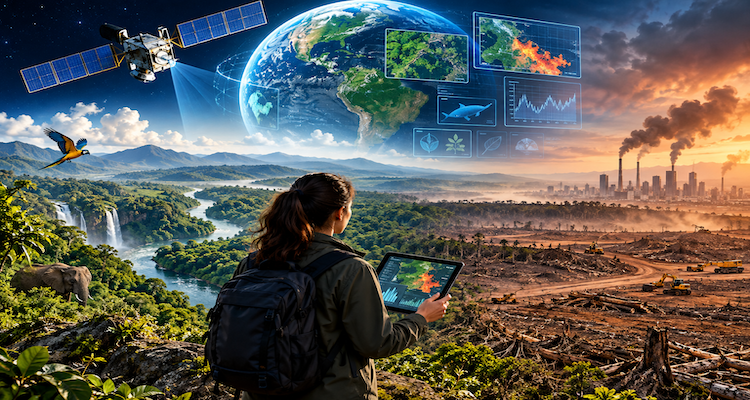








Technology at the Edge of What’s Possible: The New Limits of AI, Robotics and Computing
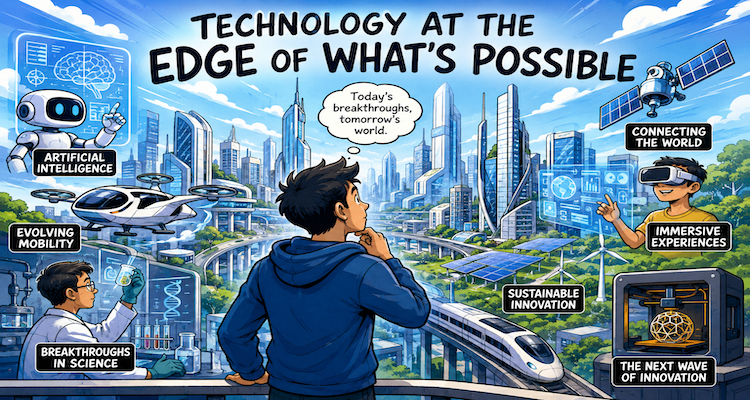
Technology is entering a period in which the hardest question is no longer whether a machine can perform an impressive task. It is whether that capability can become reliable, affordable, energy-efficient and useful outside a controlled demonstration.
That distinction is becoming increasingly important in 2026. Artificial intelligence is exceeding human performance on some demanding benchmarks while still failing surprisingly simple tasks. Robots are moving deeper into factories, hospitals and logistics, yet physical-world autonomy remains difficult. Quantum computing is approaching new experimental milestones, but large-scale fault-tolerant systems remain a future objective. Meanwhile, the computing infrastructure behind these advances is creating new demands on electricity, chips, cooling and capital.
The frontier, in other words, is no longer a single line moving forward. It is a collection of boundaries and the distance between technical possibility and dependable real-world deployment may be the most important boundary of all.
Key Takeaways
- AI capability is advancing rapidly, but benchmark success does not guarantee dependable performance in everyday situations.
- Robotics is scaling commercially, while unpredictable physical environments remain a major obstacle to broader autonomy.
- AI’s next phase depends as much on electricity, chips and infrastructure as on better algorithms.
- Quantum computing is progressing toward useful applications, but major milestones remain dependent on unresolved engineering challenges.
- AI-assisted scientific discovery is becoming more autonomous, while laboratory validation and human judgment remain essential.
- The defining technology advantage may shift from invention alone to reliable integration, efficiency, safety and scale.
The Frontier Is Becoming “Jagged”
One of the clearest examples comes from artificial intelligence.
The 2026 AI Index from Stanford’s Institute for Human-Centered Artificial Intelligence reports that frontier AI models made major gains across reasoning, coding, multimodal tasks and scientific problem-solving. Yet the same report highlights an important contradiction: some systems can achieve extraordinary results on difficult intellectual benchmarks while performing poorly on seemingly ordinary tasks.
Stanford describes this as a “jagged” frontier. On one benchmark, an AI system can approach or exceed expert-level performance; somewhere else, its reliability can fall sharply.
That matters because real work rarely consists of one benchmark question. A software developer, analyst, engineer, doctor or business manager operates across dozens of interconnected decisions. A useful system must not merely produce an impressive answer. It must know when it is uncertain, maintain consistency, interact with other systems, recover from mistakes and behave predictably.
AI agents illustrate the difference particularly well. Stanford reports that performance on OSWorld, which evaluates agents completing tasks on real computer environments, rose from roughly 12% to 66.3%. That is a dramatic improvement, but it still means substantial failure remains on a structured task benchmark.
The implication is significant: the next frontier of AI may be less about demonstrating isolated intelligence and more about making intelligence dependable over long sequences of work.
From Chatbots to Systems That Act
This shift is already visible in business.
Stanford’s 2026 AI Index reports that 88% of surveyed organizations used AI in at least one business function in 2025, while generative AI was being used in at least one function by 70%. Yet deployment of AI agents remained in the single digits across nearly all business functions.
That gap is revealing.
Using AI to draft an email or summarize a document is relatively easy to contain. Giving an AI system permission to update records, communicate with customers, modify software, approve transactions or coordinate several other systems introduces a different standard of reliability.
An agent that fails occasionally while generating ideas may be useful. An agent that fails occasionally while operating a financial, medical or industrial workflow can become a liability.
This helps explain why the commercial frontier is moving toward orchestration, verification, permissions, monitoring and human oversight rather than simply larger models.
The economic incentive is already substantial. Stanford reports that global corporate AI investment more than doubled in 2025, while compute costs and infrastructure spending also reached record levels.
The technology race is therefore becoming a systems race.
The Physical World Is a Much Harder Test
Software exists in a comparatively forgiving environment. The physical world does not.
A robot working on a factory line can operate efficiently because its surroundings are structured, repetitive and carefully engineered. A household contains different floors, lighting conditions, furniture, people, pets, fragile objects and unexpected obstacles.
Stanford’s 2026 AI Index captures this difference: robots achieved 89.4% success in simulated manipulation tasks on RLBench, but only 12% success on real household tasks.
That gap is one of the most important realities behind today’s enthusiasm about humanoid robots and physical AI.
It does not mean robotics is failing. Quite the opposite.
The International Federation of Robotics reported 542,000 industrial robots installed worldwide in 2024, more than twice the number installed a decade earlier. Asia accounted for 74% of new deployments. India recorded a record 9,100 industrial robot installations in 2024, up 7% from the previous year.
Professional service robotics is also expanding. Almost 200,000 professional service robots were sold in 2024, while medical robot sales rose 91% to approximately 16,700 units.
The lesson is more nuanced than “robots are coming.”
Robotics already works extremely well where the environment can be engineered around the machine. The harder challenge is making that reliability survive contact with the unpredictable physical world.
That distinction will determine how quickly robots move from specialized environments into ordinary workplaces and homes.
The Hidden Frontier: Energy and Infrastructure
The most visible technology breakthroughs often involve software. The less visible constraint is infrastructure.
Every large AI system ultimately depends on physical resources: advanced processors, memory, networking equipment, data centers, cooling systems and electricity.
The International Energy Agency estimates that data centers consumed around 415 terawatt-hours of electricity in 2024, approximately 1.5% of global electricity consumption. Its base case projects data-center electricity consumption to reach around 945 TWh by 2030. Electricity consumption from accelerated servers, driven largely by AI, is projected to grow much faster than conventional server consumption.
This creates a peculiar technological race.
Software can be improved through an update. A power grid cannot.
The IEA notes that a data center can become operational in two to three years, while energy infrastructure requires longer planning cycles, substantial capital and lengthy construction timelines.
That means the edge of technological possibility increasingly depends on questions that once seemed unrelated to software innovation:
- Can enough electricity reach the right location?
- Can advanced chips be manufactured at scale?
- Can data centers be cooled efficiently?
- Can networks handle rising workloads?
- Can companies justify the capital required?
- Can governments approve infrastructure quickly enough?
Efficiency therefore becomes a competitive technology.
A model that performs slightly better but requires dramatically more computing resources may not be the best system for widespread deployment. The frontier increasingly belongs to technologies that deliver useful capability within real physical and economic constraints.
Quantum Computing Shows a Different Kind of Frontier
Quantum computing offers another lesson: a technology can be genuinely advancing without being ready for broad commercial use.
IBM’s March 2026 quantum roadmap targets early examples of quantum advantage through integration with high-performance computing. The company also describes work toward real-time error correction and large-scale fault-tolerant systems. IBM says these milestones are goals and may change; they should therefore be treated as a corporate roadmap rather than as established future outcomes.
The distinction matters because quantum computing is often discussed as though simply increasing the number of qubits will unlock a new era of computing.
In practice, useful quantum computing requires much more: error correction, logical qubits, sufficiently long and reliable circuits, suitable algorithms and economically meaningful applications.
The interesting development is therefore not simply “more qubits.”
It is the convergence of quantum processors with conventional high-performance computing, software and AI-assisted workflows.
That points toward a broader pattern across emerging technology: the most consequential systems may be hybrid rather than standalone.
Science May Become the Ultimate Test
Perhaps the most consequential frontier is where AI meets scientific discovery.
In May 2026, a Nature study described Robin, a multi-agent system designed to connect literature search, hypothesis generation and analysis of experimental biological data. The researchers used it to propose therapeutic candidates for dry age-related macular degeneration and then tested candidates in laboratory experiments. The system could analyze hundreds of scientific papers rapidly, but the experimental loop still involved human scientists and laboratory validation.
That last point is crucial.
AI can search, compare, model and propose. Science still has to confront reality.
A hypothesis is not a discovery merely because a model generated it. A predicted molecule is not a treatment merely because a simulation looks promising. Experimental results must be reproduced, interpreted and eventually translated into real-world outcomes.
A July 2026 study in Scientific Reports, analyzing more than five million scientific publications across 27 fields, found that research combining AI and high-performance computing was associated with greater novelty and citation impact than conventional research or research using either technology alone. The researchers also identified growing inequalities in access to AI expertise and supercomputing resources.
This suggests that the technology frontier could increasingly be measured by how effectively humans and machines work together to explore problems that neither could address efficiently alone.
What the Next Technology Race May Actually Be About
The familiar technology race has focused on who can build the fastest processor, largest model, most capable robot or most powerful quantum system.
Those achievements still matter. But the next stage introduces a harder question: Who can turn capability into dependable infrastructure?
For businesses, that means evaluating technologies by more than demonstrations or benchmark scores. Cost per useful task, reliability, security, integration, energy requirements and human oversight can matter as much as raw performance.
For workers, the implication is equally important. AI is likely to change tasks unevenly rather than replace every occupation in one sweeping movement. Stanford’s data already shows that AI’s labor-market effects are appearing unevenly, with some effects concentrated among younger workers in exposed occupations. At the same time, measured productivity gains have been strongest in structured, measurable work.
For consumers, the question will be simpler: does the technology actually make life better?
A system that can write beautifully but produces unreliable information is limited. A robot that can perform a demonstration but cannot safely navigate a home is limited. A quantum computer with impressive specifications but no economically valuable workload is limited.
The distance between possible and useful is where much of the next decade’s technology story will unfold.
The Edge of What’s Possible Is Moving and So Are the Boundaries
Technology is clearly pushing into territory that would have seemed experimental only a few years ago. AI systems are tackling increasingly complex reasoning and software tasks. Robots are expanding beyond traditional factory automation. Scientific workflows are becoming more computational and increasingly autonomous. Quantum researchers are working toward systems that could eventually solve problems beyond the practical reach of classical machines.
But the evidence also points to a less glamorous truth.
The frontier is not only about capability. It is about reliability, infrastructure, energy, economics, safety, verification and access.
That may be the most useful way to understand technology at the edge of what’s possible in 2026. The breakthrough is no longer complete when a machine performs something remarkable once. The harder achievement is making that capability work repeatedly, safely, affordably and at meaningful scale.
The technologies that cross that final gap may have a far greater impact than those that merely produce the most impressive demonstration.
The information presented in this article is based on publicly available sources, reports, and factual material available at the time of publication. While efforts are made to ensure accuracy, details may change as new information emerges. The content is provided for general informational purposes only, and readers are advised to verify facts independently where necessary.