




Why Screens Are Slowly Losing Their Place at the Center of Technology
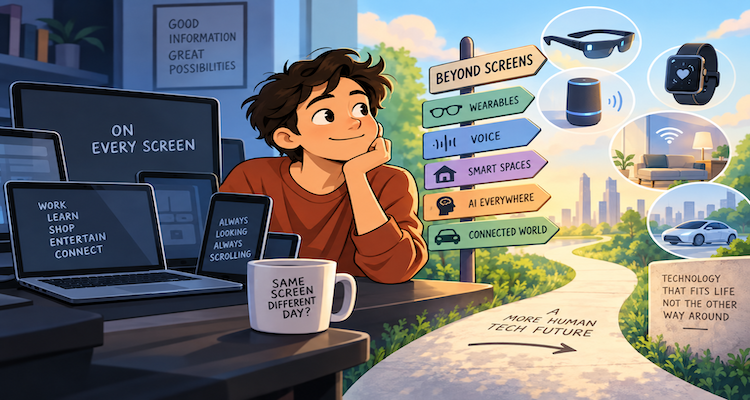
For more than two decades, the screen has been the default gateway to digital life. We tap phones, click laptops, scroll through social feeds and open apps to make almost everything happen.
That model is beginning to change.
The important shift is not that screens are disappearing. Phones, monitors, tablets and televisions remain deeply embedded in everyday computing. The change is that technology companies are increasingly trying to make the interface less visible. AI assistants can listen and respond through voice. Smart glasses can understand what a wearer is looking at. Wearables can deliver information through audio or brief visual prompts. Computers are increasingly being designed to interpret intent rather than wait for a user to navigate menus.
Google’s Android XR strategy illustrates this transition particularly clearly. Its AI glasses are designed to use cameras, microphones and speakers to provide assistance without requiring users to take their phones out of their pockets. In 2026, Google expanded that vision with intelligent eyewear designed in both screen-free and display-equipped forms.
The emerging question, therefore, is not whether screens will survive. It is whether they will remain the primary place where computing happens.
Key Takeaways
- AI is moving computing from app navigation toward conversations, context and direct assistance.
- Smart glasses demonstrate how useful digital services can operate without demanding constant attention to a phone screen.
- Screens remain valuable for complex tasks, creation and detailed information, making their disappearance unlikely.
- The biggest change may be the separation of computing from a single dominant device rather than the end of displays.
- Privacy, battery life, reliability and social acceptance remain major barriers for screen-light computing.
- The next generation of interfaces may combine voice, vision, wearables and occasional displays rather than replace screens completely.
From the Screen as Interface to AI as Interface
The smartphone made the graphical interface almost universal.
Want to book a hotel? Open an app.
Want directions? Open Maps.
Want to translate something? Open a translation app.
Want to send a message? Open a messaging application.
The user has traditionally been responsible for knowing which application to open and which controls to use.
Generative AI introduces a different model.
Instead of navigating through a sequence of interfaces, a person can increasingly describe an intention: find information, summarize something, translate a conversation, draft a message or explain what is in front of them.
Google is explicitly extending Gemini beyond phones into watches, cars, televisions and XR devices. Its Android XR glasses are designed around cameras, microphones and speakers so the assistant can understand aspects of the user’s surroundings and respond without requiring traditional phone interaction.
That represents a deeper change than simply adding another AI feature to a device.
The interface itself is becoming less important.
Smart Glasses Show What Screen-Light Computing Could Look Like
Smart glasses are one of the clearest experiments in this direction because they can put computing closer to the user’s senses without requiring a handheld display.
Google’s Android XR glasses prototypes, for example, combine cameras, microphones and speakers with Gemini. Google has demonstrated functions including directions, messaging, photography and real-time translation. Some versions include an in-lens display, while other planned forms emphasize audio assistance without a conventional visual display.
Meta has been pursuing a similar direction.
Its Ray-Ban Meta glasses already combine cameras, microphones, speakers and Meta AI. Meta has also developed display-equipped glasses that can show messages, translations and other information in the user’s field of view.
The significance is not simply that glasses can display information.
It is that the user does not necessarily need to stop what they are doing and look down at a separate computer.
That distinction could matter in situations where attention, mobility or social interaction is important.
The Most Important Change May Be Context
Traditional software generally waits for an instruction.
The user opens an application, selects an option and supplies information.
AI-enabled devices can potentially operate with much more context.
A camera can see an object.
A microphone can hear a conversation.
Location can establish where the user is.
A wearable can provide information about interaction or movement.
An AI model can combine those signals to determine what assistance might be relevant.
Google’s Android XR demonstrations explicitly emphasize this contextual approach. The company’s glasses are designed to understand what users see and hear and provide assistance in the moment.
That creates a fundamentally different relationship between person and computer.
Instead of asking, “Which screen should I use?”, the interaction can become, “What do I want to accomplish?”
The distinction is subtle, but potentially important.
Screens Are Not Going Away
It would be misleading to describe this transition as the death of the screen.
Screens remain exceptionally good at certain things.
Reading a long article is often easier on a large display. Editing a video requires substantial visual information. Programming involves multiple windows and large amounts of text. Designing graphics, comparing documents, analyzing spreadsheets and playing visually complex games all benefit from substantial display space.
Apple’s Vision Pro demonstrates the opposite side of the transition. Rather than eliminating screens, spatial computing can effectively expand them into the user’s surrounding environment. Apple’s visionOS updates have continued to develop spatial widgets, immersive experiences and interfaces that occupy physical space around the user.
Google’s Android XR strategy similarly includes an “infinite screen” concept for headsets, allowing multiple applications to occupy virtual space.
So the future is unlikely to be screen versus no screen.
It is more likely to be screen when useful, invisible computing when possible.
Why Phones May Become More Like Hubs
The smartphone may therefore evolve without disappearing.
Instead of being the place where every interaction occurs, it could increasingly become the central computer that quietly supports a collection of other devices.
A pair of glasses could provide the camera, microphone, speaker and immediate interface.
A watch could provide health, notifications and quick interactions.
Earbuds could handle audio communication.
A car could provide navigation and contextual assistance.
A laptop or desktop could remain the destination for demanding work.
The phone could coordinate much of this ecosystem in the background.
Google’s own Android strategy is already moving Gemini across phones, watches, cars, televisions and XR devices rather than treating the smartphone as the only meaningful endpoint.
This suggests that the next computing platform may not be a single replacement for the smartphone.
It may be a network of devices connected by one intelligent software layer.
The Failed Experiments Matter Too
The transition is not guaranteed.
Humane’s AI Pin became an early example of how difficult it is to build useful screen-light computing as a standalone product. In February 2025, HP announced an agreement to acquire key Humane AI capabilities, including its Cosmos platform, intellectual property and technical talent.
That episode is important because it exposes a basic problem.
Removing the screen does not automatically make technology easier to use.
Users still need reliable answers, fast responses, good battery life, intuitive interaction and a device that fits naturally into daily life.
AI hardware can be technically impressive and still fail to become a compelling everyday product.
The lesson is not that screenless computing is impossible. It is that the interface has to solve a real problem better than the interface it replaces.
Privacy Could Become the Biggest Test
The same sensors that make ambient computing useful also make it complicated.
A camera on a phone is normally pointed deliberately.
A camera on glasses can operate while the wearer is walking, talking and interacting with other people.
That changes the privacy equation.
Google has acknowledged this issue in its Android XR development and says it has been testing prototypes with trusted users while considering privacy for both wearers and people around them.
The concerns are not theoretical. Recent reporting has highlighted growing regulatory and social scrutiny around camera-equipped smart glasses and the possibility of recording people without their meaningful awareness or consent.
This could become one of the defining questions for wearable AI:
Can technology become more aware of the world without making everyone around it feel watched?
The answer will depend not only on engineering, but also on social norms, product design, privacy indicators, regulation and user behavior.
The Real Competition Is for Attention
There is another reason screens may become less central: attention has become a scarce resource.
A smartphone requires users to look away from whatever they are doing.
That is perfectly appropriate when reading, watching or creating something. But it is inconvenient when walking, driving, cooking, working with equipment or having a face-to-face conversation.
Audio and wearable interfaces can allow certain digital tasks to happen without demanding the same visual attention.
Meta’s display glasses are explicitly designed around short interactions rather than keeping a permanent display in front of the wearer.
This points toward a different philosophy of computing.
The best interface may not be the one that gives users the most information.
It may be the one that gives them only the information they need, at the moment they need it.
What Happens to Apps?
This shift could eventually affect software development as much as hardware.
The traditional mobile ecosystem is organized around applications: open an app, navigate its interface and complete a task.
AI agents introduce another possibility.
A user might ask for an outcome and allow software to determine which services are required to accomplish it.
For developers, that could mean designing less around screens and more around capabilities, APIs, permissions, structured data and AI-accessible actions.
The application would not necessarily disappear.
It could become something the user interacts with indirectly.
That would be a significant architectural change: from app-centric computing to intent-centric computing.
But it is still an emerging model. Reliability, permissions, security and the ability of AI systems to perform actions correctly remain critical constraints.
A Screen-Light Future Is More Plausible Than a Screenless One
The strongest evidence today does not point toward a world without screens.
It points toward a world in which screens become one interface among several.
Google is developing Android XR glasses and headsets around Gemini and contextual assistance. Meta is developing AI glasses with both camera-and-audio functionality and display-based interaction. Apple continues to develop spatial computing around Vision Pro rather than abandoning visual interfaces.
Together, these developments suggest a broader technological direction.
Computing is becoming more distributed.
AI is making interaction more conversational.
Sensors are giving computers greater awareness of their surroundings.
Wearables are moving computing closer to the body.
And screens are increasingly being used selectively rather than automatically.
That does not make the display obsolete. It changes its role.
The screen could become less like the front door of computing and more like a powerful tool that appears when visual information is actually the best way to interact.
Conclusion
The most interesting development in computing may not be a new screen, but the growing number of situations in which people no longer need to look at one.
Phones, monitors and televisions will remain important because visual interfaces are extraordinarily useful. But AI, voice, computer vision, spatial computing and wearables are expanding the definition of what an interface can be.
The emerging model is therefore not a screenless future.
It is a less screen-dependent future one in which computing can listen, see, understand context and respond through the device that makes the most sense at that moment.
For users, that could mean less time navigating technology and more time using it as an unobtrusive layer around everyday life.
For technology companies, the challenge will be harder: building devices that are useful enough to earn trust without becoming so intrusive that people want them out of their lives.
That tension not the disappearance of screens is likely to shape the next chapter of personal computing.
The information presented in this article is based on publicly available sources, reports, and factual material available at the time of publication. While efforts are made to ensure accuracy, details may change as new information emerges. The content is provided for general informational purposes only, and readers are advised to verify facts independently where necessary.