









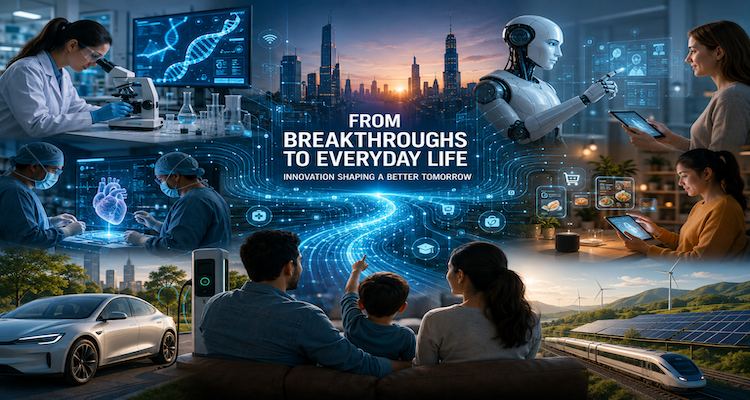
From Breakthroughs to Everyday Life: How Once-Experimental Technologies Became Invisible Infrastructure
A blue dot on a phone map, a website opened in seconds, a file stored without a hard drive, or an AI assistant answering a question can feel like ordinary parts of modern life. Yet each depends on technologies that once belonged to laboratories, research institutions, government programs, or specialist computing environments.
That transition from scientific breakthrough to everyday utility is one of the most important stories in technology. The most consequential innovations are often not the ones people talk about forever. They are the ones that eventually become so dependable and accessible that people stop noticing them.
The World Wide Web is a striking example. Tim Berners-Lee proposed it at CERN in 1989 as a way for scientists to share information across institutions. CERN released the Web software into the public domain in 1993, helping it spread far beyond its original research purpose.
GPS followed a different path. Developed through a government program with military origins, it became a foundation for civilian navigation, logistics, communications and countless location-based services. The removal of intentional civilian accuracy degradation in 2000 accelerated its commercial potential.
Today, artificial intelligence is moving through a similar transition but at a much faster pace. The question is no longer simply whether a technology can work. Increasingly, the question is whether it can become reliable, affordable, accessible and useful enough to disappear into everyday routines.
Key Takeaways
- The most influential technologies often become invisible after they turn into reliable infrastructure.
- The Web moved from a scientific information-sharing project into a foundation of communication, commerce and culture.
- GPS shows how research and government infrastructure can create unexpected civilian applications at enormous scale.
- Cloud computing changed access to computing by making infrastructure available as an on-demand service rather than a physical asset.
- Artificial intelligence is moving rapidly from experimental systems toward everyday use in work, education, healthcare and consumer services.
- Adoption alone does not guarantee social benefit; reliability, access, privacy, safety and governance determine whether breakthroughs deliver lasting value.
The Moment a Breakthrough Stops Looking Like a Breakthrough
Technology has an unusual lifecycle.
At first, an innovation is visible because it is new. Researchers discuss it, companies promote it and the public watches its progress. Later, if it succeeds, the technology becomes embedded in other products and services.
That is when its visibility can decline even as its importance increases.
Few people think about the protocols that make a website load. Most passengers do not consider satellite timing when opening a navigation app. A person collaborating on a cloud document rarely thinks about the servers and networking infrastructure supporting it.
This creates a paradox: the more successfully a technology becomes infrastructure, the less visible the original breakthrough becomes.
CERN’s own history illustrates this transformation. The Web was designed to solve a specific problem among scientists who needed to exchange information across institutions. It was not originally conceived as the foundation for social media, online shopping, streaming entertainment or modern digital publishing. Its open development and subsequent adoption allowed its usefulness to expand far beyond the original problem.
The lesson is important for understanding today’s emerging technologies. The first application of a breakthrough may not be its most important application.
GPS: From Specialized System to Everyday Utility
GPS demonstrates another route from breakthrough to ordinary life.
Satellite positioning can now appear almost trivial: enter a destination, and a phone displays a route. But behind that simple experience are satellites, ground systems, precise timing and sophisticated positioning calculations.
NIST notes that atomic clocks are fundamental to GPS because precise timing allows positioning systems to work. The same precision also supports telecommunications, financial transactions and electrical-grid synchronization.
The civilian transformation accelerated in 2000, when the United States ended Selective Availability, an intentional degradation of civilian GPS accuracy. GPS.gov says the change improved civilian accuracy substantially and helped unleash new commercial and consumer applications.
Today, GPS supports far more than driving directions. It contributes to agriculture, surveying, aviation, logistics, telecommunications, financial systems and fitness applications.
This is a recurring pattern in technological development: one capability can become the foundation for an ecosystem of applications that its original creators could not fully anticipate.
Cloud Computing Changed What a Computer Could Be
Another transformation happened when computing itself became less tied to physical machines.
Traditional computing required organizations to acquire servers, storage and networking equipment. Cloud computing introduced a different model: computing resources could be accessed on demand from shared infrastructure.
NIST’s widely used definition describes cloud computing as convenient, on-demand network access to a shared pool of configurable computing resources that can be rapidly provisioned and released.
The significance goes beyond technical terminology.
Cloud infrastructure helped turn computing capacity into something that could be provisioned as needed. A small company could access infrastructure without building an entire data center. A developer could deploy an application without owning every server required to operate it. A consumer could access files and services across devices without thinking about where the underlying hardware was located.
The breakthrough therefore changed not only technology but also the economics of technology.
It helped make computing more flexible, scalable and accessible and shifted attention from owning infrastructure toward consuming computing as a service.
Artificial Intelligence Is Entering the Same Transition
Artificial intelligence is now approaching a particularly important stage in this lifecycle.
The spectacular demonstrations of generative AI have attracted much of the public attention, but the deeper transformation may come from less visible applications.
The 2026 Stanford AI Index reports that generative AI reached an estimated 53% population adoption within three years, a faster adoption trajectory than the personal computer or internet in the report’s comparison. The report also finds that AI is increasingly integrated into business, education, science and medicine.
That does not mean every AI capability is mature or dependable. It means the technology has moved beyond a purely experimental stage.
The distinction matters.
A system performing impressively in a controlled demonstration is not necessarily ready to make unsupervised decisions in a high-stakes environment. AI systems can still produce incorrect information, behave unpredictably outside their tested conditions and create privacy, security and accountability concerns.
Stanford’s 2026 research on medicine illustrates this tension particularly well. AI-generated clinical notes saw broad adoption in 2025, with physicians in multiple hospital systems reporting large reductions in documentation time. At the same time, the report identifies significant evidence gaps in clinical AI, including the limited use of real-world clinical data in many studies.
The pattern is familiar: adoption can move faster than our ability to evaluate consequences.
The Hard Part Is No Longer Only Invention
Historically, technological progress was often framed around a simple question: Can we build it?
For many modern technologies, that is no longer sufficient.
A breakthrough has to survive a second set of tests:
- Can people use it easily?
- Can organizations afford it?
- Can it operate reliably at scale?
- Can it integrate with existing systems?
- Can its risks be measured?
- Can users understand its limitations?
- Can regulators and institutions govern its use?
- Can the benefits reach more than a small group of early adopters?
These questions determine whether an invention remains a laboratory achievement or becomes part of everyday life.
The history of the Web provides an important example. Its open availability was not merely a technical detail; it helped create the conditions for widespread adoption. CERN explicitly links the public release of the Web software in 1993 with its subsequent expansion.
Technology therefore needs an ecosystem around it.
Infrastructure, standards, business models, education, regulation, investment and user trust can be just as important as the underlying invention.
Why Today’s Breakthroughs May Look Ordinary Tomorrow
Consider how quickly extraordinary capabilities can become mundane.
Navigation once required maps and specialized knowledge. Today, a route can be calculated almost instantly.
Information once depended heavily on physical libraries and printed reference material. The Web transformed access to information.
Computing once meant interacting directly with expensive hardware. Cloud services now allow people to access computing resources without knowing where the physical machines are.
AI is beginning to follow the same trajectory. Instead of always appearing as a standalone chatbot, it may increasingly operate behind familiar services: search, software development, education platforms, customer support, healthcare documentation, translation, accessibility tools and business workflows.
The most important AI product of the future may therefore not be an AI product at all from the user’s perspective.
It may simply be a better version of something people already use.
The Hidden Cost of Making Technology Invisible
There is, however, a downside to technological invisibility.
When infrastructure works consistently, people stop thinking about its dependencies.
A navigation app can make location technology appear effortless while concealing dependence on satellites, timing systems, communications networks and software. Cloud services can make computing appear limitless while shifting infrastructure, energy and security responsibilities into data centers and service providers.
AI presents an even more complicated version of the same problem.
When an algorithm becomes embedded in a familiar service, users may not know when AI is being used, what information influenced an output, how reliable the result is, or who is responsible when something goes wrong.
Stanford’s 2026 AI Index highlights a widening gap between AI capability and society’s preparedness to evaluate and govern it.
That suggests an important principle for the next phase of technological development: invisible technology still needs visible accountability.
From Invention to Infrastructure
The history of technology is not simply a history of increasingly powerful machines.
It is a history of translation.
A scientific discovery becomes an engineering system. The engineering system becomes a product. The product becomes a service. The service becomes infrastructure. Eventually, people stop asking how it works and simply expect it to work.
That progression explains why some of the most important technologies receive less attention decades after their creation.
The Web is now ordinary because it succeeded. GPS is ordinary because it became dependable. Cloud computing is ordinary because it became convenient.
Artificial intelligence is somewhere in the middle of that journey.
Its capabilities are advancing rapidly, and its adoption is spreading, but the transition from impressive demonstration to dependable infrastructure is still unfinished. The coming years will therefore be judged less by how spectacular AI demonstrations become and more by how responsibly useful the technology becomes in ordinary life.
The ultimate measure of a breakthrough is not how extraordinary it looks in a laboratory. It is whether it can solve real problems reliably enough that people can build their lives around it.
And when that happens, the breakthrough may disappear from view—leaving behind something more consequential: a new normal.
Conclusion
The technologies that reshape society rarely remain spectacular forever. Their greatest success may be the moment people stop noticing them.
The Web became infrastructure for human communication. GPS became a quiet layer beneath navigation, logistics and synchronization. Cloud computing turned computing resources into an on-demand service. AI is now attempting a similar transition across work, education, science, healthcare and everyday services.
That transition should not be measured by novelty alone. The real test is whether a breakthrough becomes reliable, accessible, understandable and responsibly governed.
Tomorrow’s most influential technology may not be the invention that attracts the most attention today. It may be the one that quietly becomes indispensable.
The information presented in this article is based on publicly available sources, reports, and factual material available at the time of publication. While efforts are made to ensure accuracy, details may change as new information emerges. The content is provided for general informational purposes only, and readers are advised to verify facts independently where necessary.