









The Technologies Defining a New Era of Converging Innovation
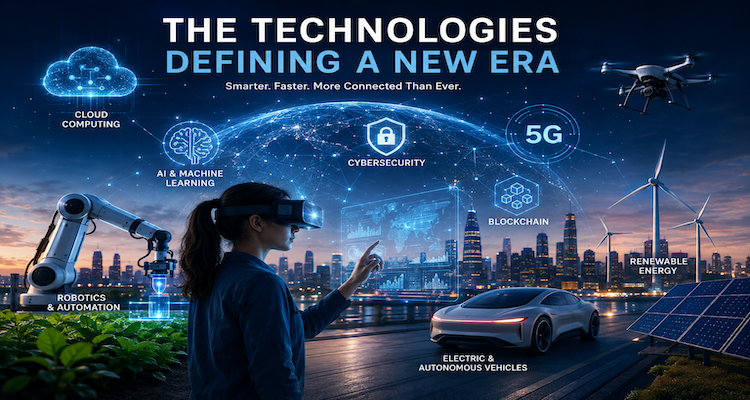
The most important technology story of 2026 is not the arrival of one breakthrough. It is the growing convergence of several technologies that were once developed largely in separate worlds.
Artificial intelligence is becoming more capable and more deeply embedded in business and scientific work. Robotics is moving beyond controlled factory environments. Advanced semiconductors are becoming strategic infrastructure. Electricity demand is being reshaped by data centres, electric vehicles and increasingly digital industries. Biotechnology is becoming more programmable and personalized, while quantum computing is already forcing organizations to rethink long-term cybersecurity.
The World Economic Forum’s 2026 technology research captures this shift directly, identifying eight domains—including AI, robotics, advanced materials, spatial intelligence, quantum and next-generation energy that are increasingly being combined rather than developed in isolation. Its broader conclusion is important: competitive advantage is increasingly determined by how effectively organizations orchestrate combinations of technologies, people, data and workflows.
Key Takeaways
- AI is becoming infrastructure for other technologies rather than a standalone digital tool.
- Robotics is expanding physical automation, but unpredictable real-world environments remain a major limitation.
- Chips and electricity are becoming strategic constraints on the expansion of advanced computing.
- Biotechnology is moving toward more personalized therapies and increasingly programmable biological systems.
- Quantum computing is influencing cybersecurity today even before large-scale quantum machines arrive.
- The defining advantage may come from combining technologies effectively rather than owning one breakthrough.
The Real Shift Is From Technologies to Technology Systems
For much of the digital era, technologies were easier to describe individually: cloud computing, smartphones, search engines, industrial robots or renewable energy.
That distinction is becoming less useful.
AI can help design materials, analyze biological data, optimize factories and operate software agents. Robotics gives AI a physical presence. Advanced chips provide the computing required to train and operate increasingly capable models. Energy systems determine whether that computing can scale. Sensors and spatial technologies provide machines with information about physical environments.
The result is a technology stack in which progress in one field increasingly creates opportunities in another.
The World Economic Forum’s 2026 Technology Convergence report describes this as a shift toward combining domains such as artificial intelligence, omni computing, engineering biology, robotics, advanced materials, spatial intelligence, quantum technologies and next-generation energy. The important point is not that every company needs all of them. It is that the boundaries between technology sectors are becoming less rigid.
That changes how technological progress should be measured. The question is no longer simply which invention is most impressive. It is increasingly about which combinations can move from demonstration to reliable, affordable deployment.
AI Is Becoming the Coordination Layer
Artificial intelligence remains the most visible part of this transition, but its significance is changing.
The 2026 Stanford AI Index reports that organizational AI adoption reached 88% in its surveyed measure, while generative AI reached 53% population adoption within three years a faster adoption curve than the personal computer or the internet. AI agents are also beginning to move from answering questions toward completing computer-based tasks. On the OSWorld benchmark, agent performance rose from roughly 12% to 66.3% during 2025, although agents still failed about one-third of structured attempts.
That last limitation matters.
AI systems can perform extremely well on some difficult intellectual benchmarks while remaining unreliable at seemingly simple tasks. Stanford’s 2026 research describes this as a “jagged frontier”: capabilities are advancing unevenly rather than producing a uniformly intelligent machine. Robots, for example, still succeed at only a small share of unpredictable household tasks despite much stronger performance in controlled environments.
The practical implication is that AI’s next phase is less about replacing every human task and more about becoming a coordination layer across software, scientific research, business processes and physical machines.
That makes reliability, evaluation and human oversight just as important as raw model capability.
Robotics Is Bringing Intelligence Into the Physical World
Software can be copied almost instantly. Physical automation cannot.
A robot must deal with friction, weight, lighting, obstacles, unexpected movement and imperfect information. That is why the transition from impressive laboratory demonstrations to useful general-purpose robots is considerably harder than improving a language model.
Yet the direction is clear. Industrial robot deployment has remained at historically high levels, while autonomous vehicles and other forms of physical automation are moving into real-world commercial operations. Stanford’s 2026 AI Index reports that autonomous-vehicle services reached mass-scale deployment in 2025, although current deployments remain concentrated in specific locations and operating conditions.
The more important development may be the combination of robotics with AI.
Better perception models can help machines interpret their surroundings. Improved planning can help them decide what to do. Faster chips can process information locally. Sensors can provide continuous environmental data.
The emerging question is therefore not simply whether robots become more capable. It is where the economics of combining AI, sensors, robotics and automation become compelling enough to change an industry’s operating model.
The Semiconductor Layer Is Becoming Strategic Infrastructure
Every major computing advance ultimately depends on physical hardware.
The semiconductor industry is therefore moving from being largely invisible infrastructure to becoming an increasingly strategic part of economic and national policy.
In June 2026, the European Commission proposed Chips Act 2.0 to strengthen semiconductor production, reduce strategic dependencies and expand Europe’s capacity in advanced and mainstream chips. The proposal explicitly links semiconductors with AI, cloud infrastructure, industrial robotics, connected vehicles and other technologies.
This reflects a broader reality: advanced computing cannot scale independently of manufacturing capacity, packaging, supply chains, electricity and data-centre infrastructure.
The AI boom is consequently becoming an industrial story as much as a software story.
Energy Is Becoming Part of the Computing Story
One of the least appreciated consequences of advanced computing is that software increasingly depends on physical energy infrastructure.
The International Energy Agency’s 2026 analysis found that global data-centre electricity consumption increased 17% in 2025, while electricity consumption from AI-focused data centres grew even faster. The IEA expects global data-centre electricity use to double by 2030, with AI-focused data-centre consumption potentially tripling.
At the same time, AI itself can become a tool for improving energy systems through forecasting, optimization and more responsive management.
This creates a feedback loop: more AI requires more electricity, but better AI can also help manage increasingly complex electricity systems.
That is why technologies such as advanced batteries, grid software, distributed energy resources and everything-to-grid systems are gaining importance. The World Economic Forum’s 2026 emerging-technology report highlights everything-to-grid energy, in which electric vehicles, buildings, batteries and other assets can potentially become active resources for balancing electricity supply and demand.
The future of computing may therefore be constrained not only by chips, but by how quickly power systems can adapt.
Biotechnology Is Becoming More Programmable
Another major shift is occurring in biology.
Advances in genetic engineering, computational biology and molecular analysis are making biological systems increasingly programmable. The frontier is moving toward therapies and biological products tailored to particular diseases, patients or production requirements.
The World Economic Forum’s 2026 emerging-technology research highlights personalized mRNA cancer vaccines, exosome drug delivery, precision fermentation and quantum simulation for drug discovery among technologies approaching greater real-world impact.
The significance is broader than any individual treatment.
When AI can analyze biological information, advanced computing can model molecular interactions and biotechnology can manufacture or modify biological systems, the research process itself changes. Some discoveries can increasingly be explored computationally before expensive physical experiments are conducted.
Stanford’s 2026 AI Index similarly identifies expanding AI use across biology, chemistry, physics and astronomy, showing how AI is becoming part of scientific discovery rather than merely a productivity tool.
But this is also an area where technical capability cannot be separated from safety, regulation and clinical evidence. A promising computational result is not automatically a proven medical treatment.
Quantum Technology Is Already Changing Security
Quantum computing is often discussed in terms of what future machines might calculate. For businesses and governments, however, one of its most immediate consequences is cybersecurity.
NIST finalized three post-quantum cryptography standards in 2024 and is now working on additional algorithms and migration guidance. In June 2026, the agency released working drafts for incorporating post-quantum cryptography into Personal Identity Verification standards.
That means the quantum era is influencing technology decisions before fault-tolerant quantum computers capable of breaking today’s widely used public-key systems exist.
Organizations need to identify where vulnerable cryptography is embedded in software, hardware and services and plan migrations. This is a useful example of how emerging technology can have consequences long before its headline capability becomes commercially widespread.
The New Competitive Advantage Is Convergence
The technologies defining this new era are therefore not a simple list of winners.
AI matters because it can interpret, predict, generate and coordinate. Robotics matters because intelligence can increasingly act in physical environments. Semiconductors matter because advanced computation requires increasingly sophisticated hardware. Energy matters because computation and electrification depend on reliable power. Biotechnology matters because biological processes are becoming more programmable. Quantum technologies matter because they introduce both new computational possibilities and new security requirements.
Their greatest impact may occur at the intersections.
A factory combining AI, sensors, robotics, advanced chips and intelligent energy management is fundamentally different from a factory that merely installs robots. A healthcare system combining AI, genomic information and personalized therapies operates differently from one that simply adds a chatbot. A city combining sensors, autonomous mobility, distributed energy and intelligent infrastructure becomes a coordinated system rather than a collection of disconnected technologies.
This is why the most useful way to understand the technology landscape is to look beyond individual products.
The critical question for businesses, governments and consumers is becoming: What happens when these technologies start working together?
What Still Stands in the Way
The convergence story should not be mistaken for a guarantee of rapid transformation.
Technical limitations remain significant. AI systems can be unreliable. Robots struggle with unstructured environments. Advanced chips require complex and geographically concentrated supply chains. Energy infrastructure takes years to build. Biotechnology requires rigorous validation. Quantum technologies remain technically challenging. And many emerging systems create new questions about privacy, safety, cybersecurity, employment and access.
Trust is becoming an infrastructure requirement of its own.
The World Economic Forum’s 2026 research identifies trust and access as two major conditions for emerging technologies to scale responsibly. Technologies that affect health, electricity, mobility, identity or financial systems cannot rely on technical performance alone; institutions and users must also be willing to trust how those systems operate.
That may become one of the defining challenges of the next technology cycle: building systems that are not merely more capable, but sufficiently reliable, transparent, secure and accessible to earn widespread adoption.
Conclusion
The new technological era is not being defined by a single machine, application or scientific breakthrough.
It is being built through convergence.
AI is becoming more capable, robotics is extending automation into the physical world, chips are becoming strategic infrastructure, energy is becoming inseparable from computing, biotechnology is becoming increasingly programmable, and quantum technologies are already influencing cybersecurity.
The biggest changes may come when these technologies stop operating as separate industries and begin functioning as interconnected systems.
That is where the next generation of technological advantage is likely to emerge not simply from inventing something new, but from combining existing breakthroughs well enough to solve problems that individual technologies could not solve alone.
The information presented in this article is based on publicly available sources, reports, and factual material available at the time of publication. While efforts are made to ensure accuracy, details may change as new information emerges. The content is provided for general informational purposes only, and readers are advised to verify facts independently where necessary.