










History That Continues to Shape Us: How the Past Lives in Modern Life
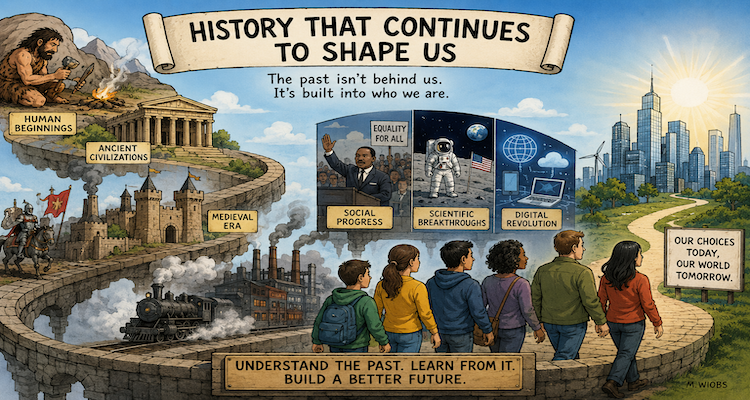
History is often treated as a record of events that happened before us. But its influence is much less distant than that. The past survives in the institutions we inherit, the languages we speak, the streets we navigate, the education systems we enter, the customs we pass between generations, and the collective memories that influence how societies understand themselves.
Research across economic history, organizational studies and social science increasingly shows that historical events can have effects long after the people who experienced them are gone. Those effects do not make the present inevitable, but they can shape the choices available to individuals and societies.
Key Takeaways
- Historical choices can remain embedded in institutions, laws, economic systems and social expectations for generations.
- Culture carries the influence of earlier experiences through beliefs, habits, language, traditions and collective memory.
- Education demonstrates how historical change can transform societies while leaving older structures behind.
- Cities and physical infrastructure often preserve decisions made under very different economic and political conditions.
- History influences the present, but research also shows that institutions can change when societies create new incentives and opportunities.
- Understanding the past is therefore less about living in it and more about recognizing forces that still affect today’s choices.
The Past Often Survives as a System
One reason history remains powerful is that it rarely survives only as a story.
It can survive as a rule.
A government regulation created decades ago can influence how businesses operate today. A property-rights arrangement can affect investment incentives. An education system established under earlier political conditions can continue shaping what children learn and how schools operate. A city planned around older transportation technologies can influence commuting patterns long after those technologies have changed.
Economists often describe this phenomenon through the idea of path dependence: earlier choices can influence later possibilities because institutions, infrastructure and expectations develop on top of what already exists.
Research by Daron Acemoglu, Georgy Egorov and Konstantin Sonin emphasizes an important qualification: institutional persistence does not mean institutions are frozen. They can change continuously while their direction remains influenced by earlier decisions.
That distinction matters. History is not destiny. It is part of the starting position from which societies make new choices.
Institutions Can Outlive the People Who Created Them
Institutions are among the clearest ways the past enters everyday life.
Laws, property systems, political arrangements, financial rules and administrative practices create incentives. Once established, they can become difficult to replace because people, organizations and markets adapt around them.
A major body of economic research argues that historical institutions can help explain differences in long-term economic development. Nathan Nunn’s review of the literature identifies several channels through which history can persist, including institutions, culture, knowledge, technology and changes in the behavior of societies.
Research has also found examples within countries rather than only between them.
One study of India examined differences created during British colonial rule in the assignment of land rights and taxation. The researchers found evidence that these differing institutional arrangements were associated with different development outcomes over time. That does not mean colonial institutions alone explain India’s regional economic differences; geography, politics, investment, education and many other factors also matter. But the research illustrates how an institutional decision from an earlier period can leave a measurable economic legacy.
This is one of history’s less visible effects. A decision made generations ago may no longer be remembered by most people, yet the system created by that decision can continue influencing incentives.
Culture Carries the Past Without Looking Historical
Not everything inherited from history is written into law.
Culture can preserve the past through beliefs, habits, social expectations, rituals, language and ideas about what is normal or desirable.
Research on cultural evolution suggests that historical shocks can have persistent effects when they alter the costs and benefits associated with particular beliefs or behaviors. Over time, those responses can become part of cultural patterns that influence later generations.
This helps explain why two societies facing similar circumstances may respond differently.
History does not necessarily determine what people believe. But it can influence the environment in which beliefs develop.
The same principle applies to collective memory. Societies decide which events are commemorated, which documents are preserved, which monuments are protected and which stories are taught. These decisions influence how later generations understand their identity and their relationship with other communities.
UNESCO’s Memory of the World Programme, updated in February 2026, explicitly focuses on preserving documentary heritage and widening access to historical records. The programme describes documentary heritage as a means of connecting the past with present understanding and future choices.
Education Shows How Historical Change Becomes Everyday Reality
Few examples demonstrate the long reach of history better than education.
Two centuries ago, literacy was limited to a relatively small share of the global population. Our World in Data estimates that about 10% of the world’s population aged 15 and older was literate in 1820. By 2022, the global literacy rate had reached about 87%, although definitions and measurement methods have changed over time and comparisons require caution.
That transformation did more than increase the number of people who could read.
Mass literacy changed access to information, participation in public life, economic opportunity and the transmission of knowledge. It also helped create the conditions for modern education systems, professional institutions and knowledge-based economies.
Yet education itself carries historical structures.
Schools around the world inherited organizational patterns developed during earlier periods of mass schooling: classrooms, age-based groups, subject-based curricula and teacher-led instruction. UNESCO’s work on the future of education notes how deeply these structures became embedded across societies during the 19th and 20th centuries.
The lesson is important for today’s debates about education technology and AI. New tools may change how information is delivered, but changing the technology does not automatically change the institutional structure surrounding it.
Sometimes the hardest part of reform is not inventing something new. It is recognizing which old assumptions are still operating underneath the new system.
Cities Are Historical Documents We Live Inside
History can also be physically visible.
A modern city may contain roads, neighborhoods, railway corridors, ports, industrial districts and property boundaries whose origins lie decades or even centuries in the past.
Urban economists increasingly use historical data to understand why cities grow in particular ways and why economic activity remains concentrated in certain locations. Research reviewed by the National Bureau of Economic Research shows that historical information can help explain long-term urban growth and the spatial organization of economic activity.
This creates an interesting paradox.
People often experience cities as present-day environments, but cities are partly accumulated decisions.
A railway built for an industrial economy can influence land values long after factories disappear. An old road network can constrain new transportation planning. A historic commercial district can become a modern business center. Earlier infrastructure can therefore create both advantages and limitations for future development.
History is not merely something displayed in a museum. Sometimes it is the physical environment around us.
The Past Can Shape What Societies Remember
There is another layer that is more difficult to measure: memory.
Historical events are not remembered identically by everyone. Different communities may preserve different experiences, emphasize different causes and interpret the same event through different perspectives.
That makes historical memory both valuable and complicated.
UNESCO’s recent work on teaching violent pasts argues that education can help learners understand the roots and legacies of violence while developing a more nuanced understanding of complex histories. Its 2025 policy guide, updated in 2026, connects history education with reconciliation, conflict transformation and global citizenship.
The implication is broader than classroom education.
Understanding history requires distinguishing between remembering an event and understanding an event.
Memory can preserve identity, but historical inquiry also requires evidence, comparison, context and a willingness to examine uncomfortable contradictions.
That distinction becomes especially important in a digital environment where historical documents, photographs and interpretations can circulate globally within seconds.
History Also Shapes Technology and the Future
Technology can appear to break with the past, but technological systems are rarely created in a vacuum.
Existing institutions influence which technologies are adopted. Existing markets determine who can access them. Existing regulations shape how they are deployed. Existing cultural expectations influence whether people trust or reject them.
History therefore affects not only what societies have inherited, but also how they respond to new technologies.
The relationship works in both directions.
Technology can preserve history through digitized archives, searchable databases and new forms of public access. UNESCO’s Memory of the World Programme specifically includes digital heritage and digitization among its areas of work.
But greater access does not automatically guarantee better historical understanding.
A digitized archive can make evidence easier to find while still leaving questions about context, selection, interpretation and preservation. The challenge is increasingly not simply whether historical information survives, but whether people can evaluate it responsibly.
History Is a Constraint and a Resource
The most useful way to think about history may be neither as an unavoidable burden nor as a collection of inspirational stories.
It is a resource for understanding why the present looks the way it does.
Historical knowledge can reveal why an institution developed, why a city has a particular shape, why a cultural practice persists, why economic differences endure, or why societies disagree about the meaning of the same event.
It can also reveal that current arrangements were once new.
That is perhaps one of history’s most practical lessons. Many things that appear permanent were created by people responding to the conditions of their own time. Some survived because they worked well. Others survived because changing them was costly, politically difficult or simply never became a priority.
Research on institutional change reinforces this point: persistence is real, but so is change. Historical paths can constrain choices without eliminating them.
Conclusion
History continues to shape us because the past does not disappear when an event ends.
It remains in institutions, infrastructure, education, culture, economic incentives, collective memory and accumulated knowledge. Some of these influences are obvious; many are invisible precisely because they have become ordinary.
Recognizing them gives history a more practical purpose.
The value of studying the past is not simply knowing what happened. It is understanding why some features of the present exist, which inherited assumptions still influence our decisions, and where change is possible.
A society that understands its historical foundations is better positioned to decide which parts of its inheritance deserve preservation, which require reconsideration, and which should no longer determine the future.
This content is published for informational or entertainment purposes. Facts, opinions, or references may evolve over time, and readers are encouraged to verify details from reliable sources.