










When Technology Feels Haunted: Strange Digital Experiences Explained
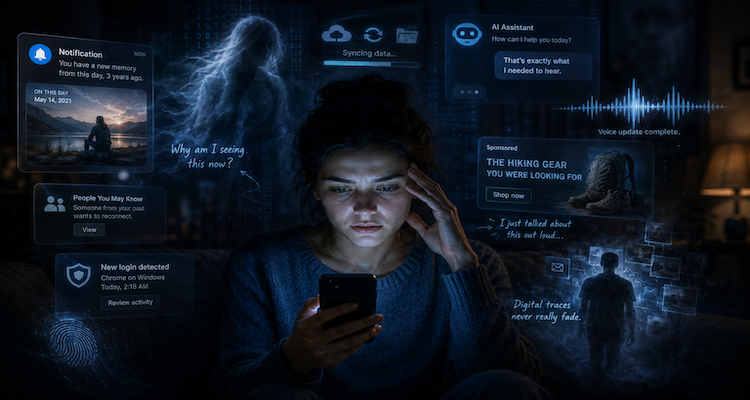
A phone lights up with a notification that appears to have no obvious source. A social media app surfaces an advertisement moments after someone discusses a product. An old account suddenly sends a birthday reminder for a person who has died. A familiar digital voice sounds slightly different after an update. A chatbot produces a sentence that feels unexpectedly intimate, even though it has no memory of the relationship the way a human would.
None of these experiences necessarily require a supernatural explanation. Yet many people describe certain digital encounters using the language of ghosts, haunting, possession or eeriness. The reason is not simply that technology is mysterious. It is that modern digital systems increasingly preserve traces, make predictions and act with a degree of autonomy that can obscure the boundary between what a machine actually knows and what a user assumes it knows.
The unsettling feeling often emerges from a mismatch: technology behaves in a way that is explainable in principle, but the explanation is hidden behind recommendation systems, cloud synchronization, machine-learning models, automated notifications and layers of data collected across devices and services.
The result can feel less like a technical malfunction and more like a presence.
Key Takeaways
- Digital experiences can feel haunted when systems produce actions whose underlying causes are invisible to users.
- Algorithms often create eerie coincidences by making predictions from extensive behavioral and contextual data.
- Recommendation systems can revive old memories, identities and digital traces long after people expect them to disappear.
- AI-generated language and voices can create a false sense of intention because humans naturally interpret social signals.
- Understanding how digital systems retain, predict and automate behavior can reduce confusion without eliminating the emotional impact.
Why Digital Experiences Can Feel Eerie
Psychologists have long studied why humans detect agency and intention, sometimes even where none exists. We are highly sensitive to voices, faces, patterns and behavior that appear purposeful. Digital technology increasingly produces all four.
A traditional machine was easier to interpret. A calculator returned a result after a user entered numbers. A television displayed a program selected by a broadcaster. The relationship between action and outcome was comparatively visible.
Modern digital systems are different. A smartphone may synchronize data automatically. A recommendation engine may respond to behavior accumulated over weeks or months. An AI system can generate a conversational reply without revealing every computational step that produced it.
This creates what might be called an explanation gap: something happens, but the user cannot easily see why.
That gap is fertile ground for eerie interpretations.
A notification that arrives at an emotionally significant moment may be statistically ordinary. But the human brain does not experience it as a spreadsheet. Context matters. If a forgotten photograph appears on the anniversary of an important event, the timing can feel deeply personal even when an automated memory feature simply followed a date-based rule.
The technology may be mechanical. The experience is still real.
The Digital Afterlife of Data
One reason technology can feel haunted is that digital systems preserve fragments of the past with remarkable persistence.
Photos remain in cloud libraries. Old messages survive in backups. Social platforms retain account histories. Contact lists synchronize across devices. Automated systems may continue generating reminders based on information that has not been updated or removed.
For users, these traces can appear unexpectedly.
A photo service may resurface an image from years earlier. A social platform may recommend reconnecting with someone no longer active in a person’s life. An old calendar entry can reappear after a device migration. In some cases, an account belonging to a deceased person may remain online unless relatives or platform administrators take action.
The important point is that digital memory does not work like human memory. People forget selectively and contextually. Databases generally do not forget unless information is deleted, altered, expired or otherwise managed.
That difference creates a strange tension. A person may feel that a chapter of life has ended while the digital systems surrounding them continue to preserve evidence of it.
In that sense, the “ghost” is often not a mysterious intelligence. It is persistent data encountering a changed human context.
When Algorithms Seem to Read Your Mind
Few digital experiences feel more unsettling than discussing something and then encountering related content or advertising shortly afterward.
The immediate suspicion is often that a device must have been secretly listening. But the explanation is frequently more complicated, and sometimes more mundane.
Advertising and recommendation systems can use combinations of signals, depending on the platform and a user’s settings. These may include browsing activity, search behavior, previous interactions, approximate location, device information, demographic inferences and other forms of data permitted within a platform’s policies and applicable rules.
The result can look psychic.
Suppose someone begins thinking about buying hiking equipment. Before searching directly, they may have already watched outdoor videos, visited travel pages, searched for destinations or interacted with related products. Advertising systems do not need to understand the person’s private thoughts. They only need enough observable signals to estimate that certain interests are becoming more likely.
This does not mean every unsettling advertising experience has the same explanation. Privacy concerns around data collection and targeted advertising are real, and users should examine the permissions and privacy settings of the services they use.
But the broader lesson is important: accurate prediction can feel like surveillance even when the system is operating through patterns rather than literal mind-reading.
The more successful the prediction, the easier it becomes to imagine an intelligence behind it.
AI Makes the Feeling More Personal
Generative AI introduces another dimension to digital eeriness because it communicates through one of humanity’s strongest social signals: language.
When a chatbot responds sympathetically, remembers details within a conversation or adopts a conversational tone, users can experience the interaction as socially meaningful. The same is true of synthetic voices that increasingly reproduce rhythm, emphasis and other characteristics associated with human speech.
But apparent personality should not automatically be confused with human intention or consciousness.
A language model can produce highly convincing text without experiencing the emotions it describes. A synthetic voice can sound familiar without possessing a personal identity. The emotional response comes partly from the technology, but also from the way humans interpret language and social cues.
This distinction matters because conversational fluency can create an illusion of deeper understanding.
The system may say exactly what feels appropriate in a moment. That does not establish that it has private feelings, personal motives or human-style awareness.
The eerie quality emerges precisely because the surface behavior is becoming more human while the underlying system remains fundamentally different from the person interacting with it.
The Uncanny Valley Is Moving Beyond Robots
The classic idea of the uncanny valley is usually associated with robots or computer-generated human faces. The basic concept is that something can become unsettling when it appears almost human without appearing entirely natural.
Digital life may now be creating a broader version of the same effect.
The unsettling object is no longer necessarily a humanoid robot. It may be:
- An AI voice that sounds almost exactly like someone familiar.
- An automated message that appears emotionally appropriate at an unexpected moment.
- A recommendation system that predicts an interest before the user consciously searches for it.
- A digital archive that resurfaces a forgotten part of someone’s life.
- A synthetic image that looks convincing until small details reveal that something is wrong.
What connects these experiences is ambiguity.
The system behaves in a way that suggests agency, memory or human understanding, but the user cannot easily determine how much of that interpretation is justified.
That uncertainty is often more unsettling than a clearly broken machine.
The Hidden-System Problem
One overlooked reason digital technology feels haunted is that much of its operation has moved out of sight.
Earlier technologies often exposed more of their mechanisms. A physical filing cabinet visibly stored documents. A radio required a recognizable signal. A computer program generally waited for a user command.
Today, important processes happen continuously in the background.
Data synchronizes. Software updates automatically. Platforms rank content. Security systems detect anomalies. Cloud services reconcile information across devices. Recommendation engines generate feeds before a user asks for them.
Convenience has increased, but visibility has not always increased with it.
This creates a trade-off. The less effort required from the user, the less obvious the chain of events may become.
A system that quietly performs useful tasks can feel magical when it works and haunted when it produces an unexpected result.
That is not merely a design problem. It is becoming a question of digital literacy.
Users increasingly need to understand not just how to operate technology, but how to interpret its behavior.
How to Investigate a “Haunted” Digital Experience
An eerie digital event does not need to be dismissed. It can be investigated.
When something unusual happens, a practical approach is to check the following:
Look for synchronization
The same account may be active on multiple devices. A change on one device can appear unexpectedly on another through cloud synchronization.
Check connected accounts and permissions
Third-party apps, social accounts and services may have access to data or functions that users no longer remember authorizing.
Examine notification settings
Automated reminders, memory features and scheduled alerts can continue operating long after their original purpose has been forgotten.
Review recent searches and interactions
An apparently mysterious recommendation may be connected to an earlier search, click, video, purchase or other behavioral signal.
Consider software updates
Updates can change voices, interfaces, recommendation behavior and automated features, sometimes making a familiar system feel unexpectedly different.
Secure accounts if the behavior is genuinely suspicious
Unexpected logins, unfamiliar account activity or unexplained changes should be treated as potential security issues rather than supernatural mysteries. Changing passwords, reviewing active sessions and enabling stronger account security can help identify or limit unauthorized access.
The goal is not to strip every strange experience of its emotional meaning. Sometimes an automated reminder can still be moving. A resurfaced photograph can still feel uncanny.
Understanding the mechanism and acknowledging the emotional response are not mutually exclusive.
Why This Matters as Technology Becomes More Autonomous
The “haunted technology” phenomenon points to a larger issue: digital systems are increasingly acting before users explicitly instruct them to act.
AI assistants can generate responses. Platforms automatically curate information. Smart devices make decisions based on sensors and learned patterns. Software can anticipate the next step in a workflow.
As these systems become more proactive, users will encounter more moments when an outcome arrives before they understand the chain of decisions behind it.
That has consequences beyond eeriness.
A recommendation that feels uncanny may also raise questions about privacy. An AI response that feels deeply personal may encourage users to overestimate what the system understands. A resurfaced digital memory may reveal how little control users have over data that remains stored across multiple services.
The central challenge is therefore not simply to make technology less strange.
It is to make important systems more understandable, while recognizing that complete transparency is not always easy. Modern AI models and recommendation systems can be technically complex, and a simple explanation may not capture every factor behind a particular output.
Still, users should not have to choose between convenience and basic comprehension.
Conclusion
Technology feels haunted when it crosses an invisible line between tool and apparent presence. A forgotten photograph returns. An algorithm predicts an interest. A machine speaks with unsettling familiarity. Something happens on a screen, and the explanation is hidden.
Usually, the mystery has a technical origin: persistent data, automated systems, statistical prediction, synchronization or machine-generated behavior. Yet that does not make the experience meaningless.
The deeper lesson is that as technology becomes more predictive, conversational and autonomous, the strange moments will become easier to encounter. What once looked like a glitch may increasingly be the visible result of systems working in ways users cannot immediately see.
The most useful response is neither blind trust nor supernatural speculation. It is curiosity backed by digital literacy: understand what the system can do, question what it appears to know, and remember that a convincing technological presence is not necessarily a conscious one.
This content is published for informational or entertainment purposes. Facts, opinions, or references may evolve over time, and readers are encouraged to verify details from reliable sources.