










Phantom Phone Vibrations: Why Your Brain Thinks Your Phone Is Ringing
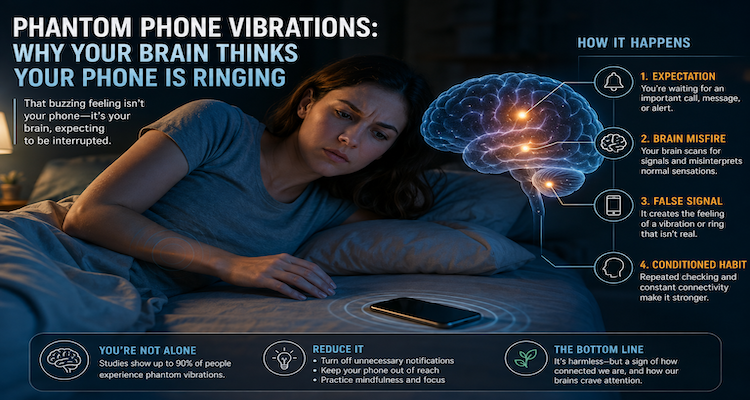
You feel a familiar buzz against your leg and instinctively reach for your phone. The screen is dark. There is no missed call, no message, and no notification.
The sensation was real enough to trigger a response, even though the phone never vibrated.
Known as phantom vibration or, more broadly, a phantom phone signal, this experience has been documented in research for years. It can also include hearing an imagined ringtone or believing a notification has arrived when nothing happened. The phenomenon is common enough to have been studied among doctors, students, adolescents and other frequent mobile-phone users. But the research points to an important distinction: experiencing a phantom vibration does not automatically mean that something is seriously wrong with the brain.
A more useful way to understand it is as a side effect of a brain that has become highly practiced at detecting signals that matter. Our phones train us to pay attention to small sounds, vibrations and movements. Sometimes, the brain appears to interpret an ambiguous sensation as the signal it has learned to expect.
Key Takeaways
- Phantom phone vibrations occur when a person perceives a vibration, ring or alert that did not actually happen.
- Frequent exposure to phone alerts may make the brain more ready to interpret ambiguous sensations as meaningful notifications.
- Research has found the phenomenon across different groups, but prevalence estimates vary widely by study and population.
- Studies have linked phantom signals with heavier or problematic smartphone use, though association does not prove causation.
- For many people, phantom vibrations are occasional and mildly annoying rather than a serious health problem.
- Changing notification habits, phone placement or vibration settings may help reduce the experience.
What Is a Phantom Phone Vibration?
A phantom vibration is the perception that a phone or other electronic device is vibrating when it is not. Related experiences include phantom ringing and, in some research, the broader category of phantom phone signals, which can include false perceptions of ringing, vibrating or other notifications.
The experience has been given informal labels such as “ringxiety” and “vibranxiety,” but these terms should not be mistaken for formal medical diagnoses. A 2015 systematic review concluded that phantom vibration and ringing were commonly reported, while also emphasizing that the evidence base was limited and that many questions about causes, consequences and clinical significance remained unresolved.
That uncertainty matters. Phantom vibrations are often described casually as a “hallucination,” but the phenomenon should not automatically be equated with a psychiatric disorder. Research reviews have noted that it is common and often does not significantly affect quality of life.
Why the Brain Can Mistake a Sensation for a Notification
The simplest explanation is not that the brain creates a completely random experience. Instead, it may be making a rapid interpretation based on expectation.
Human perception is not a passive recording of the outside world. The brain constantly interprets incomplete sensory information. A small muscle twitch, clothing moving against the skin, pressure from sitting down, or another minor physical sensation can be ambiguous. When someone regularly carries a phone in the same place and receives frequent alerts, “phone vibration” becomes one possible interpretation.
Research cannot yet reduce every phantom vibration to a single mechanism, but several patterns are consistent with the role of expectation and repeated exposure. In a 2010 survey of medical staff, 68% of respondents reported having experienced phantom vibrations. The experience was associated with factors including how long a device was carried, where it was carried and how frequently it was used in vibration mode.
This offers an important clue: the phenomenon may be influenced not only by how much a person uses a phone, but also by the physical routine built around it.
A phone carried in the same pocket every day creates a repeated sensory context. Over time, the brain learns that certain patterns of sensation may be relevant. The cost of occasionally checking a phone that did not vibrate is low. From an attention perspective, being ready for a possible signal may therefore become an automatic habit.
Your Phone Is Also Training Your Attention
The deeper story is not simply about smartphones. It is about learned attention.
Modern phones are designed to interrupt us. A message, call, calendar reminder, work alert or social notification can demand an immediate decision. Is this important? Do I need to respond? Can I ignore it?
Repeated exposure can make notifications psychologically significant even when they are not urgent.
That helps explain why phantom signals are an interesting example of the relationship between humans and technology. The device does not need to be active at the moment of the experience. What matters is that the user’s nervous system has learned to treat a certain type of signal as meaningful.
This does not mean every person who experiences phantom vibrations is addicted to a smartphone. The evidence is more complicated than that.
A 2023 study involving medical students in South India found that phantom vibration or ringing was associated with higher smartphone addiction scores and self-reported phone overuse within that specific study population.
A 2026 cross-sectional survey of 553 university students also reported associations between problematic smartphone use, phantom vibration experiences and measures including anxiety symptoms and sleep disturbance. But because the study was observational and cross-sectional, it cannot establish that smartphone use directly caused the phantom vibrations, anxiety or sleep problems.
That distinction is essential. Heavy phone use may be one factor associated with phantom signals, but the current research does not justify a simple formula that says: use your phone more, and your brain will inevitably start imagining vibrations.
Stress May Change the Picture, but the Evidence Is Not Simple
Stress is often assumed to be the obvious explanation for phantom phone experiences. Research suggests a more nuanced picture.
A longitudinal study of 74 medical interns found that reports of phantom vibration and ringing increased during the demanding internship period and declined after the internship ended. Anxiety and depression scores also changed during the study period, but the researchers did not find a significant correlation between the phantom experiences and those scores.
Other reviews have discussed possible associations between phantom phone signals and anxiety, depression or stress-related problems, while also stressing that much of the evidence comes from limited or non-clinical samples.
The broader lesson is that phantom vibrations probably do not have one universal cause.
Phone habits, alert frequency, device placement, expectation, workload and psychological context may all matter. Different studies also use different definitions and populations, making it difficult to turn individual findings into a single global prevalence figure.
Why the Numbers Vary So Widely
One reason online discussions about phantom vibrations can be misleading is the temptation to quote one dramatic percentage as though it represents everyone.
It does not.
The 2010 medical staff survey reported phantom vibrations in 68% of respondents. A 2019 study of 2,959 students aged 10 to 14 reported phantom phone signals in 58.9% of participants. A 2023 study of medical students reported a combined phantom vibration or ringing prevalence of 44.9%.
These figures should not be combined into a universal estimate. They came from different countries, age groups, occupations, definitions and research methods.
The useful conclusion is more modest: phantom phone experiences are common enough to appear repeatedly across research populations, but their exact prevalence in the general population remains uncertain.
That is a better editorial conclusion than claiming that “most people” experience phantom vibrations based on a single survey.
When Is It Probably Nothing to Worry About?
For many people, an occasional false buzz is simply a strange moment of misperception.
In the BMJ survey of medical staff, most respondents who experienced phantom vibrations described them as mildly annoying, while only a small proportion found them very bothersome. A psychiatric review similarly noted that phantom phone signals are common and generally do not appear to have a major effect on quality of life, although research on possible links with mental-health conditions remains limited.
The more important question may therefore be less about the phantom vibration itself and more about the environment surrounding it.
Are notifications repeatedly interrupting sleep? Is a person checking the phone compulsively? Does the expectation of a message make it difficult to focus? Are the experiences frequent or distressing?
Those questions move the discussion from a curious sensory glitch to the broader issue of digital habits and attention.
Can You Reduce Phantom Vibrations?
There is no established clinical treatment specifically for phantom vibration syndrome, and the research base remains limited. However, some practical changes have been associated with reducing the experience.
In the BMJ survey, participants who attempted to stop phantom vibrations reported strategies including taking the device off vibration mode and changing where they carried it.
For readers who find the experience distracting, reasonable experiments may include:
- Reducing non-essential notifications.
- Using sound or visual alerts selectively instead of constant vibration.
- Moving the phone to a different pocket, bag or desk.
- Creating periods when the phone is out of immediate physical contact.
- Reviewing whether work, social or app notifications truly require instant attention.
- Avoiding unnecessary notification checking before sleep.
The point is not to treat every phantom vibration as a medical problem. It is to interrupt the learned loop between ambiguous sensations, expectation and the automatic urge to check.
The Larger Lesson: Technology Can Change What We Notice
Phantom phone vibrations reveal something easy to overlook about digital technology. Devices do not only change what we do with our hands or where we spend our time. Repeated interactions can also influence what our attention is prepared to notice.
A smartphone notification is a tiny event, but it can carry social, professional or emotional importance. Over thousands of interactions, the expectation of that event can become deeply familiar.
That makes the phantom vibration a useful symbol of the modern attention economy not because the phenomenon proves that smartphones are damaging the brain, but because it shows how thoroughly a repeated technological signal can become part of our perceptual routine.
The phone may be silent. The brain, however, may still be listening.
Conclusion
Phantom phone vibrations are a reminder that perception is an active process shaped by expectation and experience. Research shows that false sensations of ringing or vibrating are common across several studied populations, while the exact causes and broader clinical significance remain uncertain.
The most useful response is neither panic nor dismissal. An occasional phantom buzz is likely to be just that—an occasional false alarm. But if it comes alongside compulsive checking, constant interruption or poor sleep, the experience may be worth viewing as a prompt to examine the relationship with the device itself.
The bigger question is not why the phone failed to vibrate.
It is why the brain was already expecting it.
This content is published for informational or entertainment purposes. Facts, opinions, or references may evolve over time, and readers are encouraged to verify details from reliable sources.