










The Uncanny Valley: Why Almost-Human Faces Make Us Uneasy
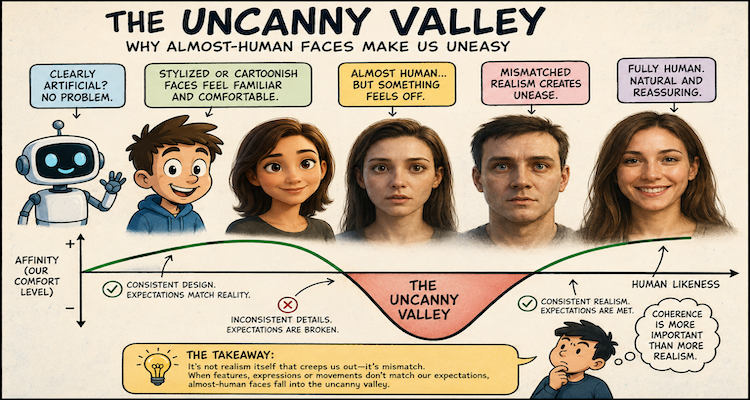
A face can be clearly artificial and still feel comfortable. A cartoon, a stylized game character or a simple robot rarely creates the same reaction as a nearly realistic digital human with lifeless eyes, slightly unnatural skin or expressions that seem almost but not quite right. That uncomfortable gap between human-like and convincingly human is the phenomenon known as the uncanny valley.
The idea has become increasingly relevant as AI-generated faces, digital avatars, humanoid robots and increasingly realistic virtual characters enter everyday life. Yet the popular explanation “the more human something looks, the creepier it becomes” is too simple. Research suggests that unease is not an automatic consequence of realism. In many cases, the stronger trigger appears to be inconsistency: features, movement, voices or expressions that do not match the level of realism our brains expect.
Key Takeaways
- The uncanny valley describes negative reactions to entities that appear almost, but not fully, human.
- Research does not support the idea that greater human likeness automatically produces greater eeriness.
- Mismatched realism—such as realistic skin paired with artificial-looking eyes has stronger empirical support as a trigger.
- Human faces are processed with high sensitivity, making small irregularities more noticeable in realistic digital characters.
- For designers of AI avatars, robots and virtual humans, consistency may matter more than simply adding realism.
From a Robotics Theory to a Modern Design Problem
The term uncanny valley was introduced by Japanese roboticist Masahiro Mori in a 1970 essay. Mori proposed that as robots become more human-like, people generally respond more positively until a point at which an almost-human appearance produces a sharp drop in affinity. A prosthetic hand or humanoid robot, in Mori’s examples, could fall into this psychological “valley” before a fully convincing human appearance restored comfort. The concept later reached a wider English-speaking audience through an authorized translation published by IEEE Spectrum.
Mori’s original idea was influential, but it was not a settled scientific law. That distinction matters.
A major review of empirical research found inconsistent evidence for the simplest version of the theorythe assumption that almost any sufficiently human-looking artificial entity will automatically become eerie. The review found stronger support for a more specific explanation: perceptual mismatch.
That changes how the uncanny valley should be understood.
The problem may not simply be that a face is too human. The problem may be that different parts of the face appear to belong to different levels of reality.
Why Faces Are Especially Vulnerable
Human beings are highly familiar with human faces. We do not merely notice eyes, mouths and skin as separate visual objects; we interpret them together with expectations about expression, movement, attention and identity.
This creates an unusually demanding test for digital characters.
A stylized animated face establishes relatively modest expectations. Its simplified eyes, exaggerated expressions and artificial movement fit together. But when a character has photorealistic skin, detailed facial proportions and human-like lighting, viewers may expect equally convincing eyes, expressions and behavior.
If those elements do not match, the result can feel wrong in a way that is difficult to explain verbally.
Research on computer-generated faces has found that atypical facial features can become more disturbing as other aspects of a face become more photorealistic. Studies have also identified mismatches between the eyes and the rest of the face as a particularly important source of eeriness.
This helps explain a familiar paradox in digital design: adding more realism can expose flaws that were previously invisible.
A simplified character can survive imperfect animation because viewers do not expect it to behave exactly like a person. A near-photorealistic character creates a much stricter standard.
The Mismatch Problem
Imagine two digital faces.
The first is deliberately stylized: smooth surfaces, simplified eyes and clearly animated expressions. It may not look human, but its visual language is internally consistent.
The second has highly realistic skin pores and facial proportions but eyes that appear unusually large, glassy or emotionally disconnected. It may be objectively closer to a real person, yet feel less comfortable.
Research examining different explanations for the uncanny valley has found meaningful support for this inconsistent realism hypothesis. A review of empirical studies concluded that perceptual mismatch such as artificial-looking features appearing alongside highly realistic ones was better supported than the broad claim that increasing human likeness alone inevitably produces an uncanny response.
That distinction has practical consequences.
For designers, the safest route may not always be to make every surface more detailed. Sometimes a coherent, intentionally stylized character can feel more natural than a nearly realistic one whose individual features operate at different levels of believability.
Is the Brain Confused About What It Is Seeing?
One long-standing explanation suggests that the uncanny valley emerges because people struggle to categorize an entity as either human or artificial.
There is some intuitive appeal to this idea. An industrial robot is clearly a machine. A real person is clearly human. A highly realistic artificial face may occupy an ambiguous middle ground.
However, the scientific evidence is not strong enough to treat categorization difficulty as a complete explanation.
The 2015 review found that evidence for the categorization hypothesis was too limited to draw firm conclusions. It also concluded that categorization ambiguity alone did not adequately account for the full range of uncanny responses reported in experiments.
Another interpretation is therefore gaining importance: the discomfort may arise less from asking, “Is this human?” and more from detecting that something familiar does not follow familiar patterns.
A face can be recognizable as human and still appear strangely unfamiliar.
Research involving manipulated images of people, animals and objects found that reducing realism consistency could make anthropomorphic characters appear unfamiliar and eerie, while the same effect did not operate in the same way for nonhuman objects.
In other words, the uncanny valley may be tied to the expectations created by familiar biological forms.
Why the Eyes Often Matter So Much
Eyes occupy a special position in how people read faces. We use them to infer attention, emotion and social intent. When a digital character looks almost real but its eyes seem vacant, fixed or disconnected from its facial expression, viewers may notice the inconsistency immediately.
The effect is not necessarily caused by one universal “dead eyes” mechanism. Different experiments use different stimuli and measures, and uncanny-valley research itself has faced methodological challenges.
Researchers have pointed out that studies can become circular if an investigator begins by selecting something because it already looks eerie and then treats its near-human appearance as evidence for the uncanny valley. Better research requires independent measurement of human likeness, eeriness and emotional response across a broader range of stimuli.
This scientific caution is important because the uncanny valley is often discussed as if it were a precisely mapped neurological phenomenon.
It is not.
The concept remains useful, but the conditions that produce uncanny reactions appear more complicated than Mori’s original curve alone suggests.
The AI Era Gives the Uncanny Valley a New Audience
When Mori proposed the idea, humanoid robots were largely a subject of robotics research and speculation. Today, near-human synthetic faces can appear in AI-generated images, virtual assistants, digital customer-service systems, games, film production and immersive environments.
That expansion changes the practical question.
The challenge is no longer limited to whether a robot should look like a person. Designers must decide how realistic an AI avatar should be, whether synthetic presenters should imitate human expressions, and how closely digital characters should reproduce real faces and behavior.
The evidence suggests that more realism is not automatically better.
A system that combines highly realistic visuals with unnatural expressions or behavior may create a stronger sense of discomfort than a clearly artificial interface. Conversely, a stylized avatar may avoid some of those expectations precisely because users immediately understand what they are looking at.
This is an important design lesson for the emerging world of digital humans: realism should be treated as a coordinated system, not a collection of visual upgrades.
A convincing face depends on relationships between multiple elements:
- facial proportions and skin texture;
- eyes and surrounding facial detail;
- expression and movement;
- appearance and voice;
- photorealism and behavioral realism.
When those signals disagree, the viewer may perceive the character as strangely artificial even if no single feature appears dramatically wrong. Research has reported evidence that mismatches in realism, including mismatches between facial and other human-like characteristics, can increase eeriness.
The Bigger Lesson: Human Realism Has a Narrow Margin for Error
The uncanny valley reveals something broader about technology and human perception.
Machines do not necessarily need to look human to be useful. In some situations, making them appear human creates additional expectations that the technology must then meet.
A chatbot with no face is not expected to blink, smile or maintain eye contact. A photorealistic avatar, however, invites constant comparison with real people. Every unnatural pause, expression or movement becomes part of that comparison.
This may be why the race toward increasingly realistic digital humans is also a race toward increasingly subtle design problems.
The goal is not simply to cross a technical threshold where a face contains enough detail. It is to create coherence between appearance, behavior and the expectations those choices generate.
That is a more demanding challenge and a more useful way to understand the uncanny valley.
Conclusion
The uncanny valley is often described as a mysterious instinctive fear of human-like machines. The research paints a more nuanced picture.
Almost-human faces do not automatically make people uneasy. The strongest explanation supported by a substantial body of research is that discomfort often emerges when realism becomes inconsistent: when a face looks human enough to trigger our expectations but contains features, movements or behaviors that violate them.
As AI-generated avatars, humanoid robots and virtual humans become more common, that insight matters beyond psychology. It is a design principle. The path to a more convincing artificial human may not always involve making it look more real. Sometimes, the better solution is to make every part of the experience agree about what it is.
This content is published for informational or entertainment purposes. Facts, opinions, or references may evolve over time, and readers are encouraged to verify details from reliable sources.