





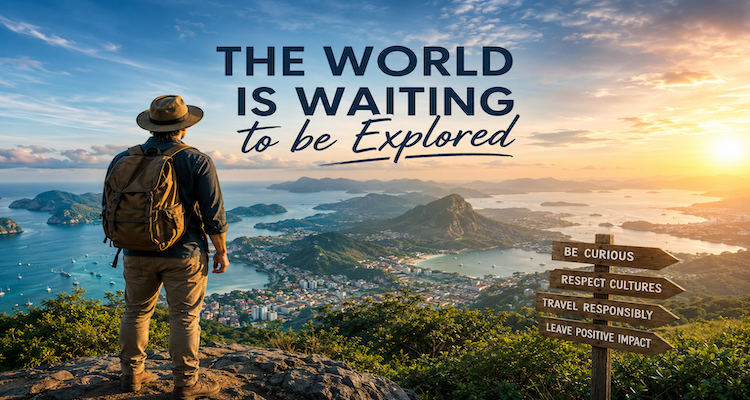
The World Is Waiting to Be Explored
A world map can make the planet seem familiar. Borders are labeled, cities are searchable, and almost any destination can be viewed through photographs, videos, satellite imagery, and travel guides. Yet seeing a place on a screen is not the same as understanding it.
Exploration begins when information gives way to experience: when a traveler notices how a city moves at dawn, how a landscape changes with the weather, how history survives in architecture, or how local communities understand a place differently from outsiders.
That distinction matters. Travel is often treated as a collection of destinations to complete, photograph, and share. But the deeper value of exploration may lie elsewhere. The world is not simply waiting to be seen. It is waiting to be understood and that requires curiosity, attention, and a sense of responsibility.
Key Takeaways
- Exploration can turn travel from a checklist of attractions into a deeper understanding of places and people.
- Digital access makes the world easier to discover, but information cannot fully replace direct experience.
- Responsible travel requires balancing visitor curiosity with respect for local communities, culture, and fragile environments.
- UNESCO recognizes that well-managed tourism can support heritage conservation and sustainable local development.
- The most meaningful journeys often involve slowing down, learning local context, and looking beyond famous landmarks.
Exploration Is More Than Going Somewhere New
The urge to explore is one of humanity’s oldest instincts. Long before modern tourism, people crossed oceans, deserts, mountains, and forests for trade, survival, knowledge, migration, faith, and curiosity.
Today, exploration has become easier in some ways. A traveler can compare routes, book accommodation, translate signs, navigate unfamiliar streets, and research a destination before leaving home. Technology has reduced many of the practical barriers that once made distant places difficult to reach.
But convenience has created a paradox.
The more easily people can access destinations, the easier it can become to experience them superficially. A journey can be planned around search rankings, viral photographs, and tightly scheduled itineraries. The traveler may arrive with hundreds of images already in mind and leave having seen only the version of the place that everyone else came to find.
Real exploration asks for something more.
It means allowing a destination to challenge expectations. It means learning why a neighborhood looks the way it does, why a local tradition matters, or how geography has shaped the lives of the people who live there. Sometimes it means visiting a famous landmark. Sometimes it means taking a slower route and discovering what exists beyond it.
A Connected World Has Not Made Exploration Obsolete
The internet has changed the meaning of distance. A person can watch a live stream from another continent, walk virtually through museums, or use satellite imagery to study landscapes that may never be visited.
That access is valuable. It can make knowledge more democratic and help people prepare for meaningful travel. It can also encourage curiosity about places that might otherwise remain outside public attention.
But digital familiarity can create the illusion that a place is already known.
A photograph captures a frame. A video follows an editorial decision. An algorithm decides what becomes visible. None of these necessarily show the full reality of a destination.
Travel adds context that is difficult to reproduce digitally. Streets have scale. Weather changes plans. Languages sound different in conversation than in translation software. A historic building reveals details that disappear in a compressed image.
This does not mean physical travel is the only form of exploration. Reading, research, cultural exchange, and virtual access can also expand understanding. But when people do travel, the opportunity is not merely to confirm what they already know. It is to discover what they did not know to look for.
The World Is Richer Than Its Most Famous Places
The global travel economy often concentrates attention on a relatively small number of iconic destinations. Famous monuments and celebrated landscapes deserve their reputation, but popularity can create pressure.
UNESCO’s World Heritage and Sustainable Tourism Programme emphasizes that tourism and heritage management must be considered together. Properly managed tourism can contribute to conservation and sustainable development, while poorly planned or excessive tourism can create social, cultural, economic, and environmental pressures.
This creates an important challenge for modern travelers: exploration should not become extraction.
A destination is not simply a backdrop for a photograph. It is also a place where people live, work, preserve traditions, raise families, and manage finite natural or cultural resources.
UNESCO’s guidance on sustainable tourism highlights practical areas such as engaging local communities and businesses, managing visitor behavior, developing appropriate infrastructure, and monitoring tourism outcomes.
For travelers, the principle can be translated into simple choices:
- Learn about local customs before arriving.
- Respect rules designed to protect cultural and natural sites.
- Support local businesses where practical.
- Avoid treating residential communities as tourist attractions.
- Consider visiting beyond the most crowded routes when appropriate.
- Leave places without adding unnecessary environmental or social pressure.
Responsible exploration does not require perfection. It requires recognizing that the freedom to travel carries consequences.
Travel Can Become a Form of Cultural Education
One of the most valuable aspects of exploration is the encounter with difference.
A new destination can reveal different approaches to food, family life, religion, work, architecture, transportation, and public space. These encounters can challenge assumptions that feel normal only because they are familiar.
That does not mean travel automatically creates understanding. A short visit can also reinforce stereotypes if a traveler interprets an entire culture through a limited experience.
Curiosity must therefore be paired with humility.
Instead of asking, “Why don’t people here do things the way I expect?” a better question may be, “What historical, social, geographic, or cultural context explains what I am seeing?”
This shift turns travel into something more than consumption. It becomes a process of learning.
UNESCO has increasingly emphasized the connection between tourism, culture, local communities, and sustainable development. In March 2026, UNESCO and UN Tourism announced a new agreement to strengthen cooperation around sustainable, inclusive, and resilient tourism, with planned initiatives involving programmes, pilot projects, and knowledge sharing.
The broader lesson is clear: tourism can create opportunities, but the quality of those opportunities depends heavily on how destinations are managed and how visitors behave.
The Best Exploration Often Begins Beyond the Itinerary
A detailed itinerary can be useful. It helps travelers manage limited time and avoid practical problems. But an itinerary should be a guide, not a barrier to discovery.
Some of the strongest travel memories come from experiences that cannot easily be ranked online: a conversation with a local shop owner, an unfamiliar regional dish, an overlooked museum, a walk through an ordinary neighborhood, or a change of plan caused by weather.
These moments matter because they introduce uncertainty and uncertainty is often where exploration begins.
The goal is not to abandon planning or deliberately get lost. It is to leave room for observation.
A traveler who moves too quickly may collect destinations without developing any real sense of place. Slowing down can reveal relationships that a packed schedule hides: how a city is organized, how people use public spaces, how tourism affects daily life, and how history remains present in ordinary surroundings.
Exploration is not measured by the number of countries visited. A person can travel across the world without looking closely, or spend several days in one place and develop a much deeper understanding of it.
Why Responsible Exploration Matters Now
The growing accessibility of travel creates both opportunity and responsibility.
More people can encounter cultures and landscapes beyond their immediate surroundings. At the same time, popular destinations must manage the consequences of large visitor flows, infrastructure pressure, environmental impacts, and changing local economies.
UNESCO’s sustainable tourism framework repeatedly stresses the importance of involving communities and protecting cultural and natural heritage while developing tourism in ways suited to local circumstances.
This is why the future of exploration should not be defined only by how far people can travel.
A better question is how well they travel.
Technology may continue to make planning easier. New transport networks may improve access. Digital tools may help travelers discover places beyond traditional guidebooks. But no technology can remove the need for judgment.
The traveler still decides whether to rush or observe, consume or learn, follow the crowd or understand the context.
Conclusion
The world is waiting to be explored, but exploration should mean more than arriving somewhere new.
The most meaningful journeys combine curiosity with attention and freedom with responsibility. They encourage travelers to look beyond the famous photograph, listen before forming conclusions, and recognize that every destination is more than a product designed for visitors.
The planet offers extraordinary landscapes, cities, histories, and cultures. Yet the deeper opportunity is not simply to see more of the world.
It is to understand more of it and to leave with a broader perspective than the one we arrived with.
This content is published for informational or entertainment purposes. Facts, opinions, or references may evolve over time, and readers are encouraged to verify details from reliable sources.