










Inside the Forces Shaping Modern Business: AI, Geopolitics, Skills and Resilience
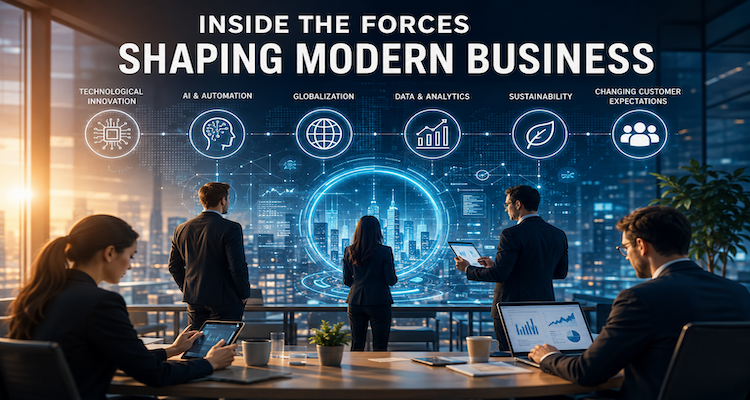
Business is being reshaped by several forces at once, and their significance lies less in any single trend than in how they interact. Artificial intelligence is changing how companies produce and make decisions. Geopolitical tensions are altering trade and supply chains. Skills shortages are becoming a constraint on transformation. Cybersecurity is moving closer to the center of corporate strategy, while energy and sustainability concerns are influencing investment and operating costs.
The result is a business environment in which efficiency alone is no longer enough. Companies increasingly need the ability to adapt when technology, markets, regulation, workforce expectations and global conditions change at the same time.
Key Takeaways
- AI is becoming a business transformation issue, not simply a technology investment.
- Geopolitical fragmentation is forcing companies to rethink supply chains, technology dependencies and risk.
- Skills gaps can prevent organizations from converting new technology into measurable business value.
- Cybersecurity is increasingly connected to geopolitical, operational and supply-chain resilience.
- Energy, sustainability and infrastructure are becoming strategic considerations for technology-intensive businesses.
- The strongest organizations may be those that combine efficiency with the ability to adapt quickly.
AI Is Moving From Experiment to Business Infrastructure
Artificial intelligence has become one of the most visible forces affecting modern business, but its real impact is broader than the introduction of chatbots or generative AI assistants.
Companies are increasingly exploring AI for customer service, software development, forecasting, document processing, marketing, research, fraud detection, knowledge management and operational decision-making. The important question is therefore shifting from whether a company should experiment with AI to where AI can reliably improve a business process.
The World Economic Forum’s Future of Jobs Report 2025 found that 86% of surveyed employers expected AI and information-processing technologies to transform their businesses by 2030. At the same time, the report identified skills gaps as the biggest perceived barrier to business transformation.
That distinction matters. Buying an AI tool does not automatically create a transformed organization.
A company may deploy sophisticated AI while retaining outdated approval processes, fragmented data, unclear accountability and incentives built around older ways of working. In such circumstances, technology can improve an individual task without fundamentally improving the organization.
The emerging competitive advantage may therefore come less from simply possessing AI and more from redesigning workflows around it.
Geopolitics Is Becoming a Business Variable
For decades, many companies treated geopolitical developments largely as external issues. Globalization encouraged businesses to optimize around cost, scale and access to international markets.
That assumption has become harder to maintain.
Trade tensions, sanctions, conflicts, technology restrictions and changing alliances can influence where companies manufacture products, source components, store data and locate critical infrastructure.
The World Trade Organization projected that global merchandise trade growth would slow in 2026 after unusually strong growth in 2025. Its analysis also highlighted how trade in AI-related products had contributed to the earlier expansion while geopolitical and energy risks created uncertainty around the outlook.
For businesses, the implication is straightforward: supply chains cannot be evaluated only on price.
A supplier that is inexpensive but exposed to a concentrated geopolitical risk may create a different kind of cost. Companies are increasingly considering multiple suppliers, regional production, inventory buffers, alternative logistics routes and greater visibility into lower tiers of their supply chains.
This does not mean globalization is disappearing. It means resilience is becoming part of the calculation alongside efficiency.
The Workforce Is Becoming a Strategic Constraint
Technology can change faster than organizations can retrain people.
That gap is becoming increasingly important. The World Economic Forum estimates that nearly 40% of workers’ core skills could change by 2030, while 63% of surveyed employers identified skills gaps as a major barrier to transformation.
The fastest-growing technical capabilities include AI and big data, networks and cybersecurity, and technological literacy. Yet the same research highlights the continuing importance of analytical thinking, creative thinking, resilience, flexibility, leadership and collaboration.
This combination challenges the idea that automation simply replaces human capability.
In many workplaces, the more important change may be that employees are expected to work alongside increasingly capable digital systems. Someone using AI effectively still needs to understand the business problem, evaluate the output, identify errors and make decisions when the system is uncertain.
That makes workforce development a strategic investment rather than merely a human-resources initiative.
Companies that introduce new technology without changing training, job design and management practices may struggle to capture its full value.
Efficiency Is No Longer the Only Measure of a Strong Business
For much of the digital economy, optimization has been a dominant business philosophy: automate processes, reduce costs, minimize inventories and make systems faster.
But highly optimized systems can also become fragile.
Recent research and business analysis increasingly point to a tension between efficiency and resilience. A supply chain with very little spare capacity may perform exceptionally well under normal conditions but become difficult to manage during a disruption.
The same principle applies to technology infrastructure. Dependence on a small number of cloud, software or AI providers can create concentration risk. If a critical provider experiences an outage or a geopolitical restriction affects access, the consequences can extend far beyond the original company.
This changes how executives need to think about resilience.
Resilience is not simply having a backup plan. It involves knowing which dependencies are critical, understanding how disruptions cascade through the organization and establishing who can make decisions when normal processes fail.
The ability to respond quickly can become a competitive capability in its own right.
Cybersecurity Has Become a Business Issue
Cybersecurity was once often treated as a specialized IT responsibility. That model is becoming increasingly difficult to sustain.
Modern businesses depend on interconnected software, cloud platforms, suppliers, payment systems, customer databases, APIs and third-party services. A weakness anywhere in that ecosystem can become an operational or financial problem.
The World Economic Forum’s Global Cybersecurity Outlook 2026 identified the intersection of AI, geopolitical fragmentation and supply-chain complexity as major forces reshaping cyber risk. Its survey found that 87% of respondents viewed AI-related vulnerabilities as the fastest-growing cyber risk during 2025.
The broader lesson is that cybersecurity cannot be separated cleanly from business resilience.
A cyber incident can interrupt production, damage customer trust, expose sensitive information, disrupt logistics or prevent employees from accessing essential systems.
AI adds another layer. The technology can strengthen defensive capabilities, but it can also increase the sophistication and speed of malicious activity. Businesses therefore face a dual challenge: adopting AI while understanding the new risks that accompany it.
Energy and Infrastructure Are Joining the Strategy Conversation
Digital business may appear intangible, but its infrastructure is physical.
Data centers, telecommunications networks, semiconductor manufacturing, cloud infrastructure and AI systems all depend on electricity, hardware, cooling systems and reliable connectivity.
The International Energy Agency reported that global electricity demand grew by around 3% in 2025, more than twice the growth rate of overall global energy demand. Growing digital infrastructure is one contributor to a wider increase in electricity requirements, alongside industrial activity, electrification and other forms of economic development.
For technology-intensive businesses, energy availability and cost can therefore become strategic considerations.
This is particularly relevant as AI workloads expand. The question is no longer simply how much computing capacity a company can obtain, but whether the supporting infrastructure can scale economically and reliably.
Energy resilience, infrastructure investment and environmental considerations are consequently becoming more closely connected to technology strategy.
Economic Uncertainty Changes the Way Companies Invest
Businesses also operate within a wider economic environment that affects demand, financing costs and investment decisions.
The World Bank’s January 2026 outlook projected global growth of 2.6% for 2026 and 2.7% for 2027, while warning that trade tensions and policy uncertainty remained important factors.
The IMF’s April 2026 outlook was more cautious, projecting global growth of 3.1% in 2026 and identifying geopolitical conflict, trade tensions and uncertainty around AI-driven productivity as downside risks.
The difference between forecasts is less important for an individual business than the underlying message: companies are making long-term decisions in an environment where assumptions can change quickly.
That favors flexible investment strategies.
Instead of asking only whether an investment produces the highest possible return under one forecast, companies may increasingly ask how well the investment performs across several plausible scenarios.
That is a different approach to strategy one based on adaptability rather than confidence in a single prediction.
The Real Competitive Advantage May Be Adaptability
Taken individually, AI, cybersecurity, geopolitics, workforce transformation, energy and economic uncertainty can look like separate management challenges.
They are not.
AI depends on skills, data, computing infrastructure and cybersecurity. Supply-chain resilience depends on geopolitics, technology and capital. Workforce transformation depends on training and organizational design. Cybersecurity depends increasingly on third-party suppliers and geopolitical conditions. Energy availability can affect the economics of digital infrastructure.
These connections explain why modern business strategy is becoming more integrated.
A company cannot necessarily solve each issue in isolation. It needs systems that allow information to move across functions and decision-makers to respond when conditions change.
This is where organizational design becomes important.
The businesses most capable of adapting may not always be the largest or the ones with the most advanced technology. They may be the organizations that can identify changes early, make decisions quickly, allocate resources intelligently and learn from disruption.
What Businesses Should Watch Next
Several questions will become increasingly important for executives and business owners:
- Can AI investments produce measurable improvements in real workflows rather than isolated demonstrations?
- Which critical suppliers, platforms and technologies create concentration risk?
- Does the workforce have the skills required to use new technology responsibly?
- Can cybersecurity teams understand risks created by AI and third-party dependencies?
- How exposed is the business to energy, logistics and geopolitical disruptions?
- Can leadership change direction quickly when assumptions no longer hold?
These are practical questions rather than predictions. Their importance comes from the fact that several major forces are moving simultaneously.
The businesses that treat them as connected strategic issues will have a clearer view of both opportunity and risk.
Conclusion
Modern business is being shaped by a transition from optimization toward adaptability.
Technology remains central, but technology alone does not determine competitive strength. AI can improve productivity, but only when organizations have the data, skills, processes and governance to use it effectively. Global supply chains can deliver efficiency, but resilience becomes essential when geopolitical conditions change. Digital infrastructure can create new opportunities, but it also increases dependence on energy, networks and cybersecurity.
The deeper shift is therefore organizational.
Companies are being asked to become more technologically capable while also becoming more resilient, more skilled and more responsive to external change. In that environment, the strongest strategy may not be predicting exactly what happens next. It may be building an organization capable of responding well when the next unexpected change arrives.
The information presented in this article is based on publicly available sources, reports, and factual material available at the time of publication. While efforts are made to ensure accuracy, details may change as new information emerges. The content is provided for general informational purposes only, and readers are advised to verify facts independently where necessary.