










The Ideas Driving Business Forward
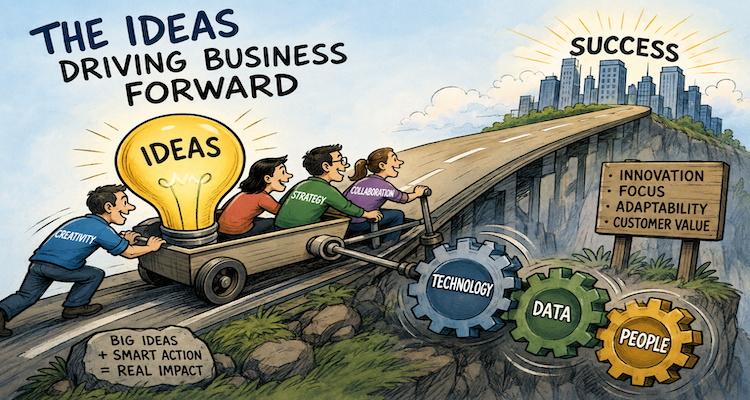
Business progress is increasingly being shaped by ideas that change how companies work, not simply by the technologies they buy. Artificial intelligence, digital access, workforce skills, cybersecurity, sustainability and faster experimentation are becoming interconnected parts of the same strategic question: how can a business become more productive, adaptable and useful without losing sight of people?
That question matters because adoption alone is proving insufficient. McKinsey’s 2025 global AI survey found that 88% of respondents said their organizations regularly use AI in at least one business function, yet only about one-third said their organizations had begun scaling AI across the enterprise. The gap suggests that the next stage of business innovation will depend less on having access to new tools and more on redesigning processes around them.
Key Takeaways
- The strongest business ideas increasingly combine technology with redesigned processes, rather than treating technology as an isolated investment.
- AI is moving from experimentation toward practical workflow integration, but many companies are still struggling to scale it effectively.
- Digital access can help smaller businesses reach customers, improve operations and compete beyond traditional geographic boundaries.
- Skills and continuous learning are becoming strategic assets as technology changes the tasks people perform.
- Cybersecurity, resilience and responsible technology use are becoming part of competitiveness rather than separate technical concerns.
- Businesses that test ideas quickly and measure real outcomes can adapt faster than those that rely on technology hype alone.
From Buying Technology to Redesigning Work
One of the most important shifts in business thinking is the move away from technology as a standalone purchase.
A company can introduce an AI assistant, cloud platform or automation tool without fundamentally changing how work gets done. The result may be faster individual tasks but little meaningful improvement across the business.
Research increasingly points toward workflow redesign as the more important challenge. McKinsey’s 2025 research found that organizations achieving greater value from generative AI were more likely to redesign workflows, establish governance and connect AI initiatives to measurable business objectives.
This changes the question leaders should ask.
Instead of asking, “Where can we use AI?” a more useful question is, “Which part of this process should work differently?”
That distinction matters. Automating an inefficient process can simply make an inefficient process faster. Redesigning it can eliminate unnecessary steps, reduce handoffs and give employees more time for work that requires judgment.
The idea driving business forward, therefore, is not automation for its own sake. It is better work through intelligent redesign.
AI Is Becoming a Business Capability
AI remains one of the strongest forces influencing corporate strategy, but the business conversation is becoming more practical.
The OECD reported in 2026 that 20.2% of firms across OECD countries with available data reported using AI in 2025, up from 14.2% in 2024 and 8.7% in 2023. Adoption was much higher among large companies than small ones, showing that access to technology does not automatically translate into equal adoption.
The OECD’s 2026 survey of more than 2,000 SMEs also found that businesses are increasingly using off-the-shelf AI tools, while more targeted applications and AI agents are emerging. At the same time, time constraints, maintenance costs, skills gaps and cybersecurity remain barriers to effective implementation.
That creates an important opportunity for businesses that approach AI pragmatically.
A small company does not necessarily need to build its own model. It may gain more value by applying existing tools to customer support, document processing, marketing analysis, internal knowledge management, software development or repetitive administrative work.
The strategic advantage may come from how intelligently a company integrates available technology, rather than from owning the most sophisticated technology.
The Rise of the Adaptable Business
Another idea gaining importance is adaptability.
Businesses increasingly operate in environments affected by changing technology, economic uncertainty, shifting customer expectations, demographic changes and geopolitical pressures. The World Economic Forum’s Future of Jobs Report 2025 identifies technological change, the green transition, demographic shifts, geoeconomic fragmentation and economic uncertainty as major forces expected to reshape businesses and employment through 2030.
Adaptability is therefore becoming more than an attractive management principle. It is an operating capability.
An adaptable company can change a product when customer behavior changes, move resources toward a promising opportunity, retrain employees when tasks evolve and abandon an experiment that fails to produce results.
This also explains why experimentation matters.
Instead of spending months developing a large initiative based on assumptions, companies can increasingly test smaller versions, measure the response and decide whether to expand, modify or stop.
The idea is simple: make learning part of the business model.
People Are Still a Competitive Advantage
The growth of AI has not made human capability irrelevant. In many businesses, it is making the quality of human judgment more important.
The World Economic Forum expects technological change to be a major driver of workforce transformation and reports that employers see skills gaps as a significant barrier to business transformation. Its 2025 report also highlights growing demand for reskilling, upskilling and skills such as analytical thinking, creativity and adaptability.
The International Labour Organization’s 2025 research similarly concludes that generative AI is more likely to transform many jobs than simply eliminate them, because most occupations contain tasks that still require human involvement.
That creates a different way of thinking about employees.
Instead of viewing technology investment and workforce development as competing expenditures, businesses can treat them as complementary. The technology handles appropriate tasks; employees develop the skills needed to supervise systems, interpret results, make decisions and solve problems that cannot be reduced to routine instructions.
The companies that benefit most may therefore be those that invest simultaneously in machines and human capability.
Digital Access Is Expanding the Competitive Battlefield
Another idea changing business is the disappearance of some traditional geographic limitations.
Digital platforms allow smaller businesses to reach customers, suppliers, specialists and markets that were previously difficult to access. The World Economic Forum identifies broadening digital access as one of the most transformative forces affecting businesses and expects it to reshape a large share of employers by 2030.
For smaller businesses, this can be especially significant.
A local company can sell beyond its immediate market. A specialist can provide services remotely. A small team can use cloud software and AI tools that once required much larger organizations and budgets.
But digital access also increases competition. When customers can compare businesses more easily, the advantage shifts toward companies that can demonstrate trust, quality, responsiveness and a clear reason to choose them.
Technology can expand the market. It does not automatically create differentiation.
Resilience Is Becoming Part of Innovation
For years, business innovation was often associated with growth, efficiency and new products. Increasingly, resilience belongs in the same conversation.
Cybersecurity is one example. As companies become more dependent on connected systems, data and digital platforms, protecting those systems becomes part of operational continuity.
The OECD’s 2026 SME survey identifies cybersecurity as an important digitalisation challenge and reports that many surveyed SMEs had experienced cyberattacks.
The broader lesson is that innovation without resilience can create new vulnerabilities.
A business that digitizes its operations but cannot recover from a system failure, data breach or technology dependency may become more efficient while simultaneously becoming more fragile.
Forward-looking companies therefore need to ask two questions together:
How can technology help us grow?
How can we remain operational when something goes wrong?
That combination is increasingly important in business strategy.
Sustainability Is Moving Into Business Strategy
Sustainability is also becoming less of a separate corporate initiative and more closely connected to competitiveness.
The World Economic Forum identifies the green transition as one of the major forces expected to influence businesses and employment through 2030. Energy technologies, environmental skills and changing resource requirements are creating new demands across industries.
For businesses, this can mean more than reducing environmental impact. It can involve improving energy efficiency, reducing waste, redesigning supply chains, developing products with longer useful lives or finding more efficient ways to use resources.
The important idea is integration.
When sustainability becomes part of product design, procurement, operations and investment decisions, it can influence both environmental performance and long-term business resilience.
The New Advantage May Be the Ability to Learn Faster
Taken together, these developments point toward a broader change in business thinking.
The competitive advantage of the future may not belong exclusively to the company with the largest technology budget, the most employees or the biggest physical footprint. It may increasingly belong to companies that can identify useful ideas, test them, learn from evidence and adapt their operations quickly.
AI is part of that transformation, but it is not the whole story.
Digital access expands opportunities. Skills determine whether people can use those opportunities. Cybersecurity protects the systems that support them. Sustainability influences long-term resilience. Experimentation helps companies distinguish promising ideas from expensive distractions.
These forces reinforce one another.
A business that introduces AI but refuses to redesign its workflows may capture limited value. A business that redesigns workflows without developing employee skills may struggle with adoption. A company that grows digitally without investing in cybersecurity may increase its exposure to disruption.
The most valuable ideas are therefore increasingly interconnected.
Conclusion
The ideas driving business forward are becoming less about finding the next fashionable technology and more about building organizations capable of using change well.
AI will continue to develop. Digital markets will expand. Skills will evolve. Sustainability pressures will grow. New risks will appear alongside new opportunities.
The businesses best positioned to respond will not necessarily be those that predict every change correctly. They will be those with the organizational discipline to experiment, measure, learn and adjust.
That may be the most important business idea of all: progress is increasingly a capability, not a single breakthrough.
The information presented in this article is based on publicly available sources, reports, and factual material available at the time of publication. While efforts are made to ensure accuracy, details may change as new information emerges. The content is provided for general informational purposes only, and readers are advised to verify facts independently where necessary.