









Kingdoms Beyond Human Reach: How Robots Are Extending Civilization Into Space
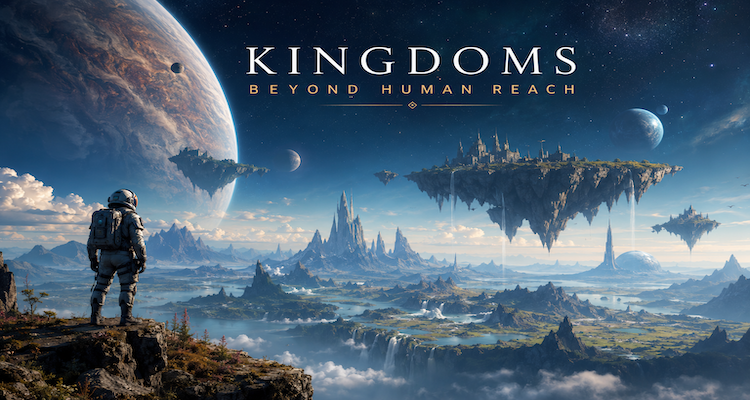
Humanity has always measured its ambition by the distance it can travel. But space is forcing a different question: What if the places we cannot physically reach can still become accessible to our intelligence, machines and instruments?
In 2026, that idea is becoming less speculative. NASA’s Artemis II mission carried humans farther from Earth than any mission since Apollo 13, while NASA and ESA continue developing systems in which robots scout, operate and prepare environments before humans arrive. At the same time, astronomers are identifying thousands of worlds around other stars that may remain physically inaccessible to human explorers for generations.
That creates a fascinating shift in the meaning of exploration. The next “kingdoms” beyond Earth may not initially belong to humans at all. They may be mapped by telescopes, investigated by robotic spacecraft, modeled by computers and gradually understood through autonomous systems.
Key Takeaways
- Humanity’s physical reach is still limited, but robotic and remote exploration can extend scientific reach dramatically.
- The Moon and Mars are becoming testing grounds for technologies that could support longer-term human exploration.
- Autonomous robots will become increasingly important where communication delays make continuous human control impractical.
- Thousands of confirmed exoplanets demonstrate how much of the universe can be studied without physically visiting it.
- The biggest frontier may be turning distant environments from unknown locations into places humans can meaningfully understand.
- Space exploration is therefore becoming less about reaching everything personally and more about extending human capability through machines.
The Boundary of Human Reach Is Moving
For most of history, exploration meant sending people into unknown territory. Ships, caravans, aircraft and spacecraft carried humans physically across increasingly difficult environments.
Space changes the economics and physics of that model.
A human expedition requires life support, radiation protection, food, water, shelter, communications, emergency systems and a reliable method of returning—or surviving without returning. A robot can operate without most of those requirements.
That does not make robotic exploration a replacement for humans. It makes robots a way of expanding the territory humans can investigate before human presence becomes practical.
The European Space Agency explicitly describes future exploration as a partnership between astronauts and robots. Its strategy focuses on Earth orbit, the Moon and Mars, with robots scouting ahead, preparing landing sites and operating in locations that are dangerous or impractical for people.
This is more than an engineering convenience. It represents a different model of exploration.
The Moon Is Becoming a Workshop, Not Just a Destination
The Moon is close enough to Earth to remain the most practical place to test technologies required for deeper exploration.
NASA’s Artemis program is designed around increasingly complex lunar missions and a longer-term objective of human exploration of Mars. Artemis II, launched in April 2026, became the first crewed Artemis flight and carried four astronauts around the Moon. During the mission, the crew reached 248,655 miles from Earth, exceeding the previous human distance record established by Apollo 13.
But the significance of lunar exploration extends beyond setting distance records.
A sustained presence beyond Earth requires technologies that can operate reliably for long periods. Habitats must manage air and water. Vehicles must navigate unfamiliar terrain. Power systems must survive extreme conditions. Robots must transport equipment and perform repetitive or dangerous tasks.
The Moon therefore functions as something closer to a laboratory for extraterrestrial civilization.
ESA’s exploration strategy similarly treats lunar activity as preparation for future missions farther into the Solar System, including Mars. Its Terrae Novae programme includes lunar landers, resource prospecting and infrastructure intended to support sustained exploration.
Mars Will Test a Different Kind of Intelligence
Mars introduces a problem that becomes increasingly important as spacecraft travel farther from Earth: communication delay.
A signal can take minutes to travel between Earth and Mars. ESA notes that radio signals can take up to about 12 minutes to reach Mars, meaning a command-and-response cycle can take roughly 24 minutes. That makes continuous joystick-style control unsuitable for many situations.
The solution is greater autonomy.
A rover operating on Mars cannot always wait for instructions before avoiding an obstacle, selecting a safe route or responding to an unexpected environmental condition. Systems therefore need onboard navigation, planning and decision-making capabilities.
ESA’s planetary robotics research specifically focuses on locomotion, navigation, localisation and onboard autonomy for robotic exploration.
This has an important implication for the future of artificial intelligence.
The most consequential AI used in space may not resemble a conversational assistant. It may instead be embedded inside machines that have to make narrowly defined decisions under extreme constraints: where to drive, what to inspect, which measurement to prioritize, whether terrain is safe and when to request human intervention.
In that environment, reliability matters more than fluency.
The First Residents of Some Worlds May Be Machines
There is a temptation to imagine space exploration as a sequence of human settlements: Moon, Mars, asteroids and eventually other star systems.
The actual sequence may look very different.
Robotic systems could arrive first, survey an environment, identify useful resources, establish communications infrastructure and prepare equipment. Humans could follow only after enough information exists to justify the enormous risks and costs.
ESA’s METERON programme has explored technologies for astronauts to operate robots remotely from orbit around the Moon or Mars. The concept is particularly important because humans in orbit could control machines on the surface while avoiding some of the risks associated with landing immediately.
That suggests an emerging hierarchy of exploration:
Telescopes discover.
Robots investigate.
Autonomous systems prepare.
Humans arrive when the environment becomes sufficiently understood.
It is a much more cautious model than the traditional image of exploration, but it may be the one that actually works.
Then There Are Worlds Humans May Never Visit
The most profound boundary lies beyond our Solar System.
NASA now lists more than 6,200 confirmed exoplanets planets orbiting stars other than the Sun with thousands of additional candidates awaiting confirmation.
These discoveries fundamentally change what “exploration” means.
A planet does not need to be physically visited to become scientifically significant. Astronomers can infer information about distant worlds by studying the light from their stars and the subtle changes produced when planets pass in front of them.
NASA’s TESS mission alone had identified 885 confirmed exoplanets and more than 7,900 candidates as of May 2026. NASA’s Nancy Grace Roman Space Telescope is expected to expand this census dramatically, with scientists anticipating roughly 100,000 new worlds from its observations, although these will include populations detected through different observational methods rather than representing 100,000 confirmed Earth-like planets.
The distinction matters.
Finding a distant planet is not the same as proving that it is habitable. Detecting an atmosphere is not the same as detecting life. And identifying a potentially Earth-like world does not mean humans could travel there.
But scientific knowledge can cross distances that human bodies cannot.
That may be one of the greatest capabilities civilization has developed.
Voyager Shows How Far Our Machines Can Go
Humanity has already sent a machine into interstellar space.
NASA’s Voyager 1 became the first human-made object to enter interstellar space, demonstrating that a spacecraft built on Earth could continue operating far beyond the planets that shaped its original mission.
Voyager is not a precursor to an interstellar colony. It is something more fundamental: evidence that human-made instruments can operate in environments humans cannot presently reach.
That distinction becomes increasingly important when thinking about the future.
The first machine sent to another star system, if humanity eventually achieves such a mission, may not carry settlers. It may carry instruments.
Its purpose could be to answer questions that currently cannot be answered from Earth: What does another planetary system actually look like up close? What are its small bodies made of? How do its planets interact with their star? Are there environments that resemble anything familiar?
Even then, interstellar travel remains an enormous technological challenge. Current spacecraft are nowhere near the capability required for practical human travel between stars.
That is precisely why the robotic path matters.
The Real Frontier May Be Autonomy
The most important technology in distant exploration may therefore not be a bigger rocket.
It may be the ability to operate intelligently without constant human supervision.
Every additional distance introduces communication delay. Every additional environment introduces uncertainty. Every additional mission creates situations engineers could not fully predict from Earth.
Autonomy can reduce that dependence.
But autonomy also introduces a difficult problem: how much authority should a machine have when humans cannot immediately intervene?
A lunar rover deciding which rock to photograph is one thing. A robotic system controlling power, life-support infrastructure or resource extraction at a remote settlement is another.
The farther civilization extends from Earth, the more important questions of reliability, cybersecurity, fail-safe design, accountability and human oversight become.
The technical frontier therefore has a social dimension.
The machines that extend humanity’s reach will also have to operate within rules established by humanity.
Beyond Exploration Lies Infrastructure
The most consequential transformation may occur when exploration stops being a series of isolated missions and becomes infrastructure.
A telescope observes repeatedly. A communications network connects multiple spacecraft. A lunar base can support new missions. Robotic equipment can be reused. Resource-processing systems can reduce the amount of material that must be launched from Earth.
This is why the idea of a permanent presence matters more than a single dramatic landing.
NASA describes Artemis as part of a longer-term effort to establish a foundation for future Mars missions, while ESA’s exploration plans emphasize a stepwise expansion from Earth orbit to the Moon and eventually Mars.
The progression is significant:
Reach → survive → operate → build → expand.
Humanity has only begun the first stages.
The Kingdoms May Be Real Before We Can Enter Them
The phrase “kingdoms beyond human reach” sounds like science fiction, but the underlying idea is already visible.
There are places humans cannot safely visit today but can observe.
There are environments humans cannot continuously operate in but robots can investigate.
There are worlds that may be reachable by spacecraft long before they are reachable by people.
And there are planets around other stars that humanity may never physically visit at all, yet increasingly sophisticated instruments can still reveal something about them.
This changes the meaning of the frontier.
A frontier is no longer necessarily a line that humans cross with their bodies. It can be a boundary crossed by sensors, machines, communications and accumulated knowledge.
That may be the more realistic path toward becoming a spacefaring civilization.
Conclusion
Humanity’s next great expansion will probably not begin with people standing on every world they discover.
It will begin with machines going where people cannot.
Robots will scout hostile terrain. Autonomous systems will make decisions when Earth is too far away for immediate instructions. Telescopes will reveal distant planetary systems. Spacecraft will carry instruments across environments no human could survive.
The ultimate achievement may not be to claim every distant world as a destination.
It may be to transform the unknown into the understood.
The kingdoms beyond human reach may remain physically distant for centuries. But with every successful observation, robotic mission and autonomous decision, the boundary of what humanity can know moves a little farther outward.
And sometimes, expanding civilization begins not by sending people somewhere but by sending our ability to understand there first.
This content is published for informational or entertainment purposes. Facts, opinions, or references may evolve over time, and readers are encouraged to verify details from reliable sources.