







Hidden Lives of the Natural World: How New Technology Is Revealing Wildlife We Rarely See
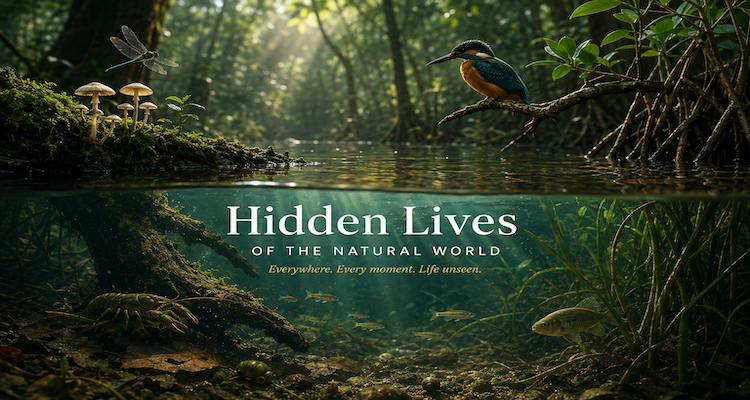
For much of human history, our picture of the natural world has been shaped by what we could see. Animals that moved in daylight, lived near people, left obvious tracks or occupied accessible habitats were easier to study. Creatures that emerged after dark, moved through dense forest canopies, lived underground or left only traces of their presence remained largely outside the scientific record.
That distinction matters more than it first appears. A species can be present in an ecosystem without being easy to observe, and a lack of sightings does not necessarily mean a lack of ecological importance. Today, thermal imaging, camera traps, environmental DNA, acoustic monitoring, drones and artificial intelligence are beginning to close some of those observation gaps. The result is not simply better wildlife photography. Researchers are gaining access to behavior, movement patterns and ecological relationships that were previously difficult or sometimes impossible to document in the wild.
Key Takeaways
- Much of wildlife activity happens outside the hours and places humans traditionally observe.
- Thermal cameras can reveal nocturnal animals moving through dense forest canopies with minimal disturbance.
- Environmental DNA can detect species from genetic traces left in water, soil and other environments.
- AI can turn enormous collections of wildlife images and video into usable behavioral and ecological data.
- Better observation can change conservation priorities by revealing where elusive species live and how they use habitats.
- Technology improves visibility, but scientists still need field expertise and careful interpretation.
The Natural World Is Larger Than What We Can See
Wildlife observation has always involved a sampling problem. Researchers cannot watch every animal, every night, across every habitat. Traditional surveys often depend on physical access, visibility, animal behavior and the ability of researchers to detect a species.
Some animals actively avoid detection. Others are nocturnal, extremely mobile, camouflage themselves against their surroundings or occupy environments that are difficult for humans to enter.
The Natural History Museum, for example, describes species such as Canada lynx, okapi, pangolins and Mexican burrowing toads as difficult to encounter because of their behavior, habitat or timing. Some animals spend most of their lives underground or become active only under particular environmental conditions.
The problem becomes particularly significant when scientists are trying to understand populations rather than simply confirm that an animal exists.
Knowing that a species is present is one question. Knowing how many there are, where they move, what they eat, which habitats they depend on and how their behavior changes is a much harder one.
That is where newer observation technologies are becoming important.
The Night Is an Entire Ecosystem of Its Own
Darkness does not switch nature off. It changes which animals are active, how predators hunt and how species interact.
Research on nighttime ecology has argued that nocturnal activity represents a major component of biodiversity, while also noting that many questions about the differences between daytime and nighttime ecosystems remain unresolved. Improved technologies are making it increasingly practical to study those environments.
One striking example comes from rainforest canopies.
In 2026, researchers working in Panama and Peru used thermal binoculars from canopy platforms to observe small nocturnal mammals at close range. The technique allowed researchers to follow animals moving through branches in darkness without relying on bright lights that could interfere with natural behavior.
The observations have already challenged assumptions.
Andean porcupines were observed moving together in ways that suggested greater social interaction than previously recognized. Researchers also recorded Panamanian night monkeys capturing insects, adding detail to understanding of a species whose diet had previously been understood largely through less direct observations.
This illustrates an important difference between finding wildlife and watching wildlife.
A camera trap may tell researchers that an animal passed through an area. A longer thermal observation can potentially reveal what happened before and after that moment: how an animal moved, interacted, searched for food or responded to another animal.
That behavioral information can be crucial for understanding what a habitat actually provides.
Technology Is Turning Invisible Traces Into Evidence
Not every hidden animal needs to be seen.
Environmental DNA, or eDNA, takes a different approach. Organisms leave genetic material in their surroundings through cells, tissues, fluids and excrement. Scientists can collect traces from environments including water, soil and aerosols and analyze them for evidence of species presence.
This is particularly valuable for rare or difficult-to-detect species.
Instead of waiting for an animal to appear in front of a researcher or camera, scientists can sometimes investigate the environment for biological evidence that the species has been there.
The International Union for Conservation of Nature describes eDNA as a potentially sensitive, rapid and cost-effective complement to conventional biodiversity monitoring. It can also help investigate wildlife communities and changes associated with habitat alteration, invasive species and other pressures.
But eDNA is not a magic detector.
DNA can degrade and can be transported through an environment. False-positive and false-negative detections are possible, meaning that sampling design, laboratory controls and interpretation remain important. The IUCN notes that broad-scale standards and best practices are still developing.
That limitation points to a broader lesson: new technology expands what scientists can detect, but it does not remove the need for scientific judgment.
AI Is Changing What Researchers Can Do With Wildlife Data
The next bottleneck is often not collecting information. It is processing it.
A modern camera trap can generate thousands of images. Acoustic sensors can continuously record sound. Drones and satellites can collect information across large landscapes. Human researchers cannot manually inspect every frame or identify every pattern at the same scale.
Machine learning can help sort, classify and analyze these datasets.
A 2026 Nature essay highlighted how advances in machine learning and related technologies are being used to investigate wildlife movement, landmarks and social behavior. The broader shift is from simply recording an animal’s presence toward extracting patterns from large amounts of ecological data.
Recent research also demonstrates how AI is being integrated directly with wildlife expertise. A 2026 Scientific Reports study examined a human-in-the-loop approach for classifying wildlife tracks, combining AI with expert tracker evaluation and explainable-AI techniques.
That human-machine combination is important.
Wildlife researchers understand context that a model may not. An algorithm can identify visual patterns extremely quickly, but unusual lighting, vegetation, partial visibility or an unfamiliar species can create difficult classification problems.
The strongest applications therefore are not necessarily about replacing field researchers. They are about allowing researchers to examine more evidence and focus their expertise where it matters most.
Camera Traps Are Becoming More Than Passive Cameras
Camera traps have been used for decades, but their role is evolving as sensors, connectivity and computer vision improve.
A 2026 Nature India research highlight described HBID24K, a dataset containing more than 24,000 annotated camera-trap images collected over 13 years from houbara bustard breeding sites in Morocco, Kazakhstan and Uzbekistan. The dataset was designed to help train algorithms to distinguish the birds from potential threats and other animals.
This represents a subtle but important transition.
The camera is no longer merely a device that produces photographs for researchers to inspect later. It can become part of an information system in which images are collected, classified and potentially used to support conservation decisions.
The same principle is being extended to individual animal identification, movement tracking and behavioral analysis. Research published in 2026 has explored AI-powered wildlife re-identification and automated analysis of animal video, demonstrating how computer vision is moving deeper into ecological research.
The practical consequence is scale.
If researchers can reliably identify animals and patterns automatically, monitoring programs can potentially cover more locations and process more observations than traditional manual approaches allow.
What We Discover Can Change Conservation
There is a direct connection between visibility and conservation.
Species that are difficult to observe can also be difficult to monitor. If researchers cannot establish population trends or understand habitat use, conservation decisions become harder.
Recent research in Assam offers another dimension to this problem. A 2026 study by researchers associated with the National Institute of Advanced Studies examined how local ecological knowledge can help identify and understand cryptic wildlife, using pangolins as a case study. The research found that knowledge held by forest-dependent communities can contribute to detecting elusive species, while also revealing the complicated human values and economic pressures surrounding wildlife use.
This matters because technology is only one part of the observation system.
A thermal camera may reveal an animal. DNA may establish its presence. AI may process thousands of images. But local knowledge can provide information about where animals are encountered, seasonal patterns and environmental changes that instruments alone may miss.
The most effective future monitoring systems are therefore likely to combine multiple forms of evidence rather than depend on one technological solution.
Better Detection Does Not Automatically Mean Better Conservation
There is a temptation to assume that once hidden wildlife becomes visible, the conservation problem becomes easier.
Reality is more complicated.
The IUCN notes that eDNA methods still face uncertainties and require careful validation. AI systems can also have transparency and reliability challenges, particularly when researchers need to understand why a model made a particular classification.
There is also a difference between observing an animal and understanding its ecological importance.
A species may appear occasionally in camera-trap footage while depending on a very specific habitat feature that the camera does not capture. A DNA trace can confirm presence without necessarily explaining population size or behavior. A satellite image may reveal movement across a landscape without showing the biological reasons behind that movement.
Technology produces evidence. Interpretation turns evidence into ecological understanding.
That distinction will remain important as monitoring becomes increasingly automated.
The Most Important Discovery May Be What We Were Missing
The deeper significance of these technologies is not that they give humans better ways to look at animals.
They challenge the assumption that what is difficult to see is necessarily uncommon, unimportant or absent.
A rainforest canopy at night can contain animals that researchers rarely encounter from the ground. A river can contain genetic evidence of species that are seldom seen. A landscape can contain years of camera-trap observations that become useful only after machine-learning systems help organize them.
That changes the scientific question.
Instead of asking only, “What animals are here?”, researchers can increasingly ask: Where do they move? What do they depend on? Which parts of the habitat matter most? What changes when the environment changes? Which behaviors have remained hidden because humans were simply looking at the wrong time, from the wrong place or with the wrong tools?
The answers can influence where conservation resources are directed and which habitats receive attention.
Conclusion
The natural world has never been fully visible to us. Much of it operates at night, beneath vegetation, underwater, underground or at distances beyond ordinary human observation.
What is changing is our ability to detect and interpret those hidden lives.
Thermal imaging can reveal movement in darkness. Environmental DNA can uncover biological traces without direct sightings. Camera traps can record wildlife over long periods, while AI can help researchers process the resulting mountain of information. Local ecological knowledge adds another layer that technology cannot replace.
The most valuable outcome is not simply a larger collection of wildlife images. It is a more complete understanding of how living systems work.
For conservation, that distinction is critical. We cannot protect what we do not understand, and we cannot understand the natural world by observing only the parts that happen to be visible.
The hidden world is not a separate world. It is the larger part of the one we already inhabit.
This content is published for informational or entertainment purposes. Facts, opinions, or references may evolve over time, and readers are encouraged to verify details from reliable sources.