








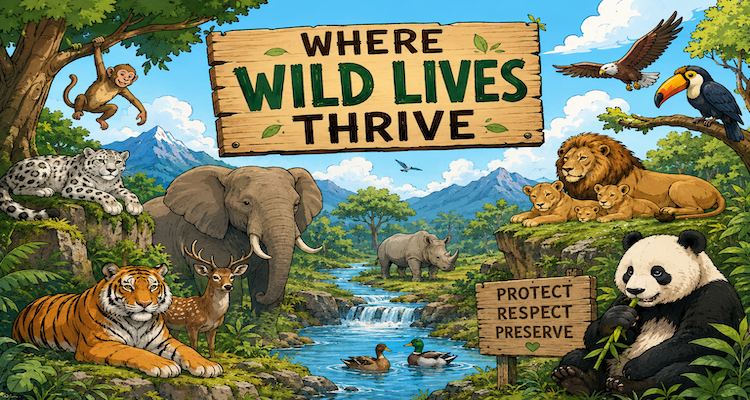
Where Wild Lives Thrive
Wildlife conservation is often described through dramatic images: a tiger returning to a forest, an elephant moving through a protected landscape, or a wetland filling again with birds. But the deeper story is less cinematic and more important. Wild animals thrive when the landscapes around them remain functional enough to provide food, water, shelter, breeding space and room to move.
That is changing how conservation is understood. Protecting individual species still matters, but increasingly the focus is on restoring ecosystems, reconnecting fragmented habitats and allowing natural processes to recover. The international Kunming-Montreal Global Biodiversity Framework adopted in 2022 reflects that broader approach, calling for at least 30% of degraded ecosystems to be under effective restoration and at least 30% of terrestrial, inland-water, coastal and marine areas to be effectively conserved by 2030.
The important question, therefore, is not simply where wildlife is protected. It is whether wild lives have enough functioning habitat to thrive.
Key Takeaways
- Wildlife recovery depends on functioning habitats, not simply protected boundaries.
- Restoring degraded ecosystems can allow nature to recover through both intervention and natural processes.
- Connected landscapes give wildlife greater opportunities to move, feed, reproduce and maintain viable populations.
- India’s tiger reintroduction programmes show how habitat, prey, monitoring and management can work together.
- The global conservation agenda is increasingly shifting from protecting isolated places to restoring ecological connectivity.
- Successful conservation must also consider the rights and livelihoods of people living alongside wildlife.
Protection Is Only the Beginning
A protected area can provide an essential refuge for wildlife, but a boundary on a map does not automatically create a healthy ecosystem.
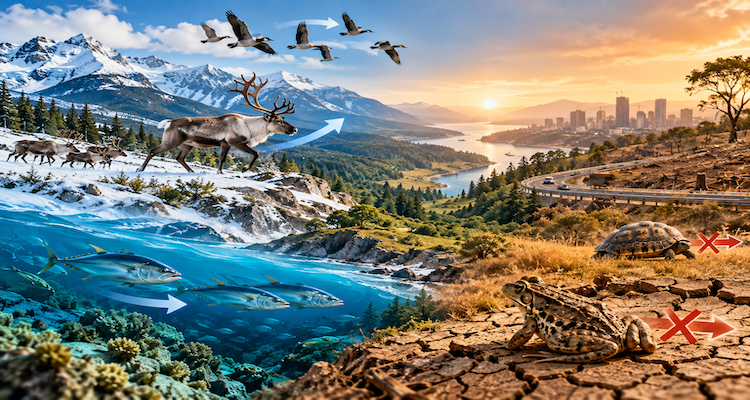
Animals need landscapes that function beyond those boundaries. Large mammals may travel considerable distances between feeding, breeding and resting areas. Rivers connect habitats. Forest corridors allow populations to move between otherwise isolated patches. Wetlands support birds, fish, amphibians and countless smaller organisms.
This makes habitat connectivity one of conservation’s less visible but most consequential challenges.
India’s tiger conservation experience illustrates the point. The National Tiger Conservation Authority has identified habitat corridors connecting tiger reserves as an important element of landscape-scale conservation because declining habitat outside reserves can threaten connectivity between populations.
A forest that is protected but isolated can therefore be less valuable than a network of connected landscapes in which animals can move safely between suitable habitats.
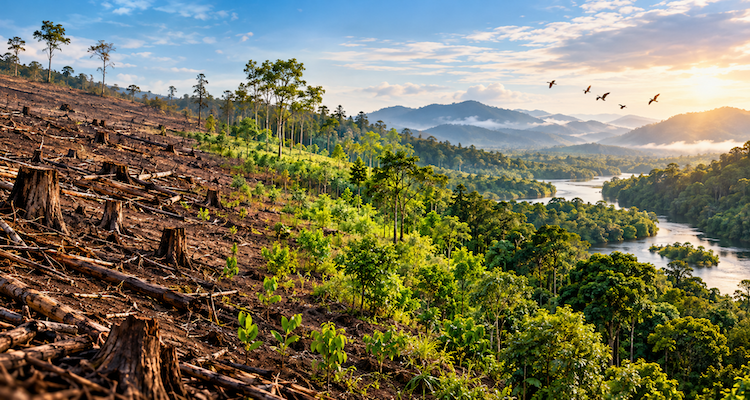
When Nature Gets Room to Recover
Not every conservation success requires humans to rebuild an ecosystem piece by piece.
The United Nations Environment Programme describes ecosystem restoration as both assisting the recovery of degraded ecosystems and conserving ecosystems that remain intact. Restoration can involve active interventions, but it can also mean removing pressures and allowing nature to recover on its own.
That distinction matters.
A degraded landscape may require removal of invasive pressures, restoration of vegetation, re-establishment of water flows or other carefully planned interventions. In another place, reducing disturbance may be enough for vegetation and wildlife to return naturally.
There is no universal restoration formula. UNEP also notes that returning an ecosystem completely to its historical condition is not always possible or desirable because landscapes must accommodate human needs and changing environmental conditions.
Good conservation is therefore less about recreating an imagined past and more about restoring ecological functions that allow life to persist.
Rewilding Is More Than Releasing Animals
The idea of rewilding can sometimes be reduced to a simple image: putting an animal back into the wild.
In reality, successful rewilding is considerably more demanding.
The International Union for Conservation of Nature’s 2025 guidelines describe rewilding as an approach intended to prevent further losses of nature, promote biodiversity recovery and restore ecological integrity.
That means the question cannot simply be whether an animal can survive after release. Conservation planners must consider whether suitable habitat exists, whether food and prey are available, whether ecological processes can function, whether human-wildlife conflict can be managed and whether the population can become viable over the long term.
India’s tiger reintroduction programmes provide a useful example.
The National Tiger Conservation Authority defines reintroduction as establishing a population in part of a tiger’s historical range where it has become locally extinct. The stated objective is to create a viable, free-ranging population capable of surviving in the wild and potentially performing its ecological role.
Tigers were reintroduced into Sariska and Panna after local extinction, with the programmes involving translocation, release protocols and subsequent monitoring.
The lesson is broader than the tiger itself: bringing back a species is only one component of rebuilding a functioning wild landscape.
The Hidden Infrastructure of Wildlife
Wildlife conservation has an infrastructure that is rarely visible to visitors.
It includes habitat corridors, prey populations, water systems, scientific monitoring, anti-poaching protection, local institutions and decisions about how people and wildlife share landscapes.
For a predator, protecting the predator alone is insufficient if its prey base has collapsed. For migratory animals, protecting one section of a route does not solve problems elsewhere. For species living in fragmented habitats, isolated populations may face difficulties maintaining connectivity.
This is why modern conservation increasingly looks at ecosystems rather than individual animals in isolation.
The CBD’s global biodiversity framework specifically calls for protected areas and other conservation measures to be ecologically representative, well-connected and equitably governed, while recognizing Indigenous and local community rights.
That wording carries an important implication: conservation success cannot be measured only by how much land receives a protected status. The quality, connectivity and governance of those places matter too.
People Are Part of the Conservation Equation
Wildlife does not exist in a separate world.
Forests, grasslands, rivers and coastal ecosystems are also landscapes in which people live, farm, work, travel and build infrastructure. Conservation decisions can therefore create both benefits and difficult trade-offs.
The CBD framework explicitly recognizes the rights of Indigenous peoples and local communities in the design and management of conservation areas.
India’s tiger programme also illustrates the complexity of this relationship. NTCA documentation describes processes involving rights, compensation and rehabilitation where villages are relocated from certain protected habitats, while emphasizing that legal rights must be addressed as part of such processes.
This is why the strongest conservation strategies cannot be built around wildlife alone. They need credible institutions, scientific evidence, local participation and fair treatment of communities.
Without those elements, even ambitious conservation plans can become difficult to sustain.
Restoration Has Benefits Beyond Wildlife
Healthy ecosystems do more than provide habitat.
UNEP identifies benefits associated with ecosystem restoration that include healthier soils, improved ecosystem productivity and greater carbon storage. Its assessment says that restoring 350 million hectares of degraded terrestrial and aquatic ecosystems between 2021 and 2030 could generate substantial ecosystem-service benefits.
That makes wildlife conservation part of a much larger environmental equation.
A restored wetland can provide habitat while also supporting water-related ecosystem functions. A functioning forest can support wildlife while contributing to soil protection and carbon storage. A connected landscape can improve ecological resilience while maintaining opportunities for species movement.
The point is not that every conservation project automatically produces every benefit. Rather, restoration can create multiple ecological gains when it is designed around the conditions of a particular landscape.
The Real Measure of a Wild Place
There is a temptation to measure conservation through visible symbols: the number of animals counted, the size of a reserve, or the number of trees planted.
Those indicators can be useful, but they do not tell the whole story.
A healthier question is whether the ecosystem is becoming more capable of supporting wildlife over time.
Are habitats connected? Are prey and plant communities functioning? Can animals move safely? Are populations reproducing? Are ecological processes recovering? Are local communities able to participate in and benefit from conservation? Can the system withstand environmental pressures?
These questions move conservation away from a simple preservation model toward a more ecological one.
The global biodiversity framework’s 2030 targets reflect that shift by combining conservation of existing areas with restoration of degraded ecosystems.
A Future Where Wild Lives Thrive
Wildlife does not need every landscape to become untouched wilderness. It needs enough functioning habitat, ecological connectivity and protection for populations to survive and recover.
That makes conservation a question of design as much as protection: how forests connect, how rivers flow, how protected areas interact with surrounding landscapes, how restoration is carried out and how people share space with wildlife.
The most encouraging conservation stories are therefore not simply stories about animals being saved. They are stories about landscapes becoming capable of supporting life again.
Where wild lives thrive, something larger is usually thriving with them: an ecosystem that still has the capacity to function, recover and adapt.
That may be the most useful definition of conservation success not merely keeping wildlife alive, but creating conditions in which wildlife can live as wildlife.
This content is published for informational or entertainment purposes. Facts, opinions, or references may evolve over time, and readers are encouraged to verify details from reliable sources.