







Following Nature’s Most Extraordinary Journeys
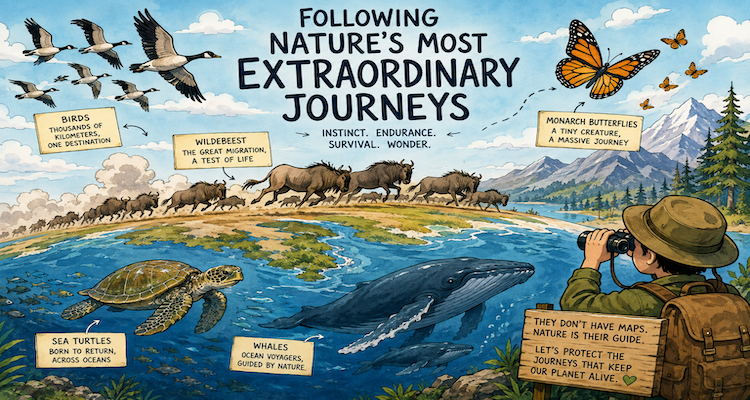
Across the planet, animals undertake journeys that can span oceans, continents, rivers and entire generations. An Arctic tern can travel more than 80,000 kilometres in a year. A salmon can leave its freshwater birthplace, spend years at sea and return to reproduce. Monarch butterflies navigate between North America and Mexico through a migration cycle that no single butterfly completes alone. Across the Serengeti, vast herds move with the seasonal availability of rain and fresh grass.
These journeys look radically different, but they share a deeper pattern: migration is rarely simply about moving from one place to another. It is a biological response to changing food, temperature, reproduction, water, predators and seasonal conditions. The route itself can become part of an animal’s survival system.
Modern tracking technology is revealing just how sophisticated these journeys can be and how vulnerable they become when the landscapes, oceans and seasonal signals they depend on are disrupted.
Key Takeaways
- Animal migration is often a response to changing food, breeding conditions, temperature and water availability.
- Arctic terns can travel more than 80,000 kilometres annually while exploiting productive ocean regions and favorable winds.
- Monarch migration is extraordinary because the complete north-south cycle spans multiple generations.
- Salmon demonstrate how migration can connect freshwater and ocean ecosystems within a single life cycle.
- Tracking technology is transforming scientists’ understanding of routes, stopovers and environmental pressures.
- Protecting migratory animals requires safeguarding the connected landscapes and waters they use throughout their journeys.
Migration Is More Than Distance
The instinct to measure migration in kilometres is understandable. Distance provides an immediate sense of scale.
But distance alone can obscure what makes migration extraordinary.
For many species, the destination is only one part of the problem. An animal must also find suitable conditions along the way. Food may be available for only a short period. A river may become difficult to cross. A bird may need a particular wind system to reduce the energy required for flight. A butterfly may need suitable temperatures and nectar sources at different stages of its route.
Migration therefore works less like a straight-line trip and more like a sequence of ecological decisions.
Research increasingly shows that animals use combinations of environmental signals to orient themselves. Depending on the species, these can include the sun, Earth’s magnetic field, landscape features, odors and other environmental information. Scientists are still investigating exactly how some of these mechanisms work at the neurological and molecular level.
That complexity becomes clearer when individual migrations are examined.
The Arctic Tern’s Pole-to-Pole Journey
Few migrations challenge the imagination like that of the Arctic tern.
The small seabird breeds in the northern hemisphere and travels toward Antarctic waters before eventually returning north. Tracking research using miniature geolocators found that some individuals travelled more than 80,000 kilometres annually. The birds did not simply follow one fixed line across the oceans: researchers observed different southbound routes and identified oceanic areas where the birds could exploit productive waters.
The significance is not just the distance.
The birds appear to take advantage of prevailing wind systems, which can reduce the energetic cost of such long flights. They also target areas of high marine productivity where food is available. In other words, the migration connects geography with atmospheric and oceanographic conditions.
Later research on Baltic Arctic terns found annual migration circuits of around 50,000 kilometres for the studied birds and showed substantial differences between populations in where and when they travelled.
The lesson is important: even within a single species, migration is not necessarily a single standardized route.
Monarchs Reveal a Different Kind of Journey
The monarch butterfly offers an entirely different definition of an extraordinary migration.
Eastern North American monarchs travel south toward overwintering areas in central Mexico and later begin the northward return toward the United States and southern Canada. But there is a crucial difference between this journey and the Arctic tern’s.
The individual butterfly that begins the southward migration does not necessarily complete the entire round trip.
The migration is multi-generational. Different generations participate in different stages of the annual cycle, creating a biological relay across thousands of kilometres. Research has shown that monarchs use a sophisticated navigational system involving a time-compensated sun compass, while evidence also supports the use of magnetic orientation under certain conditions.
Scientists have also investigated how the timing and speed of the fall migration relate to environmental conditions. A U.S. Geological Survey study using more than 1.38 million tagged monarchs found that migration pace varied during the season and was consistent with interactions among sun angle, temperature and day length.
That makes monarch migration more than a remarkable natural spectacle. It is a system in which information, behavior and seasonal timing are distributed across generations.
Salmon Turn Migration Into a Life Cycle
For salmon, the journey is inseparable from reproduction.
Pacific salmon generally begin life in freshwater. Juveniles eventually undergo smoltification, a physiological transformation that enables them to survive in saltwater, before migrating to the ocean. After growing and maturing, adults return from the sea to freshwater habitats to reproduce.
That movement connects two very different ecosystems.
The river is not simply the starting point and the ocean is not merely an intermediate destination. Each environment provides different resources at different stages of the animal’s life.
Recent NOAA Fisheries research has also complicated the traditional picture of juvenile salmon migration. Scientists have found that young salmon can move among coastal and freshwater habitats in ways that are more varied than the simple downstream-to-ocean model often used to describe their early life.
For Atlantic salmon, researchers track movements through coastal waters and the North Atlantic, including feeding areas around Greenland, before adults return toward their natal freshwater systems.
The salmon story demonstrates why protecting migration cannot mean protecting only one location. A barrier, degraded river or unfavorable ocean condition can affect a journey whose critical stages are separated by thousands of kilometres.
The Serengeti Moves With the Rain
On land, the Great Migration of wildebeest, together with zebra and gazelle, creates one of the most spectacular large-animal movements on Earth.
The animals move through the Serengeti ecosystem and into Kenya’s Maasai Mara in response to seasonal rainfall, fresh grass and water. The movement is not simply a single annual procession toward a predetermined destination. It is a continuing ecological cycle shaped by changing resource conditions.
Rain effectively changes the map.
A region that is dry and relatively poor in forage can become productive after rainfall. Herds respond to these changing conditions, while their movement in turn influences the ecosystem through grazing and the redistribution of nutrients.
This is one reason migration matters beyond the animals themselves. Migratory species can influence pollination, nutrient movement, food webs and other ecological processes. The United Nations’ 2024 State of the World’s Migratory Species report emphasized that migratory animals contribute to ecosystem functioning while also warning that many populations are declining.
Technology Is Making Hidden Journeys Visible
For much of human history, researchers could observe migration only from the ground, through recovered tags, seasonal sightings or indirect evidence.
That has changed dramatically.
Miniature geolocators, satellite transmitters, GPS devices and other tracking technologies can now reveal movements that would otherwise remain invisible. The Eurasian-African Bird Migration Atlas, for example, combines more than a century of bird-ringing information with satellite, GPS-GSM and geolocator data to map movements across three continents. Researchers from more than 50 organizations contributed to the project.
The result is a different understanding of migration.
A route can now be studied as a network of breeding areas, feeding grounds, stopover sites and seasonal habitats rather than as a line drawn between two points.
That perspective also makes threats easier to identify.
The Journey Can Be Broken Without the Animal Being Caught
A migratory species does not necessarily need to lose its final destination to be placed at risk.
A crucial stopover can disappear.
A river can become blocked.
A feeding ground can deteriorate.
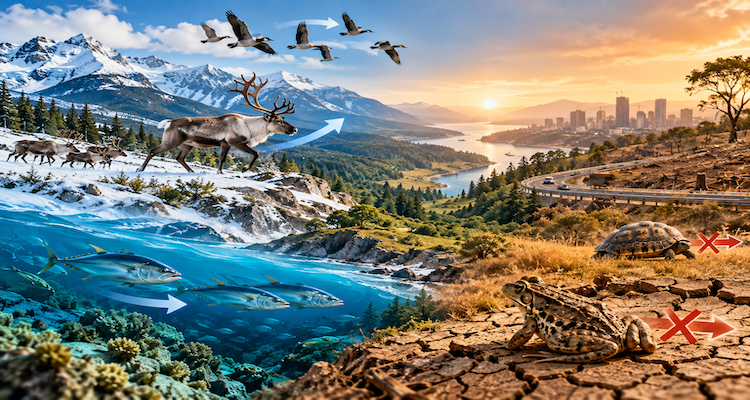
A migration corridor can be fragmented by infrastructure.
A seasonal food source can shift at a different rate from the animal’s arrival.
The 2024 UN report on migratory species found that nearly half of CMS-listed migratory species were showing population declines and that more than one-fifth were threatened with extinction. Habitat loss, degradation and fragmentation and overexploitation were identified among the major threats, alongside climate change, pollution and invasive species.
For migratory animals, fragmentation is particularly serious because their survival depends on a chain of places rather than one protected site.
A protected breeding ground is of limited value if an animal cannot safely reach it.
Climate Change Adds a Timing Problem
Migration depends heavily on timing.
Animals may arrive when food is abundant, reproduce when conditions are favorable, or leave before seasonal conditions become dangerous.
Climate change can disrupt those relationships.
Earlier changes in seasonal conditions can alter the timing of biological events, while shifts in temperature, food availability, wind patterns and habitat conditions can affect migratory behavior. Scientists have long identified the possibility of a mismatch between migrants and the resources they depend on when different parts of an ecosystem respond to climate change at different rates.
This creates a difficult conservation problem.
Protecting a location may not be enough if the ecological conditions that made that location useful are changing.
The challenge is increasingly about maintaining connectivity and resilience across entire migration systems.
What These Journeys Teach Us About Nature
The most extraordinary migrations reveal a useful correction to the way humans often imagine nature.
We tend to divide landscapes into places: forests, rivers, oceans, wetlands, grasslands and protected areas.
Migratory animals experience them as connected systems.
The Arctic tern links polar and oceanic ecosystems. Salmon connect rivers with the sea. Monarchs connect breeding landscapes across North America with overwintering forests in Mexico. Wildebeest connect different parts of an East African ecosystem through seasonal movement.
Their journeys expose relationships that are easy to miss when ecosystems are viewed separately.
That is why migration is also an important measure of environmental health.
When a species can no longer complete its journey, the problem may not exist at one point on the map. It may indicate that several parts of a larger ecological system are no longer working together.
Protecting the Journey, Not Just the Destination
Conservation is increasingly moving toward this broader understanding.
The UN report on migratory species emphasizes the importance of identifying and protecting breeding grounds, feeding areas, stopover locations and migration routes. It also highlights the need for international cooperation because animals do not recognize political borders.
Bird migration maps demonstrate the same principle from a research perspective: understanding where animals go is essential to knowing which places need protection.
For salmon, maintaining connected rivers and fish passage can be as important as protecting adult spawning habitat. For terrestrial mammals, keeping corridors open can allow seasonal movement across landscapes increasingly divided by human development.
The conservation question is therefore becoming more precise:
Not simply, “Where does this animal live?”
But, “What entire network does this animal need to survive?”
Conclusion
Nature’s greatest journeys are not impressive merely because they are long.
They are impressive because they are coordinated with changing landscapes, seasons, food supplies, weather and reproduction. They demonstrate that survival can depend on movement and that movement itself can be a highly evolved form of biological knowledge.
Modern tracking has allowed scientists to see these journeys with an unprecedented level of detail. But that knowledge has also revealed an uncomfortable reality: migration can be disrupted at almost any point along the route.
The most useful way to think about these animals, then, may be not as travellers moving between destinations, but as participants in living networks that cross ecosystems and borders.
Protect the destination, and part of the journey may survive.
Protect the journey, and an entire ecological system has a better chance of continuing to function.
This content is published for informational or entertainment purposes. Facts, opinions, or references may evolve over time, and readers are encouraged to verify details from reliable sources.