










Stories That Time Refuses to Erase
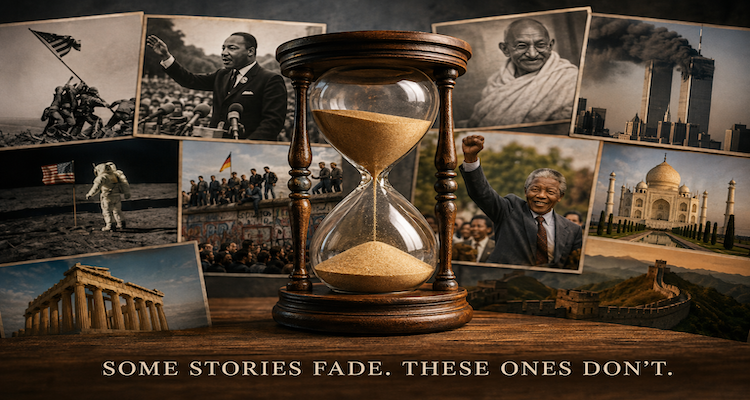
A story can outlive the person who first told it, the place where it began, and even the language in which it was first spoken. Long after buildings disappear and photographs fade, certain stories continue moving from one generation to another sometimes through books, sometimes through songs, family conversations, rituals, films, recordings, or simply a remembered sentence repeated at the right moment.
That endurance is not accidental. Human memory does not preserve the past like a perfect archive. It organizes experiences into meaningful events and connections. Research in cognitive science has found that people generally understand and recall narrative information better than comparable expository material, while other studies show that coherent narratives can help connect events separated in time.
But there is a deeper reason some stories survive: people keep finding a reason to tell them.
Key Takeaways
- Stories survive when communities continue using them to transmit memory, values, knowledge, and identity.
- Narrative structure helps people connect separate events into patterns that are easier to understand and remember.
- Oral traditions remain alive by changing with each telling rather than preserving every detail unchanged.
- Digital recording can protect fragile stories, but technology cannot replace the people and communities that keep them meaningful.
- A story’s survival depends less on escaping change than on remaining relevant through change.
Stories Are More Than Records of the Past
It is tempting to think of storytelling as an ancient storage system: before books, databases, and video archives, people simply told one another what happened.
That explanation is incomplete.
Stories do not merely preserve information. They organize information around people, choices, consequences, places, conflicts and emotions. A collection of disconnected facts may tell us what happened. A story can help explain what those events meant to the people who experienced them.
That distinction matters for memory.
A 2021 meta-analysis examining more than 75 samples and over 33,000 participants found that narrative texts were, on average, better understood and recalled than expository texts. The researchers cautioned that the advantage was not absolute in every circumstance, but the overall pattern was robust.
Other research has gone deeper into the mechanism. Studies of narrative memory suggest that people naturally divide stories into meaningful events and connect those events into larger structures. When separate events form a coherent narrative, they can be remembered as part of something larger than the individual moments themselves.
This helps explain why a story can become a remarkably durable vessel for collective memory.
The Story Changes and That May Be Why It Survives
There is an important paradox at the heart of lasting stories.
The stories that survive are rarely frozen exactly as they began.
UNESCO describes oral traditions as living forms of cultural heritage that include tales, legends, myths, epic songs, proverbs and other spoken expressions. Because they are transmitted from person to person, they can vary between performers and contexts, combining reproduction, improvisation and creation.
That variation is not necessarily a failure of preservation.
It can be the mechanism of preservation.
A story that cannot adapt may eventually become irrelevant to the people expected to carry it forward. A story that can be retold in a new setting can remain recognizable while acquiring new meanings.
UNESCO’s framework for intangible cultural heritage makes a similar distinction: cultural heritage is not simply an object inherited from the past. It is something communities continually recreate in response to their environment, history and circumstances.
In other words, cultural survival is not always about keeping something unchanged.
Sometimes it is about keeping it alive.
The People Who Carry Collective Memory
Consider what happens when a community loses the people who know its stories.
A written archive may remain. A recording may remain. A database may remain. Yet something can still disappear if nobody knows how the story fits into everyday life.
This is why oral tradition is particularly revealing.
UNESCO notes that oral traditions transmit knowledge, social values and collective memory, while emphasizing that their survival depends on an uninterrupted chain of transmission between generations. It specifically points to opportunities for elders and younger people to exchange stories as an important part of safeguarding these traditions.
The Mapoyo oral tradition of Venezuela offers one example. UNESCO describes its narratives and symbolic references to ancestral territory as part of the collective memory of the Mapoyo people.
Elsewhere, the Moorish epic T’heydinn in Mauritania preserves historical memory through poems performed by griots. The tradition is not simply a collection of old verses; its performance also brings families and communities together.
That distinction is important.
A story is not necessarily preserved because someone stored it.
It is preserved because someone still needs it.
Why Personal Stories Matter Too
Collective memory is not limited to epics and legends.
It exists inside ordinary families.
A grandparent describing childhood, a parent explaining where a family came from, a veteran recalling an experience, or an older relative explaining why a particular photograph matters can preserve information that may never have appeared in an official history.
The Library of Congress treats oral history as a method of learning about the past through people who experienced it directly. Its collections include oral histories connected to military service, civil rights, occupational life and personal conversations.
These stories can contain something that formal records often lack: the texture of lived experience.
A document may record that an event happened.
A person can explain what that event felt like, what people feared, what they misunderstood at the time, what they hoped would happen next, and what they remembered decades later.
Those details do not automatically make an oral account perfectly accurate. Human memory can change, omit details and reconstruct events. But that imperfection is precisely why oral history works best alongside other evidence rather than as a substitute for it.
Preserving memory does not mean pretending memory is infallible.
It means recognizing that human experience contains information that conventional records may not capture.
Technology Can Save the Voice But Not the Meaning
The digital age has changed the survival prospects of stories.
An oral tradition that once depended entirely on one generation teaching the next can now potentially be recorded as audio or video. UNESCO notes that information technology can help document variations in wording, performance, intonation, gestures and interactions between storytellers and audiences.
That is a profound change.
A fragile voice can now become a recording. A performance can be archived. A story once confined to one community can potentially reach people thousands of kilometres away.
But digitization introduces a new question: does preserving the file preserve the tradition?
Not necessarily.
A recording can preserve the sound of a story while the social circumstances that gave the story meaning disappear.
A database can contain a language while fewer people speak it.
An archive can hold a ceremony while the community no longer performs it.
This is why UNESCO describes intangible heritage as something that must remain a living process rather than simply a preserved product.
Technology is therefore best understood as a powerful extension of human memory, not a replacement for it.
The Digital World Creates a New Kind of Story Survival
The same technology that can weaken traditional storytelling can also give forgotten stories new lives.
A family recording can be shared across generations. An old interview can become accessible to researchers. A traditional performance can be documented before its practitioners disappear. A local story can reach people who would never have encountered it otherwise.
This creates an unusual relationship between old and new forms of memory.
The internet can flatten cultures when everything becomes interchangeable content. But it can also preserve voices that previously had little opportunity to travel beyond their immediate communities.
The difference is not simply technological.
It depends on who records the story, who controls the archive, how the context is explained, whether communities participate in preservation, and whether younger generations continue to find meaning in what has been preserved.
A file can survive indefinitely and still become culturally silent.
A living story can change dramatically and remain deeply relevant.
What Time Actually Erases
Time does not erase everything equally.
It tends to remove details first: exact dates, minor characters, precise wording, forgotten locations. What remains is often the structure that people continue to find meaningful the conflict, the lesson, the warning, the sacrifice, the journey, the injustice, the act of courage, the memory of belonging.
That does not mean the surviving version is necessarily historically complete.
In fact, the opposite can happen. Stories can accumulate embellishment, simplify complicated events or acquire meanings that were not present at their beginning. Narrative coherence can make memories easier to organize, but a coherent story should not automatically be mistaken for a perfectly accurate historical record. Research on narrative memory makes this distinction especially important.
The endurance of a story therefore tells us two things at once.
It tells us something about the past.
And it tells us something about the people in the present who continue choosing to remember it.
Why Some Stories Still Matter After Centuries
The oldest surviving stories are not necessarily the stories with the most accurate details.
They are often the stories that remain useful.
They help a community explain where it came from. They teach a child what courage looks like. They preserve a warning. They give shape to grief. They connect a family to a place. They explain a ritual. They turn an unfamiliar past into something emotionally understandable.
Research into narrative structure offers a clue to why this works: stories organize information around events and relationships, creating connections that can help people form coherent mental representations of what they encounter.
Culture adds another layer.
UNESCO describes intangible heritage as providing continuity between past, present and future, while emphasizing that communities themselves are central to recognizing, maintaining and transmitting it.
That may be the closest explanation for the strange durability of certain stories.
They survive because they are not only about what happened.
They become part of who people are.
Conclusion
The stories that time refuses to erase are not necessarily the ones protected by the strongest archives or written in the oldest books.
They are the ones people continue to tell.
Sometimes they survive in a grandmother’s recollection. Sometimes in an epic performed by a storyteller. Sometimes in a recording made before a tradition disappears. Sometimes in a novel, a film, a family photograph or a sentence repeated across generations.
Their words may change. Their interpretations may change. Their details may become blurred.
But when a story continues to answer a human need to remember, explain, warn, belong, grieve or hope it acquires a life beyond the moment in which it was created.
Time can alter a story.
It does not always have the power to make it irrelevant.
And perhaps that is the most enduring form of memory: not remembering the past exactly as it was, but continuing to find meaning in carrying it forward.
This content is published for informational or entertainment purposes. Facts, opinions, or references may evolve over time, and readers are encouraged to verify details from reliable sources.