










The Business Moves That Define Tomorrow
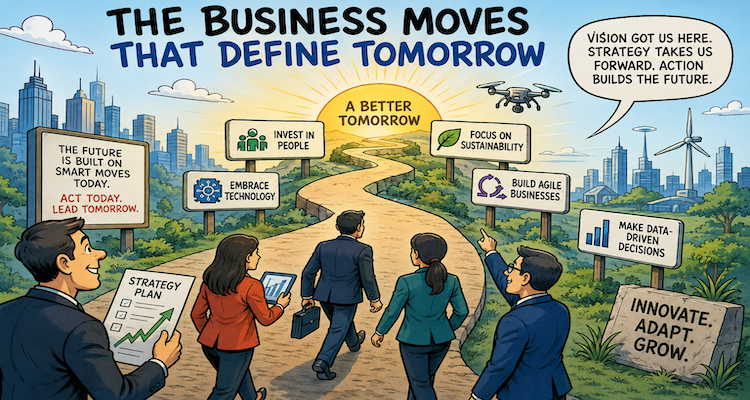
The companies best positioned for the next phase of the economy may not be the ones making the biggest bets on a single technology. They are the ones changing how they make decisions, allocate capital, build resilience and develop people.
That distinction is becoming clearer in 2026. Artificial intelligence is attracting enormous investment, but businesses are also confronting geopolitical disruption, energy volatility, changing trade patterns, skills shortages and increasingly fragile supply chains. The result is a strategic environment in which traditional five-year plans are becoming less useful and adaptability is becoming a competitive capability. The World Economic Forum describes this shift as a move toward continuous adaptation, while the IMF says the economic impact of AI will depend heavily on how widely it diffuses and whether institutions and infrastructure are ready for it.
The important business question, therefore, is no longer simply where to invest. It is how to build an organization capable of making the right investment repeatedly as conditions change.
Key Takeaways
- AI investment is becoming a core business priority, but technology alone does not guarantee productivity or resilience.
- Companies are shifting from fixed long-term plans toward faster cycles of strategic review and adaptation.
- Energy, infrastructure and supply-chain resilience are becoming strategic investments rather than operational afterthoughts.
- Human capital remains essential because technology creates value only when organizations can absorb and use it effectively.
- Diversification is gaining importance as geopolitical and trade risks reshape where companies produce, source and invest.
- Tomorrow’s strongest businesses may be those that combine technological speed with organizational resilience and disciplined judgment.
AI Is Moving From Experiment to Business Infrastructure
Artificial intelligence has moved beyond being primarily an innovation-lab concern.
McKinsey’s 2026 Global Tech Agenda survey of 632 technology and business leaders found that AI had become the leading technology investment priority for the next two years, ahead of cybersecurity and infrastructure modernization. Half of respondents identified AI as a top investment area. The research also found that technology leaders are becoming more involved in enterprise strategy rather than operating solely as technology managers.
That shift matters because the competitive advantage from AI is unlikely to come simply from having access to the same models as competitors.
The harder question is whether a company can redesign workflows around them.
An organization that adds an AI assistant to an inefficient process may save time at the edges without changing the economics of the business. A company that redesigns procurement, customer service, forecasting, software development or internal decision-making around better information and faster feedback can potentially create a much deeper advantage.
The distinction is increasingly important because AI investment itself carries uncertainty. The OECD has noted that productivity gains from AI remain uncertain in their scale and timing, even as there are signs of stronger productivity growth in some highly adopting sectors.
The business move that defines tomorrow, then, is not simply buy AI.
It is rebuild the parts of the business where AI can produce measurable value.
Strategy Is Becoming a Continuous Process
For decades, corporate strategy often revolved around annual planning cycles, multi-year forecasts and relatively stable assumptions.
That model becomes harder to maintain when major variables can change quickly.
Geopolitical tensions can alter trade routes. Energy disruptions can change production economics. New technology can affect the cost structure of an industry. A regulatory decision can change the attractiveness of an investment. Consumer behavior can shift faster than traditional planning cycles can accommodate.
The World Economic Forum and Bain argue that companies increasingly need to treat strategic decisions as dynamic bets that can be updated as new evidence emerges.
This does not mean abandoning long-term thinking.
It means separating long-term direction from short-term assumptions.
A company can maintain a ten-year ambition while reviewing the assumptions behind its next 12 months much more frequently. That approach allows management teams to preserve strategic consistency without becoming prisoners of outdated forecasts.
AI can help with this process by processing large volumes of information and identifying signals faster. But faster information does not eliminate the need for judgment. The World Economic Forum’s analysis makes the distinction clearly: AI can increase the speed of analysis, while management still has to validate information, interpret it and decide what action to take.
That combination machine speed with human accountability could become one of the defining management models of the next decade.
Resilience Is Becoming a Growth Strategy
Businesses traditionally treated resilience as protection against bad outcomes.
That view is changing.
A resilient supply chain, diversified sourcing strategy, flexible workforce or dependable energy system can also create opportunities when competitors are less prepared for disruption.
The shift is visible in global investment patterns. UN Trade and Development reported that global foreign direct investment rose 14% in 2025 to an estimated $1.6 trillion, but much of the increase was associated with financial-centre flows. Underlying real investment remained comparatively fragile, while investment became increasingly concentrated in strategic sectors.
That suggests companies cannot interpret rising investment totals as evidence that the global business environment has simply returned to normal.
Instead, businesses are having to ask harder questions:
- How dependent is the company on one supplier or geography?
- Which inputs could become strategically scarce?
- How quickly can production be shifted?
- Which markets deserve additional investment?
- What happens if energy or transportation costs rise sharply?
- How much operational flexibility is worth paying for?
Diversification can cost more than maximum short-term efficiency. But extreme optimization can leave a company exposed when the assumptions behind the optimization fail.
The emerging strategic goal is therefore not necessarily the cheapest possible operating model. It is an operating model that can continue functioning when conditions change.
Energy and Infrastructure Are Becoming Competitive Assets
The AI boom is also changing the meaning of infrastructure.
Data centers require enormous quantities of computing power, cooling and electricity. At the same time, electrification is increasing demand across transportation, industry and other sectors.
The International Energy Agency reported that global investment in electricity generation, grids and storage was set to reach about $1.5 trillion in 2025 roughly 50% more than investment in bringing oil, natural gas and coal to market. It also identified data centers and AI among the forces contributing to rising electricity demand.
For businesses, this creates an important strategic implication.
Access to energy is increasingly connected to access to technology.
A company may have capital, software and skilled employees, yet still face constraints if the infrastructure supporting its operations cannot scale reliably.
That makes investments in energy efficiency, resilient infrastructure, local capacity and diversified critical inputs more strategically significant than they appeared when infrastructure was treated mainly as a back-office concern.
The next generation of business competition will therefore not be fought entirely on websites, apps and algorithms. It will also depend on physical systems that make digital businesses possible.
Human Capital Is Not Being Replaced by Strategy It Is Becoming More Important
AI changes the value of certain tasks, but that does not make organizational knowledge irrelevant.
The World Bank’s 2026 World Development Report argues that AI has the potential to improve productivity and help address skills gaps, while warning that countries and organizations without sufficient infrastructure and skills could fall further behind.
This creates a difficult management challenge.
Companies need employees who can use increasingly capable tools, but they also need people who understand the business well enough to recognize when an automated answer is wrong, incomplete or inappropriate.
That makes training a strategic investment rather than simply an HR initiative.
The organizations likely to benefit most from AI will need a combination of technical literacy, domain expertise, critical thinking and the ability to redesign processes.
The winning question for employers may therefore shift from:
“How many tasks can technology automate?”
to:
“How much better can our people perform when technology handles the right tasks?”
That is a very different approach to productivity.
Diversification Is Replacing the Assumption of a Frictionless Global Economy
Globalization is not disappearing, but its business logic is changing.
Companies once had strong incentives to concentrate production wherever costs were lowest and supply chains could be optimized around predictable international trade.
Geopolitical competition, trade restrictions, energy shocks and strategic competition are making that model more complicated.
The World Economic Forum’s 2026 growth analysis identifies diversification and comparative advantage as strategies that can help expand opportunity and resilience in the new economy.
Meanwhile, McKinsey’s analysis of global trade found that AI-related hardware shipments increased sharply in 2025 and accounted for a significant share of global trade growth. The expansion illustrates how a technological investment cycle can reshape physical trade flows as well as digital markets.
This creates a broader lesson for executives: technology strategy and geopolitical strategy are becoming increasingly difficult to separate.
Where a company sources chips, energy, software, cloud infrastructure and other critical inputs can influence its competitive position.
The Real Advantage May Be Organizational Adaptability
The most important business move of the next decade may be less visible than an acquisition, product launch or major technology investment.
It may be the ability to change direction without losing organizational coherence.
Recent research highlighted by Reuters found that investments in AI can improve individual business functions without necessarily making an organization more resilient overall. The researchers pointed to outdated structures, disconnected supply chains and unchanged incentive systems as reasons technology improvements may fail to translate into broader adaptability.
That finding captures a central tension in modern business.
A company can become extremely efficient and still become more fragile.
It can automate forecasting while leaving its supply chain concentrated. It can deploy AI while retaining slow approval structures. It can collect enormous quantities of data while failing to establish who is responsible for acting on it.
Technology amplifies the organization that receives it.
If the organization is adaptable, technology can increase its speed.
If the organization is rigid, technology may simply make a rigid system faster.
What Businesses Should Watch Next
The strategic signals worth watching are therefore broader than quarterly technology spending.
Businesses should pay attention to whether AI investments begin producing sustained productivity improvements, whether energy constraints influence technology expansion, whether supply chains continue diversifying, whether companies change their organizational structures to take advantage of AI, and whether workforce training keeps pace with technological adoption.
The IMF’s July 2026 outlook illustrates why these questions matter. It projects global growth of 3.0% in 2026 and 3.4% in 2027, while noting that AI-driven demand is supporting economies integrated into technology value chains even as geopolitical and energy shocks create significant risks.
The numbers are less important than the underlying pattern: technology is becoming a source of growth at the same time that businesses face a more fragmented and uncertain operating environment.
That combination rewards companies that can do two things simultaneously move quickly when opportunities appear and remain stable when conditions deteriorate.
Conclusion
The business moves that define tomorrow will not be determined by technology alone.
AI will matter. So will automation, data, energy infrastructure and digital platforms. But the companies most likely to turn those capabilities into durable advantage will be the ones that connect technology with better decisions, stronger skills, diversified operations and faster strategic learning.
The central competitive advantage may therefore become adaptability itself.
Businesses that can continuously reassess their assumptions, invest where evidence supports the opportunity, protect themselves against concentrated risks and equip their people to work effectively with new technology will be better positioned for an economy in which change is no longer an occasional disruption to strategy.
It is becoming part of strategy.
The information presented in this article is based on publicly available sources, reports, and factual material available at the time of publication. While efforts are made to ensure accuracy, details may change as new information emerges. The content is provided for general informational purposes only, and readers are advised to verify facts independently where necessary.