










The Strange Psychology of Dolls: Why Do They Make Some People Feel Uneasy?
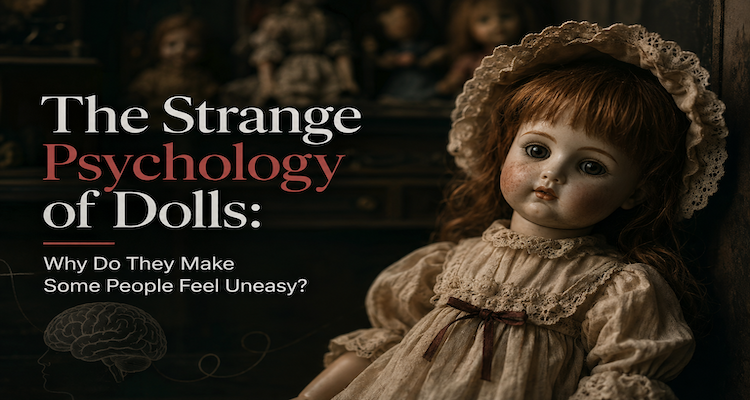
A doll sitting on a shelf is harmless. Most people know that. Yet some dolls can produce an immediate feeling of discomfort: the fixed stare, the almost-human face, the expression that seems present but never changes.
That reaction is often dismissed as something learned from horror films. Popular culture has certainly turned dolls into symbols of possession, violence and the supernatural. But psychology suggests the unease can run deeper. Human beings are highly specialized at reading faces and detecting subtle departures from what a face or body is expected to look like. A doll occupies an unusual space: it resembles a person closely enough to trigger social perception, while remaining unmistakably inanimate.
The result, for some people, is not fear in the ordinary sense. It is uncanniness he unsettling sensation produced when something feels simultaneously familiar and wrong.
Research on the so-called uncanny valley offers one explanation, but it is not the whole story. Studies suggest that human likeness, perceptual mismatch, categorization, individual sensitivity and learned cultural associations can all shape whether a doll feels charming, neutral or deeply disturbing.
Key Takeaways
- Dolls can feel eerie when they resemble humans without fully matching the appearance or behavior people expect from a real person.
- The “uncanny valley” describes discomfort that can arise when artificial figures become almost, but not completely, humanlike.
- Research suggests there is no single explanation for uncanniness; perceptual mismatch and individual differences both matter.
- Fixed faces and lifeless eyes may be especially noticeable because humans are highly sensitive to facial configuration and social cues.
- Horror films and cultural stories can amplify an existing sense of unease, but they are unlikely to explain every reaction to dolls.
- The psychology behind eerie dolls also matters for robotics, digital humans and increasingly realistic AI-generated characters.
Why Something Familiar Can Also Feel Wrong
The central puzzle is simple: why should an object designed to resemble a human sometimes become less comfortable to look at as it becomes more realistic?
Japanese roboticist Masahiro Mori famously proposed the concept now known as the uncanny valley. The idea is that increasing human likeness may initially increase familiarity, but at a certain point, an almost-human object can provoke a sharp drop into discomfort.
Dolls were among the kinds of humanlike objects later discussed in research on the phenomenon, alongside mannequins, prosthetic hands, robots and computer-generated characters. Experimental work has found evidence that reactions to humanlike objects can change in non-linear ways, although researchers continue to debate exactly what produces the effect and whether one explanation can account for all cases.
That uncertainty is important. The uncanny valley should not be treated as a universal law stating that every realistic doll will frighten every observer. It is better understood as a framework for investigating why certain combinations of human features and artificial qualities can become unsettling.
The Face May Be Doing Most of the Work
Human beings are unusually sensitive to faces. We rapidly notice relationships between the eyes, mouth, skin, expression and movement. A face does not need to be obviously grotesque to feel unusual; small deviations can become conspicuous when the overall object strongly resembles a person.
This helps explain why some stylized dolls are perfectly comfortable while a more realistic doll can feel disturbing. A cartoonish figure clearly belongs to the category of “toy.” A highly realistic doll, however, may activate expectations normally associated with a human face.
The problem can emerge when those expectations are only partly satisfied.
The eyes may look human but remain permanently fixed. The skin may resemble flesh but lack the subtle variation of living tissue. The face may appear expressive while never actually changing expression. The closer the object moves toward human appearance, the more noticeable certain deviations may become.
Recent research has continued to examine this question. A 2024 study argued that uncanniness may sometimes be better explained by sensitivity to deviations from expected facial patterns than by a simple valley-shaped relationship between human likeness and liking. In other words, what matters may not only be how human something looks, but also how strongly our perceptual systems detect that something about it deviates from the expected pattern.
That distinction is useful for understanding dolls. A crude wooden doll does not necessarily create the same expectations as a porcelain figure with carefully painted skin, glass eyes and human proportions.
When the Brain Cannot Easily Decide What It Is Seeing
Another major explanation focuses on categorization.
Human perception constantly sorts the world into meaningful categories: human or object, alive or inanimate, familiar or unfamiliar. An object that sits near the boundary between categories may require additional processing or create a sense that it does not fit comfortably into either one.
In one experiment, researchers used morphed images involving photographs and doll faces and found that individual differences were associated with stronger perceptions of eeriness for objects at particular levels of human likeness. The authors linked this response partly to avoidance of novel or potentially threatening experiences.
However, categorization is not a settled explanation. Other research has challenged the idea that simple difficulty in discriminating between human and artificial faces automatically produces negative feelings. A 2024 study instead argued that categorization failure when a stimulus does not fit expected categories may be more relevant than processing difficulty alone.
The broader lesson is that the eerie doll may not be frightening because the brain literally mistakes it for a living person. Rather, its features may create competing perceptual signals: this looks like a person, but it clearly is not one.
That tension may be enough to produce unease.
Why Some People Feel Nothing While Others Feel Deeply Uncomfortable
One of the weaknesses of popular explanations is the assumption that dolls are universally creepy. They are not.
Many people collect dolls, work with them, restore antique examples or simply see them as nostalgic objects. Others find certain dolls intensely uncomfortable. Research increasingly supports the idea that individual differences can influence uncanniness.
A 2024 study examining predictors of uncanny reactions found that factors including anxiety, disgust sensitivity and other individual differences were associated with uncanniness for some kinds of distorted humanlike stimuli. The results also suggested that reactions can vary across different categories rather than being produced by one universal psychological mechanism.
This makes intuitive sense. A person with a strong sensitivity to deviations in faces may react differently from someone who sees the same doll primarily as a decorative object. Personal memories and learned associations may also matter.
Someone who grew up with a beloved doll may experience familiarity and comfort. Someone repeatedly exposed to horror stories involving dolls may approach the same kind of object with very different expectations.
Psychology, in other words, does not require every uneasy reaction to have the same origin.
Horror Movies Did Not Invent Creepy Dolls But They Changed What We Expect
The modern image of the “evil doll” owes much to fiction.
Films, television, novels and internet culture have repeatedly used dolls because they already contain a useful visual contradiction: they are associated with childhood and innocence, yet their humanlike form allows storytellers to imagine them as watchers, substitutes or imitators of people.
Once those associations become culturally familiar, they can influence interpretation. A motionless doll in a brightly lit toy shop may seem ordinary. The same doll placed in a dark hallway, framed by ominous music, can immediately acquire a different meaning.
That does not prove horror culture causes doll-related unease. But it can provide a ready-made narrative for an ambiguous feeling. The object supplies the almost-human appearance; culture supplies the story.
This distinction matters because it separates a genuine perceptual question from the mythology built around it.
The Most Interesting Part: Dolls Are an Old Version of a New Problem
The psychology of dolls is no longer just about toys.
The same questions now appear in robotics, virtual reality, video games, digital influencers and AI-generated human characters. Designers are increasingly capable of producing faces that look strikingly realistic. Yet realism alone does not guarantee comfort or trust.
A digital character may have convincing skin and facial features but unnatural movement. A robot may speak fluently while displaying expressions that do not match the context. An AI-generated avatar may appear almost photographic while containing subtle inconsistencies that viewers cannot immediately identify.
Research on perceptual mismatch has become particularly relevant here. A major review of uncanny valley theories found support for the idea that mismatches in perceived animacy, realism or human likeness can contribute to eeriness, although the underlying mechanisms remain debated.
This is where dolls become more than a curiosity.
They reveal a design problem that technology is now encountering at scale: making something look more human also raises the standard by which people judge its human qualities.
A clearly artificial character can be accepted as artificial. An almost-human one invites much closer scrutiny.
Does a Doll’s Stillness Make It Worse?
Stillness can intensify the contradiction.
A doll is built in the shape of a social being but does not behave like one. It has eyes but does not look back. It may have a smile but no changing emotional state. It has a body but no independent movement.
When movement is added, the situation can become even more complicated. Mori’s original concept included the idea that movement could deepen the negative reaction to an almost-human object. Modern research continues to investigate how dynamic facial expressions and biological movement affect uncanniness.
The implication is that there may be no single “creepy feature.” A doll’s eeriness can emerge from the relationship between appearance, expected behavior and context.
A highly stylized puppet moving in a theatrical way may feel perfectly natural because the movement fits what the viewer expects. A realistic face paired with slightly unnatural movement may be harder to interpret.
What the Research Still Does Not Fully Explain
Despite decades of discussion, scientists have not reached a single consensus explaining every uncanny reaction.
Some evidence supports perceptual mismatch. Other studies emphasize categorization, novelty avoidance, face processing or individual psychological differences. Researchers also continue to debate whether the classic valley-shaped model accurately describes all forms of uncanniness.
That uncertainty should not be viewed as a failure. It reflects the fact that “creepy” is not one simple emotion with one trigger.
The feeling may arise from several systems interacting at once: perception notices a deviation, cognition struggles to interpret it, past experience provides an association, and individual temperament influences how strongly the reaction is felt.
A doll can therefore be technically harmless and psychologically unsettling without requiring any supernatural explanation.
Conclusion
The strange psychology of dolls lies in a contradiction built into their design. They borrow one of the most socially important forms in human experience the human face and body while remaining silent, still and inanimate.
For some people, that gap is insignificant. For others, it creates a powerful sense that something familiar has drifted just far enough away from normal to become unsettling.
The enduring value of the uncanny valley idea is not that it has solved the mystery. It has helped expose a deeper question: why does making an artificial object more human sometimes make us less comfortable with it?
As robots, digital humans and AI-generated characters become increasingly realistic, that question is likely to matter far beyond the toy shelf.
This content is published for informational or entertainment purposes. Facts, opinions, or references may evolve over time, and readers are encouraged to verify details from reliable sources.