










The Science of Déjà Vu: Why Does a New Moment Feel Strangely Familiar?
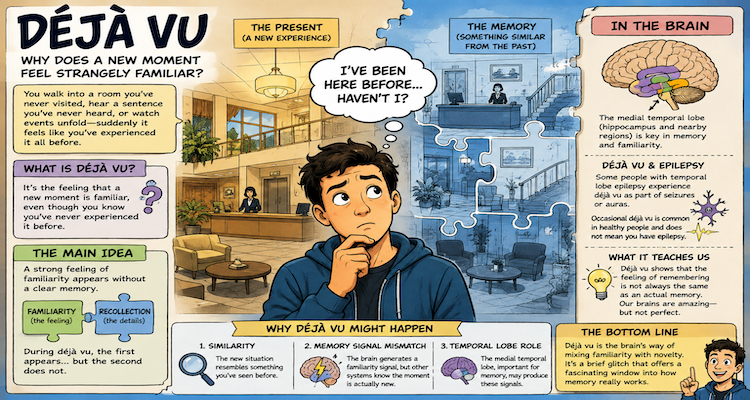
You walk into a room you have never visited, hear a sentence you are certain you have never heard, or watch a sequence of events unfold and suddenly feel that it has all happened before. The sensation can be brief but remarkably convincing. This is déjà vu, French for “already seen,” and despite its familiarity to millions of people, neuroscience still does not have a single definitive explanation for why it occurs.
Research increasingly suggests that déjà vu may reveal something important about how the brain distinguishes a genuinely remembered experience from a moment that merely feels familiar. Rather than being evidence of prediction, reincarnation, or a memory from another life, the experience is better understood as a window into the brain’s complex systems for memory, familiarity and error detection.
Key Takeaways
- Déjà vu is best understood as a mismatch between a strong feeling of familiarity and the knowledge that the present moment is actually new.
- Memory research distinguishes familiarity from recollection, helping explain why something can feel remembered without producing a specific memory.
- Similarity between a new situation and fragments of previous experiences may trigger a misplaced sense of recognition.
- Research has linked some déjà vu experiences to temporal-lobe seizure activity, but ordinary déjà vu is also common in healthy people.
- A 2024 systematic review found that non-ictal déjà vu has been experienced by a substantial proportion of healthy individuals, though experiences vary widely.
Déjà Vu May Be a Memory Signal Without a Memory
One of the most useful ways to understand déjà vu is to separate two experiences that usually work together.
The first is familiarity: the feeling that something has been encountered before.
The second is recollection: the ability to retrieve details about where, when or how that encounter happened.
Normally, these processes reinforce each other. You recognize a restaurant and remember visiting it. You hear a person’s name and remember where you met them.
During déjà vu, however, the first signal may appear without the second. The brain produces a powerful sense of familiarity, while the conscious mind cannot locate a genuine memory that explains it.
Research on recognition memory has long examined this distinction. Reviews of medial temporal-lobe function describe familiarity and recollection as related but distinguishable components of recognition memory, involving interacting brain systems rather than a single “memory centre.”
That distinction helps explain the peculiar quality of déjà vu. The experience is not simply, “I remember this.” It is closer to: “This feels remembered, but I know I should not remember it.”
The contradiction may be the defining feature.
The Similarity Hypothesis: A New Scene Can Resemble an Old One
Another influential explanation focuses on unnoticed similarity.
A completely new situation may share an arrangement, spatial pattern, object relationship or other feature with something encountered previously. The earlier experience may not be consciously retrieved as a specific memory, yet the overlap may still contribute to a feeling of familiarity.
Imagine entering an unfamiliar hotel lobby. You may never have visited the building, but the layout of the reception desk, the position of a staircase and the visual relationship between several objects may resemble an earlier environment. The similarity does not have to be exact and the earlier source of familiarity may remain inaccessible.
This possibility changes how déjà vu is often described. The brain may not be falsely “predicting the future.” Instead, it may be responding to patterns that genuinely resemble something stored in memory while failing to identify the source of that resemblance.
Laboratory research has attempted to investigate déjà vu-like experiences by exposing participants to situations that contain structural similarities to earlier experiences. Such work supports the broader idea that similarity can produce familiarity even when people cannot consciously identify the original source.
The important limitation is that this is not a complete explanation for every episode. Déjà vu remains difficult to study precisely because it is brief, subjective and often unpredictable.
What Happens in the Brain?
Neuroscience points repeatedly toward the medial temporal lobe, a region strongly associated with memory processes.
The hippocampus and nearby structures—including the perirhinal and parahippocampal regions—have been central to theories of recognition memory. Some models propose that déjà vu arises when systems involved in familiarity generate a signal that conflicts with systems evaluating whether the current experience is genuinely remembered or genuinely new.
One influential hypothesis describes déjà vu as a form of decoupled familiarity: a familiarity signal becomes activated in a way that does not match the person’s actual experience of the situation. The result is a striking sense that the present has somehow been encountered before.
However, it would be misleading to say that scientists have identified one precise brain mechanism responsible for every case.
Memory is distributed across interacting systems, and the neuroscience of familiarity itself remains an area of debate. Research supports the involvement of medial temporal structures, but the exact neural explanation of ordinary déjà vu is still not settled.
Why Déjà Vu Feels So Convincing
The striking aspect of déjà vu is not merely familiarity. It is the strength of the familiarity signal despite the absence of evidence.
This may offer a broader lesson about memory: the feeling that we know something is not identical to having a verifiable memory of it.
In everyday life, people often treat familiarity as evidence. A face looks known, so we assume we have met the person. A statement sounds familiar, so we may assume it is true or previously encountered. Déjà vu exposes a weakness in that intuition.
The brain can generate a compelling internal sense of recognition without providing the supporting details.
That does not mean familiarity is usually unreliable. Recognition is essential to ordinary memory and decision-making. But déjà vu demonstrates that the subjective experience of certainty and the underlying evidence for that certainty can occasionally diverge.
This is perhaps the phenomenon’s most interesting scientific implication. Déjà vu is not simply an odd mental glitch. It provides a natural example of how the brain monitors its own memories—and how that monitoring can sometimes produce a signal that does not fit reality.
Déjà Vu and Epilepsy: An Important Distinction
Déjà vu is common in healthy people, but it also has an established place in neurology.
Certain people with temporal lobe epilepsy may experience déjà vu as part of seizure activity or as an aura associated with seizures. This clinical association has helped researchers investigate the brain regions involved in memory-like experiences.
A 2024 systematic review and meta-analysis examined non-ictal déjà vu in healthy individuals as well as interictal and ictal experiences in people with epilepsy. The authors concluded that these categories should not simply be treated as one homogeneous phenomenon, because their characteristics and clinical contexts can differ.
This distinction matters.
Experiencing occasional déjà vu by itself does not mean a person has epilepsy. At the same time, recurrent episodes accompanied by other unusual symptoms such as altered awareness, confusion, unusual sensations or other seizure-like experiences should not be interpreted through an article alone. Medical evaluation may be appropriate.
The scientific lesson is that the same broad description, “I have experienced this before,” can arise in different contexts. Ordinary déjà vu and seizure-related experiences may overlap phenomenologically without necessarily being identical processes.
Why Scientists Still Do Not Have a Final Answer
Déjà vu presents an unusual research problem: scientists are trying to study an experience that often lasts only seconds and cannot easily be summoned on demand.
Researchers can study related processes such as familiarity, recognition, false memory and pattern similarity. They can also examine clinical cases involving epilepsy and use laboratory paradigms designed to evoke déjà vu-like states. But reproducing the full spontaneous experience reliably remains difficult.
That is why the science has produced several plausible, evidence-based models rather than one universally accepted explanation.
The strongest common thread is the relationship between novelty and familiarity. A new experience appears to acquire the feeling of an old one, while another part of the cognitive system recognizes that something is wrong.
In that sense, déjà vu may be less mysterious than it first appears but more revealing.
What Déjà Vu Tells Us About Memory
We tend to imagine memory as an archive: an event happens, it is stored, and later it is retrieved.
Modern memory research paints a more complicated picture. Recognition involves judgments, signals, reconstruction and context. A person can feel familiarity without retrieving a source. They can remember details inaccurately. They can also experience a momentary conflict between what feels known and what they know to be new.
Déjà vu compresses that conflict into a few unforgettable seconds.
The experience may therefore be valuable not because it proves that the brain has seen the future, but because it reveals how easily the feeling of remembering can become separated from an actual recollection.
That distinction extends beyond déjà vu. It touches a larger question at the heart of cognitive science: when we feel certain about a memory, what exactly is the brain telling us?
Sometimes, as déjà vu demonstrates, the answer may simply be that the brain has generated familiarity and that familiarity is not always the same thing as remembering.
Conclusion
The science of déjà vu has moved far beyond supernatural explanations, yet the phenomenon still resists a single definitive account. The available evidence points most strongly toward a disruption or mismatch in systems involved in familiarity, recognition and recollection, potentially shaped in some cases by unnoticed similarities between present and past experiences.
Its broader significance is easy to overlook. Déjà vu reminds us that memory is not a perfect recording of reality, nor is the feeling of recognition a guarantee that a genuine memory exists.
For a few seconds, the brain can make a completely new moment feel as though it belongs to the past. Understanding why that happens may ultimately tell scientists as much about how we recognize reality as about why reality occasionally feels strangely familiar.
This content is published for informational or entertainment purposes. Facts, opinions, or references may evolve over time, and readers are encouraged to verify details from reliable sources.