










Numbers Stations: The Mysterious Radio Broadcasts That Still Fascinate the World
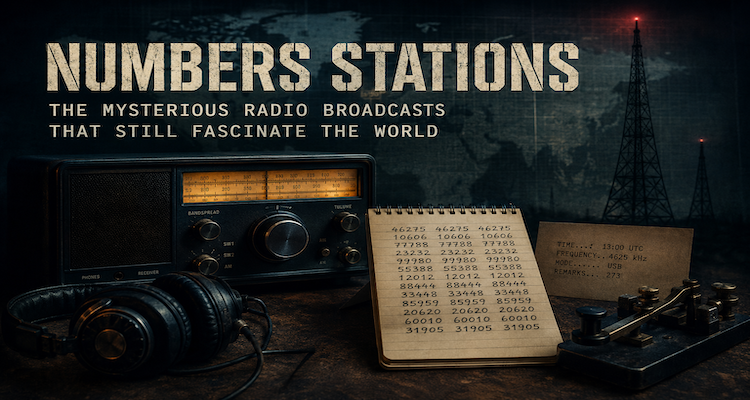
Late at night, somewhere on the shortwave spectrum, a voice begins speaking with mechanical calm. A repeated phrase may come first, followed by groups of numbers: five digits, a pause, then five more. Sometimes there is music. Sometimes Morse code. Sometimes the voice sounds synthesized, detached from any obvious human presence.
To an accidental listener, the transmission can feel like a message from nowhere.
These broadcasts are known as numbers stations, and they occupy a strange space between confirmed intelligence practice and unresolved mystery. Their precise operators are often unacknowledged, but espionage cases and decades of radio monitoring have established an important point: coded shortwave broadcasts have genuinely been used to communicate with intelligence agents. At the same time, the world of numbers stations is surrounded by uncertainty because many individual transmitters have never been officially claimed.
That combination is exactly why the phenomenon has endured. Numbers stations are not simply relics of Cold War paranoia. Radio-monitoring groups continue to document unusual and coded transmissions, while the basic communication advantages of high-frequency radio remain surprisingly relevant in an era dominated by satellites, smartphones and encrypted internet services.
Key Takeaways
- Numbers stations are coded radio broadcasts historically associated with clandestine and intelligence communications.
- Public espionage cases have provided rare confirmation that shortwave broadcasts can carry operational instructions.
- Many famous stations remain officially unattributed, so not every claimed operator can be treated as proven fact.
- Shortwave radio can transmit across long distances without requiring the recipient to send a signal back.
- Monitoring communities continue to document coded broadcasts, showing that the phenomenon did not disappear with the Cold War.
- The continuing fascination lies in a central paradox: the broadcasts are public, but their meaning can remain inaccessible.
What Exactly Is a Numbers Station?
A numbers station is generally understood as a radio transmission—often on the high-frequency or shortwave bands—that broadcasts structured groups of numbers, letters, words, Morse code or digital signals.
The classic format is simple. A station may announce an identifier, followed by a message made up of repeated numerical groups. Some transmissions use distinctive interval signals or pieces of music. Others rely on synthetic voices, Morse code or digital modes.
The public can hear the transmission. That does not mean the public can understand it.
The crucial distinction is between receiving a message and decoding it. A listener with an ordinary radio may be able to record every number perfectly, yet still have no practical way of discovering what those numbers mean.
This is why the broadcasts are so compelling. Unlike a locked digital file hidden behind a password, a numbers station often appears to reveal everything while explaining almost nothing.
The hobbyist organization ENIGMA 2000 has spent decades cataloguing and monitoring such transmissions, assigning designations and maintaining information on active and historical stations. Its continuing newsletters and station records demonstrate that numbers-station monitoring remains an active niche within the wider shortwave-listening community.
How Could a List of Numbers Carry a Secret Message?
The most widely discussed explanation involves the use of one-time pads, a form of encryption in which a message is combined with a genuinely random key that is used only once.
When correctly implemented, one-time-pad encryption is theoretically secure against cryptanalysis without access to the key. The difficulty is not mathematical weakness but operational management: the communicating parties must securely possess matching key material and must never reuse it.
In a simplified scenario, an intelligence service could encrypt an instruction, convert the encrypted result into numerical groups and broadcast those groups over shortwave radio. An intended recipient, already holding the correct decoding material, could potentially reconstruct the original message.
The radio broadcast itself would therefore not need to identify the recipient.
This model also illustrates one of the most important advantages of one-way radio communication: the intended listener may not need to transmit anything back. A recipient can simply listen at the expected time and frequency. That can reduce the communication trail associated with an outgoing call, internet connection or radio transmission.
Not every numbers station can be confidently linked to a particular encryption system, however. The exact technical methods behind many broadcasts remain unknown. It is safer to say that coded broadcasts are consistent with established intelligence communication techniques than to assume that every unexplained voice reading numbers is using the same system.
The Evidence: Numbers Stations Are More Than a Cold War Myth
The mysterious reputation of numbers stations sometimes obscures an important fact: coded shortwave communications have appeared in publicly documented espionage investigations.
One of the clearest examples involves the Cuban intelligence network known in the United States as the Cuban Five case. Court proceedings and subsequent reporting established that coded radio transmissions formed part of the communications system examined by investigators. The case provided unusually concrete evidence connecting encrypted broadcasts with real intelligence activity.
Other publicly documented espionage cases have also involved radio-delivered coded communications, including investigations connected with the Russian “Illegals Program” uncovered in the United States in 2010. These cases matter because they move the subject beyond folklore. They do not prove the identity or purpose of every mysterious transmission, but they demonstrate that the underlying method is real.
That distinction is essential for understanding the subject responsibly.
Confirmed intelligence use does not automatically confirm the operator of every station heard by radio enthusiasts.
Some famous attributions are based on direction finding, technical observation, historical records or strong circumstantial evidence rather than a formal government admission. Others remain genuinely unresolved.
Why Shortwave Still Makes Sense in a Digital World
At first glance, numbers stations can seem technologically obsolete. Why broadcast strings of digits through the atmosphere when encrypted messaging applications, satellite systems and secure networks exist?
The answer is that different communication systems have different vulnerabilities.
Internet communication can depend on infrastructure, service providers, account systems and identifiable network activity. A shortwave broadcast, by contrast, can potentially reach large geographic areas while requiring no connection between transmitter and listener.
One broadcast can also be received by an unknown number of listeners.
That does not make shortwave superior to modern encrypted communication in every situation. It is slower, more conspicuous to spectrum monitors and limited in the amount of information it can conveniently transmit. But for a narrow purpose delivering a short, prearranged message to someone who knows when and where to listen it has characteristics that digital systems do not automatically replace.
This is the deeper reason numbers stations remain interesting: old technology does not necessarily become useless when newer technology appears. Sometimes an older system survives precisely because its limitations also create operational advantages.
Radio-monitoring organizations continue to report and catalogue active coded transmissions, while specialist researchers maintain station profiles based on long-term observations. Such monitoring does not prove every claimed attribution, but it shows that the shortwave mystery is not confined entirely to historical recordings.
From Cold War Tool to Cultural Phenomenon
Numbers stations have also escaped the world of intelligence and entered popular culture.
The distinctive sounds of these broadcasts have appeared in music, film and other creative works. The Conet Project, a collection of recorded numbers-station and related transmissions assembled by Irdial-Discs, helped preserve some of the most recognizable examples for listeners far beyond the shortwave-radio community.
Part of the cultural appeal comes from the sound itself.
A human voice normally implies conversation. Numbers stations remove that expectation. The listener hears speech, but not communication in the ordinary sense. There is no explanation, no visible speaker and often no identifiable audience.
The result can sound unsettling even when the transmission is technically routine.
Famous stations acquired memorable names from listeners rather than necessarily from their operators. The Lincolnshire Poacher, for example, became known for its use of the opening bars of the English folk tune before transmissions. The nickname gave an otherwise anonymous signal an unexpected cultural identity.
That practice reveals another important feature of numbers-station history: much of what the public knows comes from listeners who patiently recorded schedules, compared frequencies and preserved audio over many years.
Without that community, many transmissions might have disappeared almost completely from public memory.
The Mystery Has Limits and So Should the Claims
Numbers stations attract speculation because their format invites interpretation. A strange voice on an unfamiliar frequency can quickly generate claims about intelligence agencies, military operations or geopolitical crises.
Many such claims are difficult to verify.
A responsible understanding of numbers stations requires separating three categories:
- Confirmed cases, where court records, declassified material or other strong evidence links coded broadcasts to intelligence activity.
- Well-supported attributions, based on technical analysis, historical evidence or long-term monitoring.
- Unresolved signals, where the operator and purpose remain uncertain.
The categories are not interchangeable.
For example, monitoring groups may document a new or unusual broadcast and assign it a designation based on its language or format. That establishes that the signal was observed and categorized by the group; it does not automatically establish the identity of the government or agency operating it.
This uncertainty is not a weakness in the story. It is part of the story.
Numbers stations demonstrate the limits of open-source observation. Modern listeners can record, archive, analyze and share a transmission almost instantly, yet knowing what was broadcast is fundamentally different from knowing who sent it and what it meant.
Why the World Still Listens
The enduring fascination with numbers stations comes from a contradiction that modern technology has not eliminated.
The message is broadcast openly.
Anyone with the right equipment and conditions may hear it.
Yet the intended meaning can remain inaccessible.
In an age when people worry about encrypted apps, data leaks and algorithmic surveillance, numbers stations offer a reminder that secrecy does not always depend on hiding the existence of a message. Sometimes the message can be placed directly into the public airwaves and remain protected by the information that the intended recipient already possesses.
That is why these broadcasts continue to capture imaginations. They connect early radio technology with modern intelligence, mathematics, cryptography and a global community of listeners who are still trying to understand what they hear.
The mystery is not that numbers stations exist. Decades of evidence show that coded radio broadcasts have had real intelligence uses. The more enduring mystery is narrower and far more difficult to solve: among the signals still heard on the spectrum, which ones are operational communications, who is listening, and what information is hidden inside those calm, repetitive voices?
Conclusion
Numbers stations survive in public imagination because they challenge a basic assumption about secrecy: that secret communication must itself be hidden.
These broadcasts demonstrate another possibility. The transmission can be completely exposed while its meaning remains inaccessible.
Historical espionage cases provide solid evidence that coded shortwave broadcasts have been used for clandestine communication. But the broader landscape remains full of uncertainty, and that uncertainty demands restraint. Not every strange signal is a spy message, and not every popular attribution has been officially confirmed.
For listeners, researchers and technology enthusiasts, that unresolved boundary may be the most fascinating part. Numbers stations sit at the intersection of radio engineering, cryptography, intelligence history and human curiosity a reminder that even in a connected world, some of the most public messages can remain among the most private.
This content is published for informational or entertainment purposes. Facts, opinions, or references may evolve over time, and readers are encouraged to verify details from reliable sources.