








The Mandela Effect: Why Do So Many People Remember Things That Never Happened?
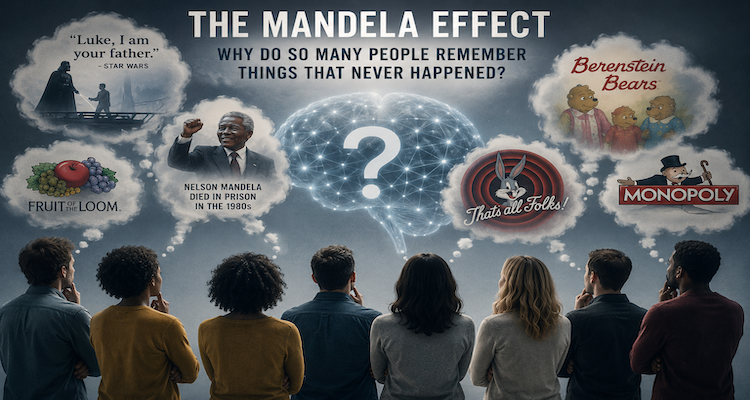
A famous person dies or so thousands of people remember. A movie line seems unforgettable, yet the version repeated for years was never actually spoken that way. A logo appears to have changed, although historical records show it did not.
These experiences are commonly grouped under the label “Mandela Effect,” a term used to describe situations in which many people share a confident memory that conflicts with the available record. The phenomenon is often treated as a pop-culture mystery. The more useful question, however, is not whether reality has somehow changed, but why memory can produce the same error across large groups of people.
Psychological research offers an important clue: memory is not a perfect recording that simply plays back the past. It is a reconstructive process. That makes memory remarkably useful, but it also leaves room for gaps, assumptions, suggestions and repeated information to influence what people later believe they remember.
Key Takeaways
- The Mandela Effect describes shared memories that conflict with documented evidence, but it is not a formal scientific diagnosis.
- Memory is reconstructive, so people can remember plausible details that were never actually experienced.
- Laboratory research shows that misleading information and social interaction can contribute to false memories.
- Familiarity and repetition can make an incorrect version feel increasingly believable.
- The same psychological mechanisms that create pop-culture memory errors also matter in an era of rapidly shared misinformation.
Where Did the Term “Mandela Effect” Come From?
The expression is generally credited to Fiona Broome, who used it after describing her own mistaken belief that Nelson Mandela had died in prison decades before his actual death in 2013. She later found that other people reported similar memories.
The name stuck because the idea was compelling: how could many unrelated people remember the same event incorrectly?
But the label itself should not be confused with a single scientific explanation. Researchers studying memory have long examined phenomena such as false memory, misinformation effects, source-monitoring errors and social contagion. The Mandela Effect is better understood as a popular cultural label that can describe several different kinds of memory error rather than one distinct psychological mechanism.
That distinction matters. Two people may arrive at the same incorrect memory for different reasons.
Memory Is Reconstructed, Not Simply Replayed
One of the most important insights from memory research is that remembering is an active process.
People do not store every experience with perfect detail. Instead, memory often preserves fragments, meanings, relationships and general patterns. When recalling an event, the brain reconstructs an account from the information available.
That process can work extremely well. It also creates opportunities for error.
Consider a list of related words such as pillow, blanket, tired and bed. In the widely used Deese-Roediger-McDermott (DRM) paradigm, people may later report remembering a strongly associated word that was never presented, such as sleep. Research using this approach demonstrates how false memories can arise even without someone deliberately supplying misinformation.
The broader lesson is not that memory is unreliable all the time. It is that confidence and accuracy are not identical things. A memory can feel vivid, familiar and convincing while still containing an error.
Why Do Groups Make the Same Mistake?
This is where the Mandela Effect becomes more interesting than an ordinary memory lapse.
If one person remembers something incorrectly, that is unsurprising. But when many people report a similar error, the question becomes: why do memories sometimes converge?
One explanation is shared expectations.
People exposed to similar culture, language, stories and visual conventions may independently make similar assumptions. If a fictional character, brand or quotation seems as though it should contain a certain detail, the brain may later reconstruct the memory in that expected form.
A second explanation is social transmission.
Experimental research has shown that false information can spread through remembering with other people. In one series of experiments, participants who heard another person incorrectly recall items from a previously viewed scene were later more likely to report those suggested items themselves.
Later research has examined how these effects can operate within groups and networks, showing that social interaction can contribute to the emergence and persistence of shared false memories.
The important point is that people do not necessarily need to coordinate their memories for convergence to occur. Shared cultural knowledge, repeated exposure and interaction can push recollections in similar directions.
The Role of Familiarity: Why a Wrong Version Can Feel Right
Imagine seeing an incorrect movie quotation online hundreds of times. Eventually, the phrase may become more familiar than the original.
That familiarity can create a powerful subjective feeling: I know this.
But familiarity does not prove that the information came from the original source.
Psychologists refer to this general challenge as a problem of source monitoring distinguishing where a remembered piece of information came from. Was it seen in the original film? Heard from another person? Read in a meme? Or inferred from related information?
Research on socially introduced false memories suggests that people can sometimes misattribute information supplied by others to their own original experience.
This may help explain why online culture can amplify Mandela Effect-style experiences. Search results, memes, comments, videos and conversations can repeatedly expose people to the same incorrect version. The more often that version circulates, the more opportunities there are for familiarity to become confused with genuine recollection.
That does not mean every widely shared misconception is caused by social media. Many famous examples predate modern platforms. But digital networks can make incorrect versions easier to repeat, preserve and rediscover.
False Memory Is Not One Single Phenomenon
A crucial limitation is often missing from popular discussions of the Mandela Effect: not all false memories arise in the same way.
The false memory produced by a related word list is not necessarily equivalent to the error created after someone receives misleading information. A study published in PLOS ONE found that performance on a DRM false-memory task was not correlated with susceptibility to the misinformation effect in its experiment, suggesting that different forms of memory distortion should not automatically be treated as the same phenomenon.
That makes broad explanations such as “the brain is glitching” scientifically unhelpful.
A particular Mandela Effect example could involve:
- an incorrect assumption based on language or cultural patterns;
- confusion between similar versions of an event or product;
- repeated exposure to an inaccurate quotation or image;
- source-monitoring errors;
- misinformation introduced after the original experience;
- social reinforcement of an existing mistake;
- or a combination of several factors.
The label may be simple. The underlying psychology is not.
What the Mandela Effect Reveals About the Information Age
The most significant implication may have less to do with famous logos or movie quotes and more to do with how societies remember.
Research on social transmission of false memories shows that memory can be influenced through interaction and can spread across groups. Reviews of this work point to broader societal implications because shared inaccuracies can shape collective understanding as information moves through social networks.
This creates an important distinction between remembering and verifying.
A large number of people agreeing about something does not automatically establish that it happened. Consensus can be evidence worth investigating, but collective confidence is not the same as documentation.
That lesson has become especially relevant in digital environments, where old claims can be reposted without context and inaccurate descriptions can circulate long after the original source has been forgotten.
The practical response is not to distrust every memory. It is to recognize when a memory concerns a fact that can be independently checked.
For historical events, official records, archival reporting and primary documents may help. For quotations, the original speech, book, film or interview is more useful than thousands of repeated versions. For images and logos, dated archives can establish whether a remembered version ever existed.
In other words, confidence should not be the final test of accuracy.
Why Correcting a False Memory Is Not Always Simple
Simply telling someone that a memory is wrong may not immediately erase the feeling attached to it.
False information can remain influential because the person may remember the information while forgetting its source or the later correction. At the same time, research suggests that returning to original material can help reduce the influence of socially introduced misinformation. In one experimental study, re-studying the original information reduced later incorporation of misleading suggestions.
The broader implication is practical: when accuracy matters, returning to the best available primary source may be more effective than endlessly repeating the false claim alongside a correction.
This is also why Mandela Effect discussions can be educational when handled carefully. They create an opportunity to ask a more valuable question than “How can so many people be wrong?”
The better question is: What information, assumptions and social influences might have helped produce the memory?
Conclusion
The Mandela Effect does not require alternate timelines or mysterious changes to reality to be interesting. The established science of memory is already remarkable enough.
Human memory is powerful, but it is also reconstructive. We fill gaps, connect related ideas, absorb information from other people and sometimes lose track of where a remembered detail originated. When large groups share similar experiences, similar expectations and the same information environment, those errors can sometimes become collective.
That is what makes the Mandela Effect more than a collection of internet curiosities. It is a reminder that memory and evidence serve different purposes. A memory can tell us what feels true to us; verification helps determine what actually happened.
In an information environment built on repetition, sharing and constant reinterpretation, knowing the difference may be more important than ever.
This content is published for informational or entertainment purposes. Facts, opinions, or references may evolve over time, and readers are encouraged to verify details from reliable sources.