










The Art of Seeing the World Differently
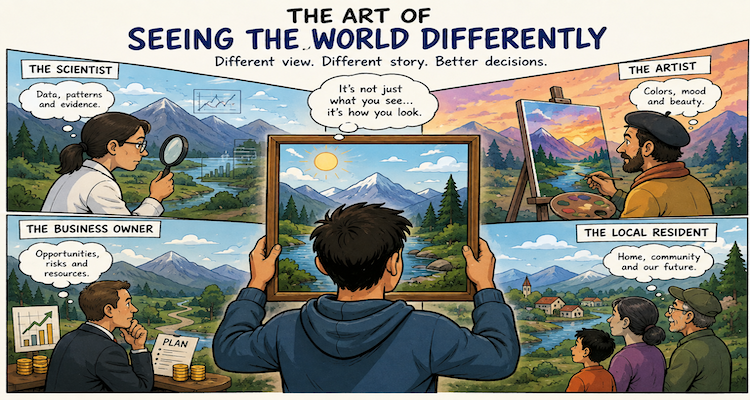
Most of us assume that we see the world as it is. In reality, perception is an active process: the brain selects, interprets and organizes information rather than simply recording everything around us. That distinction matters. It shapes how people solve problems, judge others, create new ideas and respond to unfamiliar situations.
The deeper value of “seeing differently” is not in trying to be unusual for its own sake. It lies in recognizing that the first interpretation is not always the only interpretation and sometimes not the most useful one.
Key Takeaways
- Perception is an active process shaped by attention, expectations, context and prior knowledge.
- Looking at the same problem from multiple perspectives can reveal assumptions hidden by familiar thinking.
- Cognitive biases can narrow interpretation, making alternative viewpoints harder to notice.
- Creative insight often depends on reframing a problem rather than simply gathering more information.
- Technology can expand access to information while also influencing what people notice and prioritize.
Why Seeing Differently Begins With Understanding Perception
The first step is to challenge a simple assumption: seeing is not the same as recording.
The American Psychological Association describes perception as the process of recognizing, interpreting and organizing sensory information, while attention selectively directs cognitive resources toward particular parts of that information. In other words, the world may contain far more information than we consciously notice at any given moment.
That helps explain why two people can experience the same event and still describe it differently. What they notice may be influenced by prior beliefs, expectations, memories and the context in which they encounter the event. Recent reporting from the APA on sensory processing also highlights the limits of perception, including the way preexisting beliefs can influence attention and how inattentional blindness can cause people to miss stimuli that are plainly present in their environment.
This does not mean that every interpretation is equally valid. Evidence still matters. Facts still matter. But our first interpretation should sometimes be treated as a starting point rather than a final verdict.
The Hidden Cost of Familiar Thinking
Familiar ways of thinking are efficient. They allow people to make quick judgments without reconsidering every decision from the beginning.
The problem appears when efficiency becomes rigidity.
A difficult workplace issue may continue because everyone defines the problem in the same way. A product may fail to improve because its designers focus on technical features while customers are struggling with a completely different problem. A disagreement may become more hostile because each side assumes the other sees the situation through the same information and priorities.
Psychologists use the term reframing for the process of reconceptualizing a problem from a different perspective. Changing the conceptual or emotional context of a problem can alter how difficult it appears and open alternative possibilities for responding to it.
The important point is practical: sometimes progress does not require more information. It requires asking whether the information already available is being organized in the right way.
That distinction matters in business, education, technology and everyday life. A team can spend weeks debating the answer to the wrong question. An individual can search for a solution while unconsciously protecting an assumption that prevents the solution from becoming visible.
Perspective Is More Than Empathy
Perspective-taking is often discussed as a social skill: the ability to understand how another person might see a situation. Its value, however, extends beyond improving relationships.
Research published in Cognitive Science compared a perspective-taking mindset with mind-wandering and a control condition in tasks involving new uses for familiar objects. In the studies described by the researchers, participants prompted to think from different roles generated more ideas and more original ideas than the other groups. The authors argued that perspective-taking can provide a useful search strategy for innovation and problem-solving.
That finding offers an important insight for anyone trying to solve a stubborn problem.
Instead of repeatedly asking, What is the answer?, it may be useful to ask:
- How would a customer describe this problem?
- What would someone unfamiliar with our industry notice first?
- Which assumption would a critic challenge?
- What changes if the opposite interpretation is correct?
- What would this situation look like from a different role?
These questions do not guarantee a better answer. They do something more fundamental: they expand the range of answers that can be considered.
Creativity Often Requires Escaping Fixation
One of the biggest obstacles to seeing differently is fixation the tendency to remain attached to familiar ideas, solutions or representations of a problem.
Research on creativity and insight has repeatedly examined ways to help people move beyond stereotypical responses. A review of research on “thinking in opposites,” for example, argues that changing the initial representation of a problem can help people move away from fixed approaches and explore alternative solutions. The authors also emphasize that more research is needed to understand when and how such strategies work best.
This is an important limitation to remember. “Thinking differently” is not a magical technique. Looking at a problem from another angle can produce useful insight, but it can also produce bad ideas, unsupported assumptions or unnecessary complexity.
The goal is not to reject conventional thinking. Conventional solutions are often conventional because they work.
The real skill is knowing when a familiar approach has reached its limit.
Technology Can Expand Perspective and Narrow It
The modern information environment creates an interesting contradiction.
Technology gives individuals access to an extraordinary range of perspectives. A person can read research from universities, follow reporting from different countries, explore historical archives and encounter communities they might never meet in everyday life.
At the same time, digital systems compete for attention.
Because attention is limited, the information we encounter is never simply “everything that exists.” Search systems, recommendation systems, social networks and our own choices influence what becomes visible. The broader psychological point is straightforward: attention is selective, and selective attention shapes what information receives deeper processing.
For readers and technology users, this creates a practical responsibility. Access to more information does not automatically create a broader perspective. A person can consume thousands of pieces of content while repeatedly encountering the same assumptions.
Seeing differently in the digital age may therefore require deliberate habits:
- Compare credible sources rather than relying on a single version of an event.
- Notice what information is missing, not only what is present.
- Separate evidence from confident presentation.
- Look for the assumptions built into the question itself.
- Change the source of information when every answer begins to sound the same.
A Different View Is Not Automatically a Better View
There is a temptation to romanticize unconventional thinking. But originality and accuracy are not interchangeable.
A useful alternative perspective should be tested against evidence. If a new interpretation explains less, ignores important facts or depends on unsupported assumptions, its novelty does not make it valuable.
This is where critical thinking and creative thinking need each other.
Creative thinking expands the possibilities. Critical thinking evaluates them.
Research examining the relationship between creative thinking and perspective-taking suggests that shifts in perspective can influence how people interpret later information and social situations. But such findings should not be stretched into a universal claim that creativity automatically makes people more accurate or more empathetic in every context. Human cognition is more complicated than that.
The strongest form of open-mindedness is therefore not believing every alternative explanation. It is being willing to consider an alternative and then asking what evidence supports it.
The Practical Art of Seeing Differently
The ability can be developed less through grand acts of inspiration than through small changes in how problems are approached.
When confronted with a familiar issue, pause before searching for an answer. First examine the frame.
Ask:
What am I assuming?
Some assumptions are facts. Others are habits that have become invisible.
What information am I ignoring?
Attention always selects. The challenge is to identify what selection may have left behind.
Who sees this problem differently, and why?
A different perspective may reveal different incentives, constraints or priorities.
Can the problem itself be stated another way?
Changing the question can change the range of possible answers.
What evidence would change my mind?
This question protects open-mindedness from becoming vague relativism.
These habits are especially useful in a world where decisions increasingly involve complex systems, rapidly changing technology and large volumes of information. The challenge is no longer simply finding more data. Often, it is deciding what deserves attention and whether the framework used to interpret it still makes sense.
Conclusion
The art of seeing the world differently begins with intellectual humility: recognizing that perception is selective, interpretation is shaped by context, and familiar explanations can sometimes hide alternatives worth examining.
That does not require abandoning judgment or treating every viewpoint as equally credible. It requires a more disciplined approach expanding the range of possibilities, testing them against evidence and remaining willing to revise an interpretation when the facts demand it.
The world does not always change when we look at it from another angle. But sometimes the angle reveals that the problem, the opportunity or even the question was never quite what we thought it was.
This content is published for informational or entertainment purposes. Facts, opinions, or references may evolve over time, and readers are encouraged to verify details from reliable sources.