










Turning Ambition Into Advantage: The Skills That Make Career Goals More Valuable
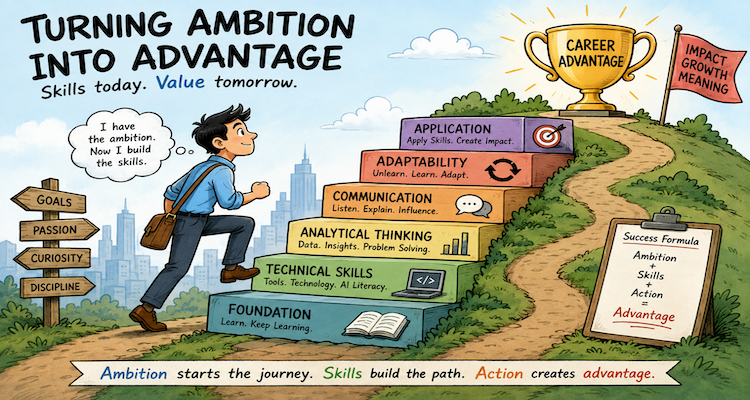
Ambition can open a door, but it rarely determines what happens after someone walks through it. In a workplace being reshaped by artificial intelligence, automation and rapidly changing skill requirements, the more useful question is not simply how ambitious a professional is. It is whether that ambition is being converted into capabilities that create measurable value.
The distinction matters because career progress is becoming less dependent on holding one fixed set of skills for a long period. The World Economic Forum’s Future of Jobs Report 2025 estimates that about 39% of workers’ existing skill sets could be transformed or become outdated between 2025 and 2030. At the same time, analytical thinking remains a leading core skill, while AI and big data, cybersecurity and technological literacy are among the fastest-growing skill areas.
That does not mean every professional needs to become an AI engineer. It means ambition increasingly has to be paired with adaptability, technical fluency, judgment and the ability to apply knowledge to real problems.
Key Takeaways
- Ambition becomes valuable when it is translated into skills, decisions and measurable outcomes.
- AI literacy is becoming useful across careers, but technical knowledge alone is not enough.
- Analytical thinking and human capabilities remain important as technology takes on more routine work.
- Building adjacent skills can create more career options than simply pursuing a higher job title.
- The strongest professional advantage is increasingly the ability to learn, apply and adapt repeatedly.
Ambition Alone Is Not a Career Strategy
Ambition is often described as a personal quality: wanting a promotion, leading a larger team, earning more money or reaching a senior position.
Those goals are legitimate, but they describe destinations rather than capabilities.
A professional who wants to move into management, for example, may discover that technical expertise alone is insufficient. Leadership requires communication, prioritization, decision-making, stakeholder management and the ability to understand how individual work contributes to broader business objectives.
The same principle applies to someone seeking a technology career. Learning a programming language can be valuable, but knowing how to use that language to solve a business problem is considerably more useful.
This is where ambition can become an advantage rather than simply a desire.
The useful question becomes: What capability would make me more valuable if I developed it?
That question changes career development from title chasing into capability building.
The Workplace Is Rewarding Combinations of Skills
One of the most important findings in current workforce research is that the future of work is not being defined exclusively by technical skills.
The World Economic Forum reports that AI and big data are among the fastest-growing skills, but analytical thinking remains the most sought-after core skill. Creative thinking, resilience, flexibility, leadership and social influence are also expected to remain important through 2030.
That creates an interesting opportunity.
A professional does not necessarily need to compete with a specialist on the specialist’s strongest ground. Instead, career advantage can come from combining disciplines.
Consider three broad combinations:
- Technology + business: understanding how digital tools can improve operations, revenue or customer experience.
- AI + domain expertise: understanding how AI can be applied responsibly within a particular profession.
- Technical ability + communication: being able to build something and explain why it matters.
These combinations can be more difficult to replace than isolated knowledge because they require judgment about when and how a capability should be applied.
AI Literacy Is Becoming a Career Skill, Not Just a Technical Skill
The rise of AI has created a common misconception: that professionals must become machine-learning specialists to remain relevant.
The evidence points toward a broader interpretation.
LinkedIn’s 2025 research on skills in India identified AI literacy among the fastest-growing skills, alongside areas such as creativity and innovation and strategic thinking. Its India workforce analysis also reported that many professionals were already using AI to accelerate tasks and that non-technical professionals were increasingly engaging with AI learning.
AI literacy does not necessarily mean understanding every technical detail behind a large language model.
For many professionals, it means knowing:
- which tasks AI can assist with;
- where its output needs verification;
- how to provide useful instructions and context;
- how to evaluate an AI-generated answer;
- what information should not be given to an AI system;
- and how AI can be incorporated into an existing workflow.
The distinction is important. Using AI to produce more output is not automatically valuable. Using it to improve a meaningful process can be.
The Real Advantage Is Application
Knowing a tool is different from knowing what to do with it.
Someone may complete an AI course, learn several prompting techniques and experiment with automation platforms. That creates knowledge, but the career advantage appears when those capabilities solve an actual problem.
For example, an employee who uses automation to reduce repetitive administrative work has created a measurable outcome. A marketer who uses AI to accelerate research while maintaining human editorial review has created a different kind of advantage. A developer who combines coding with AI-assisted development may be able to prototype and test ideas more quickly.
The underlying pattern is the same:
Skill → application → outcome.
That progression is more meaningful than collecting certificates without demonstrating what the knowledge can accomplish.
LinkedIn’s research has similarly emphasized the growing importance of continuous learning and AI literacy as work changes.
Build an Adjacent Skill Before You Need It
One of the safer ways to turn ambition into opportunity is to develop a skill adjacent to the work you already understand.
A financial professional might learn data analysis. A writer might learn content analytics and AI-assisted research. A developer might learn automation and business process design. A manager might develop stronger data literacy.
The advantage is that the existing expertise provides context.
Starting from zero in an unrelated discipline can be difficult. Adding a complementary capability to existing experience can create a new professional profile without requiring someone to abandon everything they already know.
This is particularly relevant as employers increasingly focus on skills rather than relying exclusively on traditional job descriptions.
The World Economic Forum estimates that, if the global workforce were represented by 100 people, 59 would need reskilling or upskilling by 2030.
That figure suggests that learning should not be treated as a one-time career event. It is becoming part of the career itself.
Turn Ambition Into Evidence
Another overlooked part of career development is proof.
Saying that you understand AI, automation, programming, analytics or leadership is less persuasive than demonstrating what you have done with those capabilities.
Evidence can take different forms:
- a working project;
- a process that was improved;
- a measurable efficiency gain;
- a portfolio;
- a well-documented experiment;
- a successful implementation;
- or a clear case study explaining a problem and its solution.
This changes the professional conversation.
Instead of saying, “I want to move into technology,” someone can demonstrate a working automation project.
Instead of saying, “I understand AI,” they can show how an AI-assisted workflow improved a genuine process while explaining its limitations.
Ambition becomes much more credible when it leaves evidence behind.
Human Judgment Still Matters
The growth of AI should not be interpreted as a reason to neglect human capabilities.
The World Economic Forum’s skills analysis places analytical thinking, creative thinking, resilience, flexibility, leadership and social influence alongside rapidly growing technology skills.
That combination is significant.
Technology can increase the speed at which information is produced, but organizations still need people who can determine which problems deserve attention, which information is reliable, what trade-offs matter and how decisions affect customers and colleagues.
As AI becomes easier to access, the ability to question an answer may become as important as the ability to obtain one.
That is why ambition should not lead professionals toward technology at the expense of judgment. The stronger strategy is to combine both.
A Better Way to Think About Career Growth
Traditional career thinking often follows a relatively simple sequence:
Learn → get a job → gain experience → get promoted.
The modern version is becoming more iterative:
Learn → apply → measure → adapt → learn again.
This does not make traditional expertise irrelevant. It makes continuous development more important.
A professional who stops learning when they become comfortable may eventually find that the environment has moved beyond the skills that once created their advantage.
By contrast, someone who treats every significant change as an opportunity to add a complementary capability can gradually build a broader professional toolkit.
That is a more realistic form of career resilience than trying to predict exactly which job will exist several years from now.
The Advantage Comes From Connecting Ambition to Value
Ambition is useful because it creates movement. But movement by itself is not progress.
The professionals most likely to benefit from changing workplaces are not necessarily those with the most ambitious titles or the longest lists of qualifications. A stronger advantage can come from understanding where technology is heading, identifying problems worth solving, developing the skills needed to address them and demonstrating the resulting value.
The lesson is particularly relevant in an AI-driven economy.
The goal should not be to become permanently “future-proof.” No skill guarantees that. The more practical objective is to become better at adapting: learning new tools, questioning old assumptions, combining capabilities and turning knowledge into useful outcomes.
That is how ambition becomes an advantage.
Conclusion
A career goal becomes powerful when it is connected to a capability that other people, organizations or customers genuinely value. In a period of rapid technological change, that means pairing ambition with continuous learning, AI literacy, analytical thinking, communication and practical problem-solving.
The most durable professional advantage may therefore be less about knowing exactly where the workplace is going and more about becoming capable of moving with it.
The information presented in this article is based on publicly available sources, reports, and factual material available at the time of publication. While efforts are made to ensure accuracy, details may change as new information emerges. The content is provided for general informational purposes only, and readers are advised to verify facts independently where necessary.