










Markets, Minds, and the Pursuit of Growth
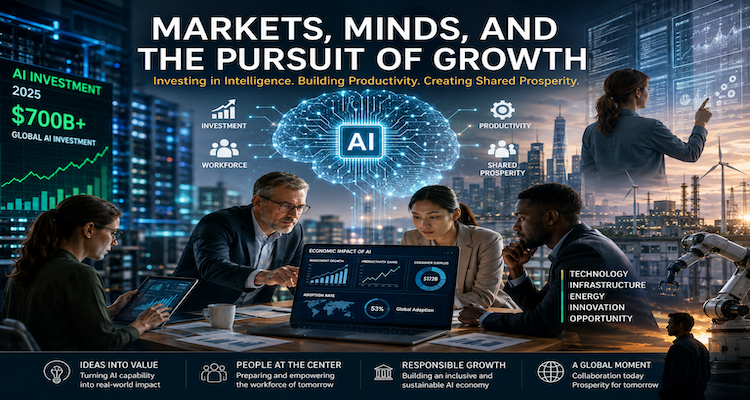
Economic growth has always depended on a difficult combination of capital, ideas, productivity and human capability. What is changing now is the speed at which those forces are being connected.
Artificial intelligence is moving from an experimental technology into a significant part of corporate investment, workplace adoption and consumer activity. Stanford’s 2026 AI Index reports that global corporate AI investment more than doubled in 2025, while generative AI reached roughly 53% population-level adoption within three years of its mass-market introduction. At the same time, the report cautions that measurable productivity gains remain concentrated in particular tasks and that evidence of a broad macroeconomic productivity transformation is still early and mixed.
That tension sits at the center of today’s growth story. Markets are pricing the possibility of a much more productive economy, companies are spending heavily to build it, and workers are being asked to adapt to it. But investment is not the same thing as productivity, and productivity is not automatically the same thing as broadly shared prosperity.
Key Takeaways
- AI investment is accelerating, but the economic payoff remains uneven across companies, industries and workers.
- Markets are increasingly treating computing infrastructure, energy and AI capability as strategic growth assets.
- Measurable AI productivity gains are strongest in structured work where outputs can be evaluated clearly.
- Rapid adoption does not guarantee that companies will capture sustainable profits from AI spending.
- Workers may experience the transition differently depending on their age, occupation, skills and exposure to automation.
- The central economic question is shifting from AI capability to how effectively organizations convert capability into durable value.
The New Growth Equation
For much of modern economic history, growth has been tied to improvements in labor, capital and productivity. New technologies can influence all three, but they rarely transform an economy simply because they exist.
AI is beginning to affect the equation at several levels simultaneously.
Companies are investing in models, computing capacity, software, data centers and specialized infrastructure. Employees are using generative AI for coding, customer support, marketing, research and administrative work. Consumers are using AI tools for tasks that previously required paid services or considerable amounts of time.
The scale of this investment is significant. Stanford’s 2026 AI Index found that global corporate AI investment more than doubled during 2025, with private investment increasing 127.5%. Generative AI accounted for nearly half of private AI funding.
But capital expenditure is an input into growth, not proof of growth.
A company can spend billions on technology without generating a proportional increase in revenue or productivity. The more important question is whether AI allows businesses to produce more valuable output with the same resources—or the same output with fewer resources.
That distinction is becoming increasingly important for investors.
Why Markets Are Paying Attention
Financial markets are forward-looking. Investors do not necessarily wait for productivity statistics to confirm a technology’s value before assigning companies higher expectations.
The current AI investment cycle illustrates this dynamic.
Demand for advanced computing has created opportunities not only for model developers but also for semiconductor companies, cloud providers, data-center operators, power suppliers and other infrastructure businesses. Recent financial reporting has increasingly focused on the scale of capital expenditure required to support AI workloads. Reuters reported in August 2026 that major technology companies’ AI-related investments were expected to exceed $700 billion during the year, while strong earnings were helping sustain investor optimism.
This creates an important feedback loop:
AI expectations → investment → infrastructure demand → corporate revenue → investor expectations.
Such loops can accelerate technological development. They can also create risks if expectations become detached from eventual economic returns.
The infrastructure challenge is particularly revealing. AI systems require enormous amounts of computing power and electricity. The Financial Times reported that AI infrastructure providers were increasingly attracting investment as power availability and grid constraints became strategic bottlenecks.
The lesson is broader than AI.
When a technology becomes economically important, its growth eventually depends on physical systems that cannot be scaled instantly. Chips, electricity, buildings, networks, skilled workers and capital all impose limits.
The Missing Link: Productivity
The most important test for the AI economy is productivity.
If AI simply increases spending while creating little additional economic output, its long-term contribution will be limited. If it substantially improves productivity across large parts of the economy, the consequences could be much larger.
The evidence so far is encouraging but not conclusive.
Stanford’s 2026 AI Index reports measurable productivity improvements in several structured applications. Studies summarized by the report found gains of approximately 14–15% in customer support, 26% in software development and 50% in marketing output. However, the size of gains varies significantly by task, and the report notes that productivity effects are smaller for work requiring deeper reasoning.
This distinction matters.
A productivity improvement in one task does not automatically translate into a productivity improvement for an entire company, industry or national economy.
Organizations still have to redesign workflows, train employees, integrate systems, verify outputs and determine where human judgment remains essential.
In other words, AI capability is only the beginning of productivity growth. Organizational adaptation is the second half.
The Human Variable
Markets measure capital. Businesses measure output. But economies ultimately depend on people.
AI is changing the relationship between workers and technology in a more complicated way than the simple narrative of “jobs replaced by machines.”
Stanford’s research indicates that labor-market effects are appearing unevenly. The 2026 AI Index reports that employment among software developers aged 22 to 25 fell nearly 20% from 2024, while employer surveys indicate that many organizations expect workforce reductions in the coming year. At the same time, broad employment data have not yet demonstrated economy-wide job destruction on the scale sometimes predicted.
This suggests that the first effects may appear not as mass unemployment, but as changes in hiring, career entry and the composition of work.
That distinction is important for younger workers.
An entry-level employee traditionally learns by performing tasks that more experienced workers have already mastered. If AI takes over some of those tasks, companies may gain efficiency while inadvertently reducing opportunities for inexperienced workers to build expertise.
The productivity benefit today could therefore create a skills-development question for tomorrow.
That is one reason AI adoption cannot be evaluated only through quarterly efficiency figures.
Growth Does Not Automatically Mean Shared Prosperity
A growing economy can still distribute its gains unevenly.
Stanford’s AI Index notes that AI investment is highly concentrated among a relatively small number of countries, companies and large funding deals. The United States remains the dominant destination for private AI investment, with $285.9 billion in private AI investment in 2025 compared with $12.4 billion in China, according to the report. The report also warns that private-investment comparisons do not capture all forms of Chinese government-backed AI financing.
The concentration matters because technological advantages can reinforce existing economic advantages.
Companies with access to capital, computing resources, proprietary data and highly skilled employees may adopt AI faster and capture more of its benefits. Smaller firms may benefit from increasingly affordable AI services, but they can also face stronger competition from larger organizations that use those tools at greater scale.
The outcome is therefore not predetermined.
AI could widen economic concentration, or it could lower barriers to sophisticated capabilities for smaller businesses and individuals. The difference will depend partly on competition, access to infrastructure, skills, regulation and how organizations choose to deploy the technology.
The Consumer Side of the Equation
There is another part of the growth story that markets can overlook: consumer value.
People do not necessarily pay directly for every economic benefit created by technology. Some value appears as time saved, improved access to information or services that would otherwise be expensive.
Stanford estimates that U.S. consumer surplus from generative AI reached $172 billion annually by early 2026, compared with $112 billion a year earlier. The estimate reflects the economic value consumers receive beyond what they pay for these tools.
This is significant because it illustrates a familiar pattern in technology: economic value can emerge before conventional revenue models fully capture it.
Search engines, smartphones and internet services created enormous consumer value that was not always reflected directly in the price paid by users.
AI may follow a similar path, although whether that consumer value becomes durable corporate profitability remains a separate question.
Growth Needs More Than Intelligence
The AI economy is sometimes described as a competition to build increasingly capable machines.
That is only part of the story.
The deeper competition may be between organizations that can effectively integrate intelligence into their operating systems and those that merely purchase access to AI tools.
A business does not become more productive simply because its employees have access to a chatbot. Productivity depends on whether the technology improves decisions, reduces unnecessary work, increases quality, accelerates innovation or enables employees to concentrate on higher-value activities.
This is where management becomes as important as technology.
The organizations most likely to benefit sustainably are not necessarily those spending the most. They are those capable of identifying where AI genuinely creates economic value, measuring the results and redesigning processes around what works.
What Investors and Businesses Should Watch
The next phase of the AI economy may therefore be less about announcements and more about evidence.
Several signals deserve particular attention:
- Revenue growth: Are AI-related businesses converting enormous investment into sustainable revenue?
- Productivity: Are efficiency improvements appearing beyond isolated experiments?
- Infrastructure returns: Can data centers, chips and energy investments generate adequate returns on capital?
- Labor-market adaptation: Are workers moving into higher-value roles as routine tasks become automated?
- Competition: Does AI broaden access to advanced capabilities or concentrate them further?
- Organizational change: Are companies redesigning workflows rather than simply adding AI tools to existing processes?
These indicators can tell a more useful story than AI adoption figures alone.
Stanford’s Digital Economy Lab launched AI Economic Indicators in June 2026 specifically to track AI’s effects on labor markets, economic growth, productivity and technology adoption an indication of how much uncertainty remains around measuring AI’s economic impact.
The Real Pursuit of Growth
The most important question surrounding AI is no longer whether machines can perform increasingly sophisticated tasks.
They can.
The harder question is whether societies and organizations can turn those capabilities into sustained productivity, productive employment, new businesses and broadly distributed economic value.
Markets are already responding to the possibility. Companies are investing at extraordinary levels. Consumers are adopting AI rapidly. Workers are adapting their skills. Infrastructure providers are becoming strategically important.
Yet the ultimate measure of the AI economy will not be the size of the investment cycle or the sophistication of the latest model.
It will be what happens after the investment.
If AI enables people and organizations to create more value with fewer constraints, it could become an important source of long-term economic growth. If investment outruns productivity, however, enthusiasm alone will not close the gap.
The pursuit of growth has always involved more than finding a better machine. It requires capital willing to invest, people capable of adapting, institutions able to respond and businesses that can convert innovation into lasting value.
AI may change the tools of economic growth. The difficult work of turning those tools into prosperity remains human.
Conclusion
The emerging AI economy sits between extraordinary promise and an unresolved economic test. Investment and adoption are rising rapidly, but broad productivity gains have yet to be established at the scale implied by market expectations.
That makes the coming years less a question of whether AI will matter and more a question of how its benefits will be converted into durable economic value and who will capture them.
For businesses, that means measuring outcomes rather than counting AI deployments. For workers, it means building skills that complement increasingly capable systems. For investors, it means distinguishing genuine productivity from spending driven primarily by expectations.
The pursuit of growth has entered a new technological phase. The winners will not necessarily be those who use the most AI, but those who understand where intelligence human and artificial actually creates value.
The information presented in this article is based on publicly available sources, reports, and factual material available at the time of publication. While efforts are made to ensure accuracy, details may change as new information emerges. The content is provided for general informational purposes only, and readers are advised to verify facts independently where necessary.