










What’s Next for Business? Why Adaptability, AI and Resilience Will Define the Next Era
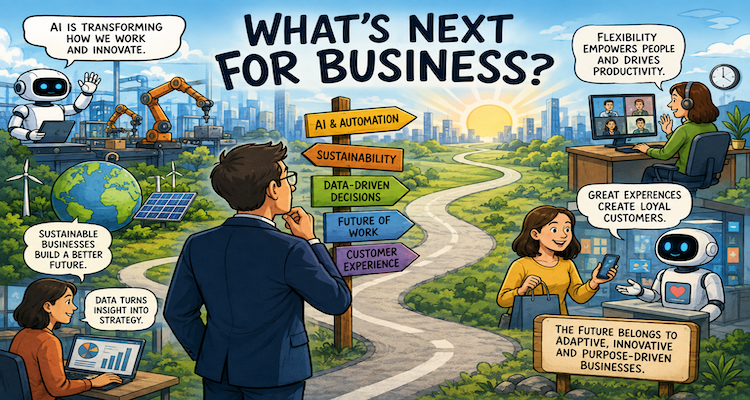
For years, business strategy was often built around a familiar formula: grow faster, reduce costs, expand markets and use technology to gain an advantage. That formula still matters, but the conditions around it are changing.
Businesses now have to operate through slower and uneven global growth, trade and geopolitical uncertainty, increasingly complex supply chains, rapid advances in artificial intelligence, cybersecurity risks and a workforce whose skills are changing faster than many organizations can retrain them.
The next phase of business is therefore unlikely to be defined by one technology or one economic cycle. It will be defined by how effectively companies combine AI, adaptability, resilience, human skills and disciplined investment.
The evidence already points in that direction. The World Bank expects global growth to remain relatively modest in 2026, while the International Monetary Fund has also warned that geopolitical fragmentation, trade tensions and uncertainty surrounding AI-driven productivity could affect the outlook.
Key Takeaways
- AI adoption is spreading, but many companies have yet to convert experimentation into enterprise-wide financial impact.
- Business resilience is becoming as important as efficiency as companies face geopolitical, cyber and supply-chain risks.
- The strongest organizations will redesign workflows around technology rather than simply add AI tools to existing processes.
- AI and big data are among the fastest-growing skills, but analytical thinking, creativity and adaptability remain critical.
- Slower global growth makes disciplined investment, customer understanding and operational flexibility increasingly important.
- The next competitive advantage may come less from owning technology and more from adapting faster than competitors.
The Business Environment Is Becoming Harder to Predict
The first major shift is economic.
The global economy has remained more resilient than many earlier expectations suggested, but the growth environment is not especially strong. The World Bank’s January 2026 outlook projected global growth of 2.6% in 2026 and 2.7% in 2027, while noting persistent trade and policy uncertainty. It also estimated that South Asia would remain among the faster-growing regions, although growth there was expected to moderate in 2026.
The IMF’s April 2026 outlook was similarly cautious, projecting 3.1% global growth for 2026 and highlighting risks from geopolitical conflict, trade tensions and the possibility that AI-related productivity gains may fall short of expectations. Its July update subsequently put global growth at 3.0% for 2026 and 3.4% for 2027.
The important business lesson is not which forecast will prove correct.
It is that companies are planning in an environment where assumptions can change quickly.
That favors organizations capable of adjusting pricing, supply arrangements, investment priorities, staffing and technology decisions without destabilizing the entire business.
AI Is Moving From Experiment to Operating Model
Artificial intelligence remains one of the biggest forces shaping business strategy, but the important question is changing.
A few years ago, companies were asking: Where can we use AI?
Now the more consequential question is: How should the business itself be redesigned around AI?
McKinsey’s 2025 global survey found that 88% of respondents said their organizations regularly used AI in at least one business function. Yet most organizations were still experimenting or running pilots rather than scaling AI across the enterprise. Only 39% reported an enterprise-level EBIT impact from AI.
That gap matters.
Buying an AI tool does not automatically create a more productive company. If an organization adds AI to an inefficient process, it may simply automate parts of an inefficient process.
The more valuable approach is to reconsider the workflow itself.
A customer-service team, for example, might use AI to draft responses. A more ambitious transformation would examine the entire customer-service process: how requests are classified, which problems can be resolved automatically, when humans intervene, how customer information is retrieved and how outcomes are measured.
The distinction is important because productivity gains increasingly depend on process redesign, not software acquisition alone.
The Next AI Advantage May Be Organizational
The spread of AI could eventually make access to basic technological capabilities less distinctive.
If competing businesses can access similar foundation models, cloud platforms and AI-powered software, the technology itself becomes less of a differentiator.
The differentiator becomes execution.
McKinsey’s research found that organizations reporting greater AI value are more likely to pursue growth and innovation objectives alongside efficiency, and that workflow redesign is an important characteristic of higher-performing AI adopters.
This suggests a broader shift in management.
Companies may need leaders who understand enough about AI to make strategic decisions without necessarily becoming AI engineers themselves. They also need employees who can identify useful applications, evaluate outputs, understand limitations and combine machine-generated work with human judgment.
That creates a new form of organizational capability: AI literacy across the business.
Resilience Is Becoming a Competitive Capability
Efficiency has traditionally encouraged companies to eliminate excess inventory, simplify supply chains and concentrate resources where they deliver the highest returns.
But extreme efficiency can create fragility.
Recent research reported by Reuters, based on work involving researchers from the Stockholm School of Economics and Circular Transparency, found that AI investments could improve specific business functions without necessarily making organizations more resilient overall. The researchers pointed to outdated structures, rigid planning, disconnected supply chains and unchanged incentive systems as obstacles.
That distinction deserves attention.
A company can become extremely efficient at forecasting while remaining vulnerable to a supplier failure. It can automate financial processes while retaining outdated decision-making structures. It can deploy sophisticated AI while depending heavily on a small number of technology providers.
The next generation of business strategy will therefore have to balance efficiency with optionality.
That may mean maintaining alternative suppliers, building stronger data governance, diversifying technology dependencies, testing contingency plans and giving managers enough flexibility to respond when assumptions fail.
Cybersecurity Will Move Closer to the Center of Business Strategy
Technology expansion also expands exposure.
The World Economic Forum’s Global Cybersecurity Outlook 2025 found that 54% of large organizations identified supply-chain interdependencies as their greatest barrier to cyber resilience. The report also highlighted a gap between the expected impact of AI on cybersecurity and the processes companies have in place to assess AI-related security risks.
The 2026 outlook continues to emphasize the dual nature of AI: it can strengthen cyber defense while also creating new opportunities for attacks, data leaks and other harms.
For business leaders, cybersecurity can no longer be treated solely as an IT department responsibility.
A major security failure can affect operations, customers, reputation, intellectual property and financial performance simultaneously.
That makes cyber resilience part of business continuity and strategic planning.
People Will Matter More, Not Less
One of the more important misconceptions about the next phase of business is that technological progress simply means fewer people will be needed.
The evidence is more complicated.
The World Economic Forum’s Future of Jobs Report 2025 projects substantial job creation and displacement by 2030 while emphasizing that the underlying skills required for many jobs are changing. It estimates that 39% of workers’ existing skill sets could be transformed or become outdated during the 2025–2030 period.
AI and big data rank among the fastest-growing skills, alongside networks and cybersecurity and technological literacy. But creative thinking, resilience, flexibility, agility, analytical thinking and leadership also remain highly important.
This points toward a more realistic model of the AI-enabled workplace.
The valuable employee may not simply be the person who knows how to use an AI tool. It may be the person who understands the business problem, knows where automation is appropriate, recognizes when an AI output is unreliable and can make a sound decision when the available information is incomplete.
That combination of technical and human capability will be difficult to automate completely.
What Businesses Should Focus On Next
For executives and business owners, the emerging environment suggests several practical priorities.
First, measure outcomes rather than AI adoption.
The number of AI tools deployed tells management little about whether the business is actually improving. Productivity, revenue, customer satisfaction, quality and cycle time are more meaningful measures.
Second, redesign processes before automating them.
Automation works best when companies understand the workflow they are trying to improve.
Third, build adaptable teams.
Continuous learning will become increasingly important as software, customer expectations and job requirements change.
Fourth, treat resilience as an investment.
Supplier diversification, cybersecurity, data governance and contingency planning can look inefficient during stable periods but become valuable during disruption.
Fifth, protect customer trust.
AI can make businesses faster, but speed without accuracy, transparency and accountability can damage the relationships companies depend upon.
Finally, avoid betting the company on a single forecast.
Economic projections, technology expectations and market conditions can change. Businesses need strategies that remain workable across multiple plausible scenarios.
The Real Competitive Advantage May Be Adaptability
The next era of business will not belong automatically to the companies that spend the most on technology.
Nor will it necessarily belong to the companies that grow the fastest during favorable conditions.
A stronger advantage may belong to organizations that can learn, redesign and respond faster.
That is especially important because technology is becoming widely accessible. AI can lower the cost of certain cognitive tasks, automation can improve operational efficiency and digital platforms can reduce barriers to entering markets. But these technologies do not eliminate the need for judgment, strategy, customer understanding or organizational discipline.
Instead, they raise the value of those capabilities.
The business question is therefore shifting from What technology should we buy? to a much broader one:
What kind of organization do we need to become to use technology effectively in an uncertain world?
Conclusion
What’s next for business is unlikely to be a single breakthrough moment. It will be a period of continuous adaptation.
AI will reshape workflows and decision-making. Economic uncertainty will reward financial discipline. Cybersecurity and supply-chain resilience will become deeper parts of corporate strategy. And changing skill requirements will force businesses to rethink how they recruit, train and organize people.
The companies best positioned for the next decade may not be those that predict the future most accurately.
They may be the ones designed to change when the future proves them wrong.
That is the deeper business opportunity in the AI era: not simply becoming more efficient, but becoming more capable of adapting.
The information presented in this article is based on publicly available sources, reports, and factual material available at the time of publication. While efforts are made to ensure accuracy, details may change as new information emerges. The content is provided for general informational purposes only, and readers are advised to verify facts independently where necessary.