










The New Rules of Business: Why Competitive Advantage Is Being Rewritten
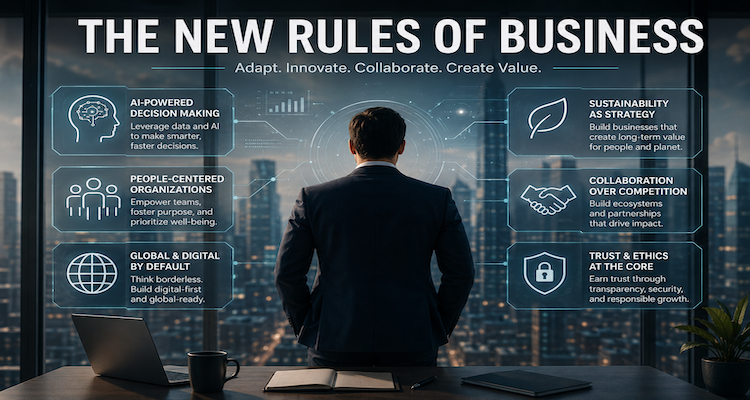
For decades, business advantage was often built around assets that were difficult to acquire: capital, distribution networks, specialized talent, physical infrastructure, proprietary technology and scale. Those advantages still matter. But the economics around them are changing.
Artificial intelligence is accelerating that change, while economic uncertainty, shifting customer expectations, cybersecurity risks, changing workforce skills and faster technology cycles are putting pressure on traditional ways of operating. The result is not that the old rules of business have disappeared. Rather, companies increasingly have to compete on a second layer: how quickly they can learn, adapt, automate, redesign work and turn information into decisions.
That distinction matters. AI adoption is spreading rapidly, but adoption alone is not producing automatic business transformation. McKinsey’s 2025 global survey found that 88% of respondents said their organizations regularly used AI in at least one business function, yet only about one-third reported that their organizations had begun scaling AI programs across the enterprise.
The emerging business model is therefore less about simply owning more resources and more about building an organization capable of using technology, people and information together.
Key Takeaways
- Competitive advantage is increasingly tied to organizational adaptability, not simply company size or technological ownership.
- AI is becoming useful when companies redesign workflows rather than merely adding another software tool.
- Human judgment, analytical thinking, creativity and leadership remain important as automation expands.
- Faster experimentation can help smaller companies compete with organizations that have traditionally benefited from greater scale.
- Trust, cybersecurity and responsible AI governance are becoming strategic business capabilities.
- The strongest businesses will treat continuous learning as an operating requirement rather than an occasional training exercise.
1. The Advantage Is Shifting From Size to Adaptability
Scale remains powerful. Large companies can spread costs across millions of customers, negotiate favorable supplier agreements and invest heavily in research and infrastructure.
But scale can also create friction.
Large organizations often have more layers of decision-making, legacy systems and established processes. A smaller company may not have the same resources, but it can sometimes change direction faster.
Technology is strengthening that possibility.
Cloud computing, software-as-a-service platforms, automation and increasingly capable AI systems allow relatively small teams to access capabilities that once required larger departments. That does not eliminate the advantage of scale, but it can reduce the amount of scale required to perform certain knowledge-intensive activities.
Microsoft’s 2025 Work Trend Index describes an emerging organizational model built around human-AI teams and what it calls “digital labor.” Its research surveyed 31,000 knowledge workers across 31 markets and found that 82% of leaders viewed 2025 as a pivotal year for rethinking strategy and operations.
The more important lesson is not Microsoft’s terminology. It is the organizational implication: companies can increasingly change their productive capacity by changing how work is structured.
That makes adaptability itself a competitive asset.
2. AI Is Changing the Operating Model, Not Just the Software Stack
The first wave of business AI largely involved individual productivity: drafting emails, summarizing documents, generating content, writing code or searching information.
The next question is more consequential:
What happens when AI becomes part of the workflow itself?
An employee using an AI assistant is one thing. A company redesigning customer support, research, software development, marketing analysis or internal operations around human-AI collaboration is something else.
McKinsey’s 2025 research found that organizations obtaining greater value from AI were more likely to redesign workflows. The same research found that 62% of respondents said their organizations were at least experimenting with AI agents.
This suggests a new rule: buying AI is not the transformation; redesigning work around it is.
A company that simply gives employees another AI tool may achieve incremental productivity. A company that examines an entire process who performs each task, where information enters, where decisions are made, what can be automated and where human approval is required has a greater opportunity to change its economics.
That distinction also explains why widespread AI adoption does not automatically translate into widespread financial impact.
3. The Best Businesses Will Combine Machine Speed With Human Judgment
It would be easy to interpret automation as a race to remove people from business processes. The evidence points toward something more complicated.
The World Economic Forum’s Future of Jobs Report 2025 estimates that 39% of workers’ existing core skills could be transformed or become outdated by 2030. At the same time, employers expect analytical thinking, creative thinking, resilience, flexibility, leadership and social influence to remain important alongside technology skills.
That creates an important tension.
AI can process information quickly, generate alternatives and perform repetitive tasks at scale. Humans remain responsible for setting objectives, understanding context, judging consequences, building relationships and accepting accountability for important decisions.
The business question therefore becomes less:
“What jobs can AI replace?”
and more:
“Which combination of humans and AI produces the best outcome for this particular task?”
For routine work, automation may make sense. For ambiguous, high-stakes or relationship-driven decisions, human involvement may remain essential.
Businesses that understand this distinction are likely to deploy AI more effectively than those treating automation as an objective in itself.
4. Skills Are Becoming a Strategic Asset
Businesses traditionally treated employee training as a support function. In a rapidly changing technology environment, that approach becomes increasingly difficult to sustain.
The World Economic Forum estimates that, if the global workforce were represented by 100 people, 59 would need reskilling or upskilling by 2030. AI and big data, networks and cybersecurity, and technological literacy are among the fastest-growing skill areas, while creative thinking and adaptability are also expected to rise in importance.
This changes the economics of talent.
A company does not necessarily need employees who already know every emerging technology. It increasingly needs employees who can learn new tools, understand their limitations and apply them to business problems.
That makes curiosity and learning capacity economically relevant.
It also creates a challenge for management. Buying new technology without developing the workforce capable of using it can produce expensive underutilization.
The new rule is straightforward: technology investment and skills investment increasingly have to move together.
5. Speed of Experimentation Matters More Than Perfect Planning
Traditional business strategy often rewards careful planning before significant investment.
That remains necessary for major capital decisions. But digital products and AI-enabled processes can often be tested at a much lower cost.
This creates room for a different operating rhythm:
- Identify a meaningful business problem.
- Test a small solution.
- Measure the result.
- Learn from failure.
- Improve the workflow.
- Scale only when the evidence supports it.
This is especially important for smaller companies.
A startup does not need to beat a large competitor at everything. It may only need to discover a better process faster.
That can mean experimenting with customer service automation, internal knowledge systems, AI-assisted development, personalized marketing or data analysis while a larger competitor remains constrained by legacy processes.
But experimentation should not become technology theater. The objective is not to accumulate pilots. It is to discover which experiments produce measurable business value.
McKinsey’s research is instructive here: despite widespread AI use, nearly two-thirds of respondents in its 2025 survey said their organizations had not yet begun scaling AI across the enterprise.
The gap between experimentation and execution may therefore become one of the defining competitive battlegrounds.
6. Trust Is Becoming Part of the Product
Faster technology does not eliminate business risk. In some cases, it increases it.
AI-generated information can be inaccurate. Automated systems can expose sensitive data if poorly governed. Cybersecurity threats can become more sophisticated as companies become more digitally dependent. Customers may also reject automated experiences when they feel opaque or careless.
That means trust is no longer simply a communications issue.
It is becoming an operating capability.
Companies need to know:
- What data their systems use.
- Who can access that data.
- When AI-generated outputs require human review.
- How important decisions are documented.
- What happens when an automated system fails.
- Which processes should never be fully automated.
McKinsey’s 2025 research found that organizations were increasingly establishing governance and risk-management practices as they expanded AI use. It also reported a correlation between CEO oversight of AI governance and higher self-reported bottom-line impact from generative AI, although correlation does not establish that governance alone caused better financial performance.
The broader lesson is more durable: responsible technology management is becoming part of competitive execution, not simply compliance.
7. The Customer Still Sets the Rules
Technology can change how a business operates, but it cannot repeal the basic economics of customer choice.
Customers still care about price, reliability, convenience, quality, responsiveness and trust.
AI can make personalization easier. Automation can reduce waiting times. Data can help companies identify patterns in customer behavior. But these capabilities matter only when they improve the experience customers actually value.
This creates another emerging rule:
Automation should be measured by customer and business outcomes, not by the number of tasks automated.
A chatbot that prevents customers from reaching a human when they genuinely need one may reduce staffing costs while damaging loyalty.
Likewise, an AI-generated marketing campaign that produces enormous volumes of content may create little value if customers find it irrelevant.
Efficiency matters. But efficiency without effectiveness is not a durable competitive advantage.
8. Business Strategy Is Becoming More Continuous
One of the biggest changes may be happening inside management itself.
A five-year strategy used to provide a relatively stable framework for investment and expansion. Today, companies still need long-term direction, but the assumptions supporting that direction may need to be reviewed more frequently.
Technology cycles are shorter. Competitive threats can emerge from unexpected industries. Skills change quickly. Customer behavior can shift rapidly.
That does not mean businesses should abandon strategy for constant improvisation.
It means strategy increasingly needs feedback loops.
Leaders need reliable information about what is working, where customers are changing, which technologies are becoming economically viable, what employees are struggling with and where new risks are emerging.
The organization that learns faster can potentially adjust faster.
That may prove more valuable than having the most elaborate strategic plan.
What the New Business Rules Mean for Leaders
The emerging environment does not require every company to become an AI company.
It does require leaders to reconsider several assumptions.
First, technology should begin with business problems. A company should be able to explain what a new technology improves and how success will be measured.
Second, workflows deserve as much attention as tools. Installing software without changing inefficient processes rarely creates transformational results.
Third, workforce development cannot be separated from technology strategy. Employees need opportunities to build both technical and human capabilities.
Fourth, experimentation needs measurement. A pilot without a clear success criterion can become an expensive demonstration rather than a business improvement.
Fifth, governance needs to scale with capability. The more autonomy technology receives, the clearer accountability and oversight need to become.
These principles apply whether the organization is a global corporation, a family-owned business or a five-person startup.
Conclusion
The new rules of business are not really about replacing one generation of technology with another.
They are about changing what makes an organization capable of competing.
Capital, scale, infrastructure and specialized expertise will continue to matter. But businesses increasingly need another set of capabilities alongside them: adaptability, rapid learning, intelligent automation, workforce development, strong judgment and institutional trust.
The evidence already shows the transition is underway, but it is far from complete. AI adoption is broad while enterprise-scale transformation remains uneven. Employers expect significant skill disruption while still placing high value on human capabilities. And companies are experimenting with new forms of human-machine collaboration without yet knowing exactly which models will become dominant.
That uncertainty is important.
The winners of the next phase of business may not simply be the companies with the most advanced technology. They may be the companies that learn fastest how to combine technology with people, redesign their processes intelligently and remain useful to customers as conditions change.
The new competitive advantage is therefore not simply having more.
It is being able to adapt better.
The information presented in this article is based on publicly available sources, reports, and factual material available at the time of publication. While efforts are made to ensure accuracy, details may change as new information emerges. The content is provided for general informational purposes only, and readers are advised to verify facts independently where necessary.