










Beyond the Bottom Line: Why Long-Term Business Value Is Measured in More Than Profit
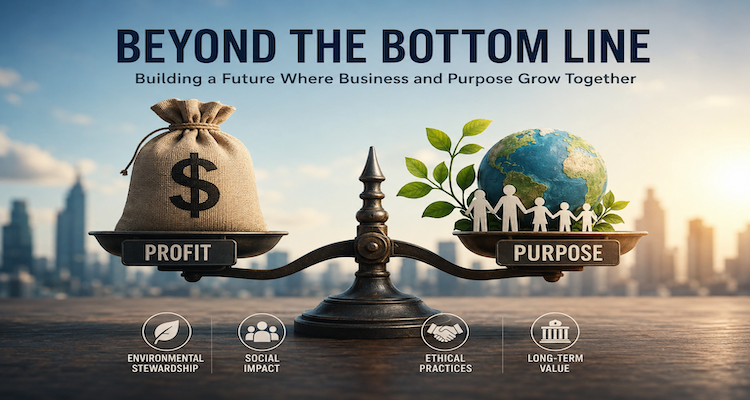
A company can report a strong quarter and still be weakening underneath it. Customers may be losing trust, skilled employees may be leaving, suppliers may be under pressure, technology investments may be falling behind, or environmental and regulatory risks may be accumulating. None of those problems necessarily appears immediately in a profit-and-loss statement.
That is why the traditional bottom line revenue, costs and profit remains essential but increasingly looks incomplete as a measure of business health. Modern corporate governance and reporting frameworks are paying greater attention to sustainability, resilience, human capital, stakeholders and other factors that can affect a company’s ability to create value over time. The shift does not mean profit has become irrelevant. It means businesses are being asked to understand what produces durable profit in the first place.
Key Takeaways
- Profit remains fundamental, but it does not capture every factor that determines whether a company can sustain growth.
- Customer trust, employee capability, innovation and resilience can influence long-term competitive strength.
- Sustainability risks increasingly matter when they can affect cash flows, financing, assets or future growth.
- Investors and regulators are demanding more comparable information about material non-financial risks and opportunities.
- The strongest businesses increasingly treat stakeholder relationships as strategic assets rather than peripheral concerns.
Why Profit Alone Can Give an Incomplete Picture
Profit is one of the clearest indicators of whether a business is economically viable. Without sufficient revenue and financial discipline, even a company with an admirable mission eventually faces difficult choices.
The problem begins when a single financial period is treated as a complete description of business performance.
Consider two companies with identical profits. One has loyal customers, strong employee retention, modern infrastructure and resilient suppliers. The other has declining customer satisfaction, high employee turnover and aging technology but has temporarily reduced spending enough to produce the same earnings.
Their financial statements may look similar in the short term. Their underlying prospects may be very different.
This is why the debate about looking “beyond the bottom line” is better understood as a measurement problem than an argument against profitability.
The question is not whether companies should make money. The question is whether the metrics used to judge performance capture the factors that determine how reliably that money can be generated in the future.
The Hidden Assets Behind Business Performance
Some of the most important resources in a modern company do not appear on the balance sheet in the same way as cash, buildings or inventory.
Employee knowledge is one example. So are software capabilities, organizational processes, customer relationships, brands and accumulated expertise.
Research published by the World Bank has highlighted the importance of intangible capital in explaining differences in productivity, innovation and growth among firms.
These assets can be difficult to measure precisely, but their importance is difficult to ignore.
A software company’s competitive advantage may depend heavily on engineers and intellectual property. A retailer may depend on customer trust and supply-chain reliability. A manufacturer may depend on workforce skills, supplier relationships and operational know-how.
Cutting investment in such areas can sometimes improve short-term financial results while weakening the foundations of future performance.
That creates a central management challenge: distinguishing genuine efficiency from costs that have simply been postponed.
Customers, Employees and Suppliers Are Part of the Value Chain
A business does not create value in isolation.
Employees provide skills and knowledge. Suppliers provide inputs and capacity. Customers provide revenue and feedback. Communities provide infrastructure, labour markets and the social environment in which businesses operate. Investors provide capital.
The OECD’s corporate-governance principles explicitly recognise the contributions of different stakeholders including workers, customers, suppliers, creditors and affected communities to the long-term success of corporations.
That does not mean every stakeholder demand should automatically override financial considerations. Businesses still have to make trade-offs.
But ignoring stakeholders can create risks that eventually become financial problems.
High employee turnover can increase recruitment and training costs. Poor supplier relationships can increase operational vulnerability. Loss of customer trust can reduce demand. Weak governance can increase regulatory and reputational exposure.
The connection is important: stakeholder management is not necessarily separate from business strategy. In many cases, it is part of risk management and value creation.
Sustainability Is Moving Closer to Financial Decision-Making
The language around sustainability has sometimes been dominated by corporate responsibility reports and broad environmental commitments. A more consequential development is the growing emphasis on whether sustainability-related risks and opportunities can affect financial performance.
IFRS S1, issued by the International Sustainability Standards Board, requires companies applying the standard to disclose sustainability-related risks and opportunities that could reasonably be expected to affect cash flows, access to finance or cost of capital over the short, medium or long term. The standard became effective for annual reporting periods beginning on or after January 1, 2024.
That distinction matters.
A sustainability issue does not become financially important simply because it is environmentally or socially significant. Under the financial-materiality approach, the crucial question is whether it could affect the company’s prospects.
For example, environmental exposure could affect operating costs, assets or future revenues. Human-capital policies could affect the company’s ability to recruit and retain skilled workers. Regulatory changes could alter the economics of an existing business model.
The OECD similarly notes that material sustainability information can include environmental and social matters capable of affecting asset values, revenues and long-term growth.
The Shift Is Also Visible in Corporate Reporting
The movement beyond a narrow financial scorecard is not simply a philosophical debate.
The OECD’s 2025 Corporate Governance Factbook found that sustainability-related disclosure was required by law or regulation in 79% of the jurisdictions it examined. It also found that 60% had established requirements for assurance of sustainability information, while another 17% were considering such requirements.
India provides a useful example of this broader reporting direction. SEBI’s corporate-filings framework includes Business Responsibility and Sustainability Reports, while regulatory provisions have established BRSR requirements for large listed entities.
The significance goes beyond paperwork.
As non-financial information becomes more structured, companies face greater pressure to identify which environmental, social and governance issues are actually material, establish reliable measurements and connect them to corporate strategy.
That can make sustainability less of a communications exercise and more of a governance discipline.
The Technology Question: What Are Companies Actually Building?
Technology makes the issue even more complicated.
Artificial intelligence, automation, cloud infrastructure and data systems can create new productivity opportunities, but they also introduce questions about cybersecurity, workforce skills, data governance, reliability, energy consumption and capital allocation.
A company that announces an ambitious AI strategy may generate attention without necessarily creating durable value.
The more useful questions are harder:
- Does the technology solve a meaningful customer problem?
- Does it improve productivity or quality measurably?
- What new operational risks does it introduce?
- Can employees use it effectively?
- What happens when the system fails?
- Is the investment strengthening a durable capability or simply following a market trend?
This is where looking beyond quarterly results becomes particularly useful. Technology investment should ultimately be evaluated not only by spending or immediate savings, but by whether it improves the organization’s capacity to compete.
What “Beyond the Bottom Line” Should Not Mean
There is also a danger in taking the idea too far.
A company cannot solve every social problem, and not every environmental or social initiative automatically creates shareholder value. Claims that sustainability always produces higher profits would be just as simplistic as claims that it never matters.
The evidence is more nuanced.
The OECD’s governance framework argues that sustainability-related information becomes particularly relevant when it can influence assessments of company value, investment decisions or voting decisions. It also stresses the importance of materiality and company-specific circumstances.
That provides a useful discipline.
Companies should not collect dozens of impressive-looking metrics simply because they can. They should identify the factors that genuinely matter to their business model, stakeholders, resilience and long-term financial prospects.
In other words, the goal should not be more metrics.
It should be better measurement.
The New Business Scorecard
A more complete view of business performance can therefore be thought of as several connected layers.
Financial strength: Can the company generate sustainable revenue, control costs and allocate capital effectively?
Customer value: Are customers receiving enough value to remain loyal?
Human capability: Can the organization attract, retain and develop the skills it needs?
Innovation: Is the company building capabilities that will remain relevant as technology and markets change?
Resilience: Can the business withstand supply, regulatory, technological, environmental and economic shocks?
Trust and governance: Can investors, employees, customers and other stakeholders rely on the organization to behave responsibly and transparently?
These dimensions should not be treated as a replacement for financial performance. They help explain the conditions under which financial performance can endure.
The Real Test Is Whether the Measures Change Decisions
The strongest evidence that a company has moved beyond the bottom line is not the number of sustainability pages in its annual report.
It is whether the information changes what management does.
Does the company invest differently because it identifies a future risk? Does it redesign a product after discovering a customer problem? Does it improve employee training because critical skills are becoming scarce? Does the board reconsider a strategy because environmental or regulatory exposure could threaten future cash flows?
If the answer is yes, measurement is influencing strategy.
If the information simply appears in a report while executive incentives, capital allocation and operational decisions remain unchanged, the exercise risks becoming largely symbolic.
That distinction is becoming more important as sustainability reporting becomes more widespread. The OECD’s recent governance work emphasises reliable, consistent and comparable information, along with board responsibility for sustainability-related risks and opportunities.
Conclusion
The bottom line is not disappearing. It is being placed in context.
Profit tells a company whether its economic model is working. It does not always explain whether that model is resilient, trusted, innovative or prepared for the risks ahead.
The more useful question for modern business is therefore not profit or purpose. It is whether a company can connect financial performance with the capabilities and relationships that make financial performance sustainable.
That means paying attention to customers before they leave, employees before critical skills disappear, technology before systems become obsolete, suppliers before disruptions occur and emerging risks before they become expensive.
Looking beyond the bottom line is ultimately about looking further ahead.
A business that measures only what it earned yesterday may understand its performance. A business that also understands what determines its ability to create value tomorrow has a better chance of remaining competitive.
The information presented in this article is based on publicly available sources, reports, and factual material available at the time of publication. While efforts are made to ensure accuracy, details may change as new information emerges. The content is provided for general informational purposes only, and readers are advised to verify facts independently where necessary.