








Where Travel Meets Discovery: Why the Best Journeys Change How We See the World
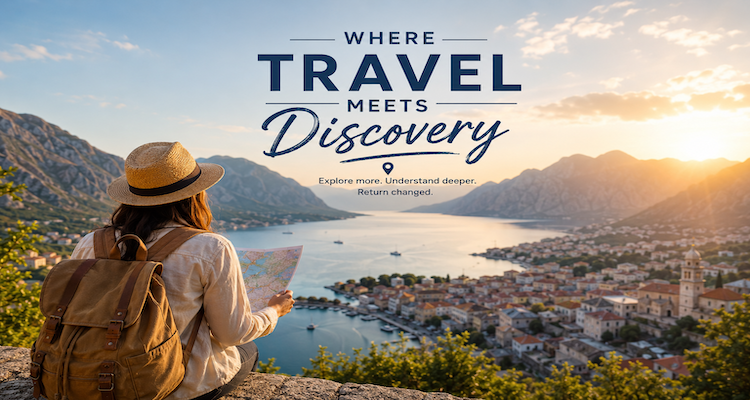
Travel is often measured in distances, destinations and photographs. Yet its deeper value can be harder to quantify. A journey becomes meaningful not simply when someone arrives somewhere new, but when the experience changes what they notice, understand or remember.
That distinction matters at a time when global travel has regained much of its momentum. International tourism reached an estimated 1.5 billion arrivals in 2024, according to UN Tourism, reflecting the sector’s broad recovery and the continued appetite for crossing borders and exploring unfamiliar places.
But more travel does not automatically mean more discovery. A traveller can move thousands of kilometres while remaining inside a carefully curated routine of hotels, attractions, algorithms and familiar comforts. Discovery begins when travel creates a genuine encounter with a landscape, a history, a community, a different way of life or even an assumption the traveller did not realize they held.
That is where travel becomes more than movement. It becomes a way of learning.
Key Takeaways
- Travel becomes discovery when it leads to deeper understanding rather than simply collecting destinations.
- Cultural and natural heritage can enrich journeys, but tourism must be managed carefully to protect the places people come to experience.
- Local communities are not just part of the backdrop; their participation is central to more sustainable tourism.
- Digital tools can make travel easier, but convenience does not guarantee meaningful experiences.
- The strongest journeys often combine curiosity with preparation, respect and a willingness to move beyond familiar routines.
Travel Is Expanding, but Discovery Requires More Than Movement
The recovery of international tourism demonstrates how strongly people continue to value the ability to explore beyond their everyday environment. UN Tourism’s recent reporting shows that international travel recovered to around pre-pandemic levels in 2024, while tourism demand continued into 2025, although performance varied between regions.
The scale of this movement creates opportunities for discovery. Travellers encounter different languages, food traditions, architecture, ecosystems and social customs. They may visit places whose histories are far more complicated than the short descriptions found on booking platforms or social media.
Yet the modern travel experience also contains a contradiction: the same technology that makes the world easier to reach can make journeys increasingly standardized.
Recommendation systems can direct millions of people toward the same restaurants, viewpoints and attractions. Short-form videos can turn a destination into a sequence of recognizable photo locations. Online planning can reduce uncertainty but it can also reduce the space for curiosity.
This does not make technology the enemy of discovery. Digital maps, translation tools and public information have made travel more accessible to many people. The challenge is understanding the difference between using technology to navigate a place and allowing technology to determine the entire experience.
A useful journey still needs room for observation.
Discovery Begins With Context
A famous monument can be impressive on its own. Understanding why it was built, who preserved it, what historical events shaped it and how local people relate to it can make the experience substantially richer.
The same principle applies to natural destinations.
A forest is more than scenery. A coastline is more than a background for photographs. Historic neighbourhoods are not outdoor museums detached from everyday life. Places have ecological limits, cultural meanings and communities whose lives continue after visitors leave.
UNESCO’s approach to sustainable tourism emphasizes integrating tourism and heritage management at the destination level and involving stakeholders in protecting cultural and natural assets. Its framework also places importance on empowering local communities rather than treating them as an afterthought.
This provides an important way to think about discovery: the more a traveller understands the context of a place, the less likely that place is to become a disposable experience.
Context can come from many sources:
- Local museums and cultural institutions
- Community guides and locally run experiences
- Historical archives and reliable books
- National parks and conservation organizations
- Conversations approached with respect rather than entitlement
- Time spent outside the most heavily promoted visitor zones
The goal is not to turn every holiday into an academic project. It is simply to recognize that places usually contain more meaning than an itinerary can capture.
The Discovery Economy Has a Responsibility Problem
Travel can support jobs, local businesses and investment. It can also create pressure on housing, infrastructure, ecosystems and heritage sites when visitor growth outpaces local capacity.
That tension is becoming increasingly important as tourism volumes recover.
UNESCO’s World Heritage and Sustainable Tourism Programme argues for managing tourism in ways that protect cultural and natural heritage while supporting sustainable development and stakeholder participation.
This means the question is no longer only, “How can more people visit?”
A more useful question is: “What kind of tourism allows a place to remain worth visiting?”
That shift affects travellers as well as governments and tourism businesses.
Choosing locally owned businesses where possible, respecting access restrictions, avoiding environmentally damaging behaviour and learning basic cultural expectations are small decisions. None will solve structural problems alone. But they reflect an important principle: discovery should not depend on degrading the thing being discovered.
The traveller is not separate from the destination’s future.
Why the Most Memorable Journeys Often Resist Optimization
Modern travel planning encourages efficiency. Flights are compared by price. Hotels are ranked by reviews. Routes are optimized to save minutes. Attractions are sorted according to popularity.
Efficiency is useful, particularly when time and money are limited. But a fully optimized journey can sometimes leave little room for the unexpected.
A missed turn may lead to an unfamiliar street. An unplanned conversation may explain a place better than a guidebook. A decision to spend longer in one location may reveal details that would have been invisible during a rushed itinerary.
This does not mean travellers should abandon planning. Poor planning can create safety, financial and logistical problems.
The better approach may be intentional flexibility: prepare enough to travel responsibly, then leave enough space to actually experience the destination.
That distinction is especially relevant as travel becomes increasingly mediated through digital platforms. Technology can answer where to go. It is less capable of deciding what a place should mean to an individual traveller.
Discovery remains personal.
Culture Is Not a Tourist Product Alone
Cultural tourism can contribute to economic development, heritage protection and wider understanding when it is developed responsibly. UNESCO notes that countries increasingly use cultural assets and creative industries as part of broader development strategies, including efforts related to urban and rural development, employment and conservation.
However, culture can also be simplified when it is packaged exclusively for visitors.
A living tradition is not automatically better understood because it has been photographed. A local festival does not exist solely as entertainment for outsiders. Food traditions, crafts, religious practices and historic spaces often have meanings that extend far beyond the visitor experience.
For travellers, this suggests a different approach to authenticity.
Authenticity is not necessarily found by searching for the least-known location or trying to enter spaces not intended for visitors. It can come from engaging honestly with what is available, learning the context and recognizing that travellers are guests rather than owners of an experience.
Respect is not a limitation on discovery. It is often what makes deeper discovery possible.
A New Measure of a Successful Journey
The traditional signs of a successful trip are easy to count: the number of places visited, photographs taken or attractions completed.
A more meaningful measure may be harder to display.
What did the traveller learn that could not have been understood from a screen?
What assumption changed?
What story, landscape, idea or encounter stayed with them after returning home?
This perspective does not diminish the simple pleasures of travel. Rest matters. Beautiful views matter. Food, entertainment and adventure matter too.
But discovery adds another dimension. It transforms travel from consumption into participation and observation.
UNESCO and UN Tourism reinforced their cooperation on sustainable, inclusive and resilient tourism in 2026, highlighting the growing recognition that tourism policy, cultural heritage, communities and long-term resilience are closely connected.
For travellers, the lesson is practical: a better journey may not require travelling farther or spending more. It may require looking more carefully.
Conclusion
Where travel meets discovery, destinations become more than points on a map. They become places with histories, communities, ecosystems and perspectives that can expand a traveller’s understanding of the world.
As global tourism continues to grow, the quality of travel will matter as much as the quantity. The most valuable journeys may not be the ones that cover the greatest distance, but those that leave the traveller with a deeper sense of where they have been and a greater responsibility toward the places and people they encountered.
This content is published for informational or entertainment purposes. Facts, opinions, or references may evolve over time, and readers are encouraged to verify details from reliable sources.