






Why Biodiversity Can Decline Even When Animals Are Still Everywhere
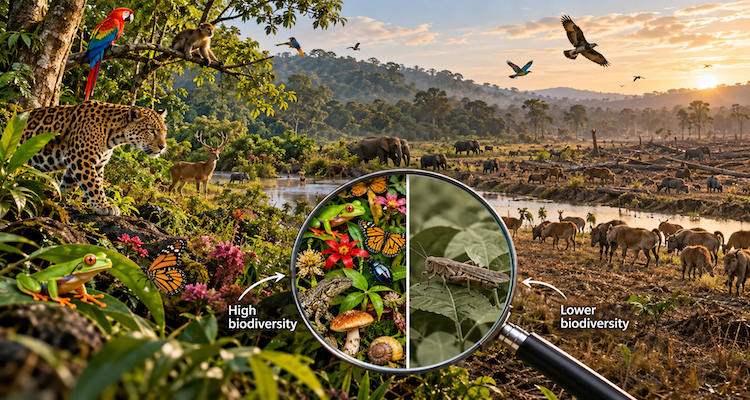
Walk through a city park, visit a farm, watch birds around a lake, or look at insects gathering around a light, and it can be difficult to believe that biodiversity is declining. Animals are still visible. Some species may even seem more common than before.
That apparent contradiction comes from a basic misunderstanding of what biodiversity measures.
Biodiversity is not simply the number of animals people can see. Scientists also examine how many species are present, how abundant their populations are, where those populations occur, how evenly individuals are distributed among species, and whether ecosystems retain their natural composition and ecological functions. The Convention on Biological Diversity explicitly treats abundance, distribution, species richness and ecosystem structure as different dimensions that need to be monitored.
That distinction explains how a landscape can remain full of animals while becoming biologically poorer.
Key Takeaways
- Seeing many animals does not necessarily mean many species or healthy populations remain.
- Biodiversity can decline when rare species disappear while a smaller number of common species persist.
- Population declines can happen long before a species becomes locally or globally extinct.
- Losing insects or other less-visible organisms can alter food webs even when larger animals remain noticeable.
- Scientists therefore track abundance, distribution, composition and ecosystem integrity alongside species counts.
Biodiversity Is More Than Counting Species
Imagine a meadow containing 100 species of insects. Ten species are abundant, while the other 90 occur in smaller numbers.
Now imagine that environmental change causes 50 of the less-common species to decline sharply, while the 10 abundant species remain plentiful.
A casual observer might see plenty of insects and conclude that little has changed. A biodiversity assessment could reach a very different conclusion.
This is because species richness—the number of species is only one measure. Ecologists also examine abundance, meaning how many individuals of each species exist, and distribution, meaning where populations occur.
The Convention on Biological Diversity identifies species abundance and distribution, species richness, and ecosystem structure and complexity as separate dimensions relevant to assessing biodiversity.
This matters because biodiversity loss does not have to begin with extinction.
A species can still be present but have far fewer individuals, occupy a much smaller area, or become isolated in scattered populations. Those changes can reduce the ecological role of that species and potentially increase its vulnerability to future disturbances.
The International Union for Conservation of Nature also assesses species using information that includes population size, geographic range, habitat, threats and conservation actions rather than relying solely on whether a species still exists.
The Disappearing-Rare-Species Problem
One reason biodiversity decline can be visually deceptive is that ecosystems are not made up of equally abundant species.
Some species naturally occur in large numbers. Others are naturally rare or highly specialized.
If rare species disappear while widespread species remain, the landscape may continue to look biologically busy. But its composition has changed.
This is sometimes easier to understand through a forest.
Suppose a forest originally contains dozens of tree species, hundreds of insect species and numerous birds, mammals, fungi and other organisms. If environmental pressures favor a smaller group of adaptable species, those species can remain visible while specialized species become increasingly uncommon.
The forest has not necessarily become empty. It has become less diverse and potentially less representative of its original ecological community.
Research published in Nature in 2024 illustrates why scientists increasingly examine the abundance patterns of common species rather than looking only at species totals. The study analyzed more than one million trees across 1,568 locations in old-growth tropical forests in Africa, Amazonia and Southeast Asia to investigate patterns among common tree species.
The broader lesson is important: knowing that a species is present does not tell us how healthy its population is.
A Population Can Decline Without Disappearing
Consider a hypothetical population of 10,000 animals.
If it falls to 3,000, the species has not disappeared. A wildlife observer may still encounter it regularly.
But the population has lost 70% of its individuals.
That change can matter ecologically even though the species remains visible.
Population size can affect reproduction, genetic diversity, interactions with other species and the ability of populations to recover from disturbances. Habitat fragmentation can also separate populations that were once connected.
The Convention on Biological Diversity’s framework for ecosystem integrity therefore considers not only which species occur in an ecosystem, but also their diversity, composition and abundance, together with ecological processes and resilience.
This is one reason conservation scientists monitor population trends rather than waiting for species to become extinct before describing biodiversity loss.
The Animals We Notice Are Not the Whole Ecosystem
Human perception also creates a problem.
People are much more likely to notice a deer, elephant, eagle or monkey than a tiny parasitoid wasp, soil organism or nocturnal insect. Yet less-visible organisms can perform important ecological functions.
Insects provide food for other animals and participate in pollination, decomposition and nutrient cycling. Their decline can therefore affect organisms that people notice more easily.
A long-term study in Germany provides a striking example. Researchers used standardized insect traps at 63 protected-area locations and analyzed data collected between 1989 and 2016. They estimated a 76.7% decline in flying insect biomass over the study period, with an estimated mid-summer decline of more than 80%. The study examined biomass rather than simply counting individual species.
That study does not mean that flying insects everywhere have declined by the same percentage. Its locations, sampling design and geographic scope matter, and its findings should not be automatically generalized to every ecosystem.
But it demonstrates the central point particularly well: an ecosystem can lose enormous biological mass without becoming visibly empty.
Why Biomass Matters
Counting species and counting individuals answer different questions.
Imagine two ecosystems containing exactly 50 bird species. In the first, most species have relatively healthy populations. In the second, many species survive in very small numbers while a handful of adaptable species dominate.
A simple species count would treat both ecosystems as equally rich.
Their ecological condition could nevertheless be very different.
This is why researchers increasingly consider abundance and biomass alongside species richness. A 2025 article in Nature Reviews Biodiversity argued that absolute abundance can influence ecosystem functioning and should be considered alongside traditional biodiversity measures.
A 2025 Nature Communications study of marine fishes similarly examined how abundance-based measures relate to ecosystem functioning, highlighting the importance of looking beyond simple species counts.
The implication is not that one biodiversity metric should replace all others. Rather, different measurements reveal different parts of the ecological picture.
Ecosystems Can Become Simpler While Remaining Full of Life
There is another important distinction: presence is not the same as ecological integrity.
An ecosystem can retain many of its visible organisms while experiencing changes in its structure, interactions and functions.
For example, habitat fragmentation can separate populations and reduce connectivity. Pollution can alter which organisms can survive. Changes in land use can favor generalist species over specialists. Overexploitation can remove particular species or reduce their populations. Climate change can shift suitable habitats.
The IUCN’s Red List of Ecosystems evaluates ecosystem collapse risk using evidence that includes geographic distribution and changes in key ecosystem elements. Its framework complements species-level assessments because biodiversity exists at multiple levels of biological organization.
The Convention on Biological Diversity similarly notes that ecosystem integrity involves the composition, structure, functions and ecological processes of ecosystems, not simply whether some animals remain present.
This is why a landscape can appear green, populated and productive while undergoing substantial biological change.
Extinction Is Often the End of the Story, Not the Beginning
One of the most important misconceptions about biodiversity loss is that it begins when species disappear.
In reality, extinction is an endpoint.
Before a species becomes extinct, its population may shrink, its geographic range may contract, suitable habitat may become fragmented, and remaining populations may become increasingly isolated.
The IPBES global assessment illustrates the scale of the broader problem. It reported that natural ecosystems had declined substantially relative to their earliest estimated states and that the abundance of naturally present species in terrestrial ecological communities had declined on average. It also reported elevated extinction risk across many animal and plant groups.
These measurements describe different aspects of biodiversity change. They should not be collapsed into a single number or interpreted as meaning that every ecosystem has changed in the same way.
But together they show why waiting for visible extinction is a poor way to detect biodiversity decline.
What Should We Look For Instead?
For ordinary observers, the most useful lesson is not to stop noticing wildlife. It is to recognize the limits of observation.
Seeing wildlife is evidence that wildlife is present. It is not, by itself, evidence that populations are stable.
A more complete ecological assessment asks questions such as:
- Which species are present?
- Which species are becoming less abundant?
- Are populations shrinking or becoming geographically restricted?
- Are rare and specialized species being replaced by a smaller group of widespread species?
- Is habitat becoming fragmented?
- Is the amount of living biomass changing?
- Are ecological interactions and functions being maintained?
These are the kinds of questions reflected in modern biodiversity indicators and monitoring systems. The CBD notes that biodiversity monitoring must deal with incomplete knowledge and that different indicators are needed to capture different components of biological diversity.
The approach also explains why conservation assessments increasingly combine species-level information with habitat and ecosystem-level measurements.
The Real Warning Sign May Be What We No Longer Notice
A landscape does not need to look empty to be losing biodiversity.
It can remain full of birds, insects, mammals and plants while becoming increasingly dominated by fewer species, with smaller populations of specialists and declining ecological complexity.
That makes biodiversity loss unusually difficult to see from everyday experience.
The important question is therefore not simply “Are there still animals here?” It is “How has the biological community changed?”
That shift—from counting what remains visible to examining abundance, distribution, composition and ecosystem integrity—is essential for understanding what biodiversity decline actually means.
A healthy ecosystem is not defined merely by the presence of life. It is also defined by the diversity, abundance, relationships and ecological processes that allow that life to persist.
Conclusion
Biodiversity can decline while animals remain everywhere because biodiversity is not a headcount.
Species can become less abundant without disappearing. Populations can lose habitat and connectivity while remaining locally visible. Rare species can decline while common species continue to flourish. And organisms that receive little public attention can disappear in large numbers while larger, more noticeable animals remain.
The most important signal of ecological change may therefore be hidden in who is becoming less common, where populations are disappearing, and how the balance among species is changing.
Seeing animals is reassuring evidence that life remains. It is not, by itself, evidence that biodiversity is intact.
This content is published for informational or entertainment purposes. Facts, opinions, or references may evolve over time, and readers are encouraged to verify details from reliable sources.
Related News
- The Hidden Climate Story Inside the World’s Changing Water Cycle
- Why Scientists Are Paying More Attention to What Happens Underground
- The Places on Earth That Are Changing Without Looking Different
- Nature’s Signals, Science’s Answers: How Scientists Are Turning Living Systems Into Environmental Early Warnings