









The Hidden Skill Schools May Be Teaching Without Realizing It
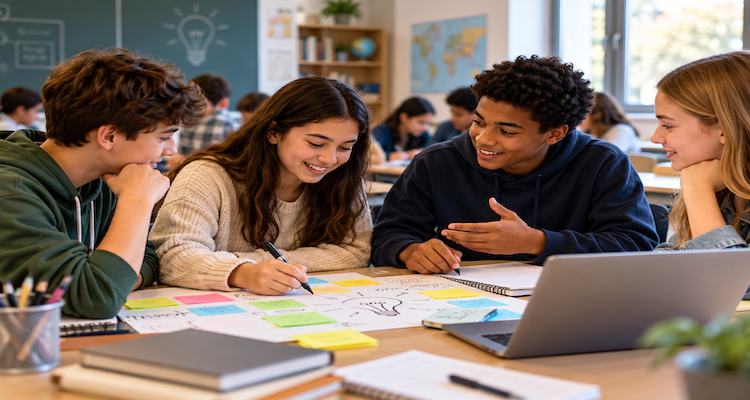
A student finishes a difficult assignment, checks the answer, notices something does not make sense, changes the approach and explains why the new method works. The visible result is the completed work. The less visible achievement is the ability to monitor and direct one’s own thinking.
That skill has a name: metacognition.
Schools have been developing it for years through activities such as planning an essay, checking a mathematical solution, explaining reasoning, evaluating evidence and reflecting on mistakes. But the rise of generative AI is making this quiet educational skill much more consequential. When a machine can produce an answer in seconds, knowing how to think about an answer can become more important than simply producing one.
Research-based guidance from the Education Endowment Foundation (EEF) describes metacognition and self-regulation as approaches that help pupils plan, monitor and evaluate their learning. Its evidence synthesis, updated in 2025, draws on 355 studies and reports an average impact equivalent to eight additional months of progress, while also stressing that implementation and teacher support matter.
At the same time, UNESCO’s AI competency framework for students places critical judgement, human agency, ethical reasoning and the ability to understand and evaluate AI among the capabilities students need in an AI-shaped world.
The connection between these developments points to a larger story: schools may not simply be teaching students what to know. They may be teaching them how to supervise their own thinking.
Key Takeaways
- Metacognition helps students plan, monitor and evaluate their own learning rather than simply complete tasks.
- AI makes this skill more visible because students increasingly have access to instant answers and generated explanations.
- UNESCO identifies critical judgement and human agency as important competencies for students using AI.
- Evidence suggests metacognitive strategies can support learning across subjects and age groups.
- AI does not automatically strengthen independent thinking; how students use it and how teachers structure learning matter.
- The emerging educational challenge is not only AI literacy, but knowing when to trust, question and verify an answer.
The Skill Hidden Inside Ordinary Classroom Work
Metacognition can sound like an advanced psychological concept, but its classroom manifestations are remarkably ordinary.
A teacher might ask:
- How did you decide where to begin?
- Why did you choose that method?
- How do you know your answer is correct?
- What part of the task caused difficulty?
- What would you change next time?
These questions shift attention from the answer to the process used to reach it.
According to the EEF, effective metacognitive approaches explicitly teach pupils strategies for planning, monitoring and evaluating their learning. Teachers can model these processes by thinking aloud, demonstrating how they approach a problem and gradually reducing support as students become more independent.
This matters because knowing something and knowing how well you know it are different capabilities.
A student can remember a formula but fail to recognize that it has been applied incorrectly. Another student may struggle initially but recognize the error, change strategy and eventually arrive at a stronger solution.
The second student is exercising a transferable learning skill.
Why AI Makes Metacognition More Important
Generative AI changes the economics of answering questions.
Previously, producing an essay, explanation, summary or solution required a substantial amount of human effort. Students had to search, read, organize information and formulate an answer.
AI can now perform some of those steps almost instantly.
That does not automatically make learning worse. Research into generative AI and education is producing a mixed picture, with outcomes depending heavily on how AI is integrated into learning.
A 2025 systematic review and meta-analysis covering 57 studies and 97 estimates, for example, reported positive effects of generative AI on several university learning outcomes, including higher-order thinking, while finding no statistically significant overall effect on metacognition in its analysis. The authors also found substantial variation according to learners, tools and learning contexts.
That distinction is important.
AI can help produce an answer without necessarily teaching a student how to judge the answer.
The difference lies in what happens around the technology.
If a student asks an AI system for a solution and copies the response, much of the cognitive work may have been outsourced.
If the student first develops an approach, asks AI to challenge it, checks the response against evidence and explains which parts were accepted or rejected, the same technology becomes part of a more reflective learning process.
The tool has not changed nearly as much as the student’s relationship with the tool.
Schools Were Already Practising This
The interesting part is that schools did not have to invent this skill because of AI.
Metacognition has long been part of educational research and classroom practice.
The EEF’s 2025 evidence review describes strategies involving planning, monitoring and evaluating learning and recommends that these strategies be taught explicitly and embedded within normal curriculum subjects rather than isolated as abstract “thinking skills.”
That means a science lesson can become a metacognitive lesson when students are asked to evaluate how they designed an experiment.
A history lesson can do the same when students examine why they trust one source more than another.
A mathematics lesson can develop the skill when students are required to identify where their reasoning changed.
Writing assignments can reinforce it when students review not only what they wrote but why they structured an argument in a particular way.
The hidden curriculum is therefore not necessarily a separate subject.
It is often the thinking surrounding the subject.
AI Is Turning “Check Your Work” Into a Bigger Question
For generations, teachers have told students to check their work.
AI makes that instruction more complicated.
Checking an answer generated by a machine requires more than looking for spelling mistakes. A student may need to ask:
What evidence supports this?
Could the system have misunderstood the question?
Is the information current?
Does the conclusion actually follow from the evidence?
What assumptions are hidden inside the answer?
These are metacognitive and critical-thinking questions.
UNESCO’s AI Competency Framework for Students explicitly emphasizes a human-centred mindset, AI ethics, AI techniques and applications, and AI system design. It organizes competencies around understanding, applying and creating, while stressing critical examination and human agency.
That framework suggests AI education is broader than learning how to operate an AI chatbot.
Students also need to understand when and why to use AI, what its limitations are and how humans remain responsible for decisions.
The Difference Between Getting Help and Giving Away the Thinking
There is a useful distinction emerging for classrooms.
Imagine a student struggling with a complex question.
One approach is:
“Solve this for me.”
Another is:
“Here is my reasoning. Identify the weakest part and explain why.”
The second approach preserves an important role for the learner.
This distinction becomes particularly significant because research is beginning to examine the relationship between AI dependence and critical thinking. A 2025 study of 580 Chinese university students reported an association between greater AI dependence and lower critical-thinking measures, with cognitive fatigue examined as a mediating factor. The study concerns university students rather than schoolchildren, so its findings should not simply be generalized to every educational setting.
That limitation is important.
The evidence does not justify saying that AI inevitably makes students less capable of thinking.
Instead, it reinforces a more useful question:
What kind of thinking does an educational activity require when AI is available?
That is a curriculum-design question, not merely a technology question.
The Teacher’s Role May Be Changing Too
The arrival of AI also changes what teachers need to model.
UNESCO’s separate AI competency framework for teachers identifies human-centred thinking, AI ethics, AI foundations and applications, AI pedagogy and AI for professional learning among the areas educators increasingly need to understand.
This does not mean teachers need to become software engineers.
It does mean that teaching students to use AI responsibly requires teachers to understand enough about the technology to design appropriate learning activities around it.
A teacher might therefore move from asking students simply to produce an essay toward asking them to:
- Develop an initial argument.
- Identify evidence.
- Use AI to challenge or extend the argument.
- Check AI-generated claims.
- Identify errors or unsupported assertions.
- Revise the work.
- Explain what changed and why.
The final essay remains important.
But the reasoning trail becomes part of the learning.
What Students May Actually Need to Learn
The emerging skill set is broader than “AI literacy.”
Students may increasingly need a combination of:
- Metacognition — understanding and directing their own learning.
- Critical evaluation — questioning whether an answer is reliable.
- Information literacy — finding and assessing evidence.
- AI literacy — understanding what AI systems can and cannot reliably do.
- Self-regulation — managing attention, effort and learning strategies.
- Human judgment — deciding when a technological answer should be accepted, challenged or rejected.
These abilities reinforce one another.
A student who knows how an AI system works but cannot evaluate its output remains vulnerable to incorrect information.
A student who can think critically but does not understand AI’s limitations may also misjudge what the technology is doing.
The strongest approach is therefore not necessarily AI versus traditional learning.
It is learning that combines technology with deliberate human reasoning.
The Skill That Becomes More Valuable When Answers Become Cheap
There is an important paradox here.
When information was difficult to obtain, education naturally placed considerable emphasis on acquiring information.
When information becomes easier to generate, judging information becomes more important.
That does not make knowledge obsolete. In fact, students need background knowledge to recognize bad reasoning and inaccurate information. But knowledge increasingly operates alongside another capability: knowing how to interrogate what appears in front of you.
This may explain why apparently ordinary classroom habits checking work, explaining reasoning, comparing sources, reflecting on mistakes and planning a task deserve renewed attention.
They are not merely old-fashioned study techniques.
They are mechanisms for keeping the learner intellectually involved.
The Bigger Educational Shift
The most consequential change AI may bring to schools is therefore not necessarily the arrival of AI lessons.
It may be a change in what counts as evidence of learning.
If a machine can produce a polished paragraph, a calculation, a summary or a presentation, the finished product becomes a less complete picture of what a student understands.
Teachers may increasingly need to examine the student’s reasoning, decisions, revisions and ability to evaluate machine-generated material.
That does not mean every assignment needs to become an investigation into AI use. Nor does current research justify one universal model for every classroom.
But the direction is becoming clearer.
UNESCO’s framework calls for students to become not merely users of AI but responsible participants who can critically understand, apply and eventually help shape AI systems.
The underlying educational skill is remarkably human:
knowing what you are thinking, why you are thinking it, and when you should change your mind.
Schools may have been teaching that skill for years.
AI is simply making its importance much harder to overlook.
Conclusion
The hidden skill is not typing better prompts, memorizing AI terminology or learning how to obtain faster answers.
It is learning how to supervise your own thinking.
Metacognition gives students a framework for planning, monitoring and evaluating their learning. Critical thinking gives them tools for examining evidence. AI literacy helps them understand the technology they are increasingly working alongside.
Together, these capabilities offer a different way to think about education in the AI era.
The goal is not to ensure that students never use machines to help them think. It is to ensure that students remain responsible for the thinking that matters.
The information presented in this article is based on publicly available sources, reports, and factual material available at the time of publication. While efforts are made to ensure accuracy, details may change as new information emerges. The content is provided for general informational purposes only, and readers are advised to verify facts independently where necessary.