










Cancel Culture in 2026: Accountability, Outrage or Digital Mob Justice?
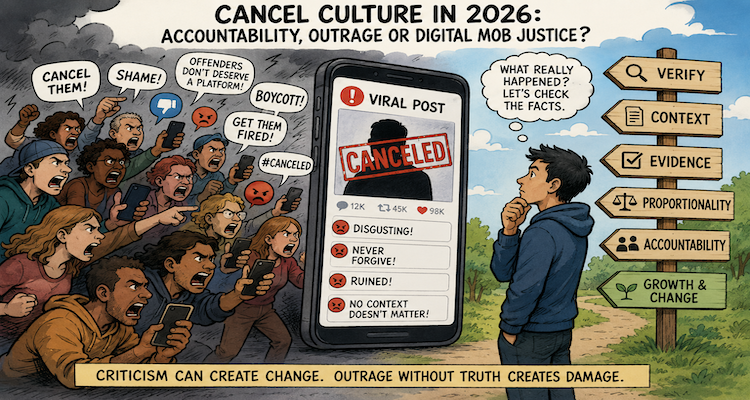
A decade ago, “cancel culture” was often discussed as a simple question of whether powerful people should face consequences for harmful behavior. In 2026, the debate is harder to reduce to a slogan.
Social media platforms can still turn an old post, controversial remark or allegation into a global controversy within hours. But the environment surrounding public shaming has changed. Algorithms reward engagement, screenshots can circulate without context, and generative AI has made the problem of verifying digital material more complicated. At the same time, campaigns for accountability remain important to people who believe traditional institutions have often failed to respond to racism, harassment, abuse or other harmful conduct.
The central question, therefore, is no longer whether public accountability is legitimate. It is whether the internet is capable of distinguishing accountability from punishment without due process.
Key Takeaways
- Cancel culture remains a contested label because it can describe both legitimate accountability and disproportionate online punishment.
- Social media can amplify accusations faster than institutions can investigate or establish context.
- Generative AI and manipulated media make verification increasingly important before online outrage becomes irreversible.
- Deplatforming, boycotts and criticism are not automatically censorship, but collective pressure can still produce serious consequences.
- The strongest accountability systems combine transparency, evidence, proportionality and meaningful opportunities for correction.
The Problem With Treating “Cancel Culture” as One Thing
“Cancel culture” is not a precise legal or academic category. It is commonly used to describe a wide range of actions: consumer boycotts, calls for resignation, social-media criticism, professional consequences, deplatforming and coordinated campaigns to withdraw support from a public figure or organization.
That breadth is part of the problem.
A customer choosing not to support a company is different from an employer acting after a verified investigation. Both are different again from thousands of strangers attempting to identify, contact or punish an individual on the basis of incomplete information.
When these situations are all described as “cancellation,” the important distinctions disappear.
Criticism is not automatically a digital mob. Nor is every public consequence evidence of injustice. People and institutions can be held accountable for genuine wrongdoing. The more difficult question is whether the response is based on reliable evidence, whether it is proportionate, and whether there is any meaningful process for correcting false or misleading claims.
Accountability Needs Evidence, Not Just Virality
Online attention does not function like an investigation.
A viral post can provide an allegation, a fragment of video or a screenshot. What it often cannot provide is the full record: what happened before and after the clip, whether the material is authentic, whether relevant information is missing, or whether an accusation has been independently verified.
That gap matters because the incentives of social media are not necessarily the incentives of fact-finding. Content that produces strong reactions can spread rapidly even when the underlying situation is uncertain.
The arrival of increasingly capable generative AI adds another complication. Synthetic images, audio and video can make fabricated material more convincing, while genuine material may also be dismissed as fake. This creates a difficult environment in which speed can become the enemy of verification.
For readers, the practical lesson is increasingly simple: virality is evidence of attention, not evidence of truth.
Why Public Pressure Can Still Serve a Legitimate Purpose
The critique of cancel culture should not become a defence of impunity.
Public pressure has historically played an important role when institutions failed to respond to misconduct or injustice. Consumer boycotts, organized criticism and social movements can force companies, governments and influential individuals to address behavior that might otherwise have been ignored.
Digital platforms have expanded that ability. A person who lacks institutional power may now be able to document an experience and reach an audience directly.
That does not make every online campaign justified. It does mean that the alternative to public pressure is not always a fair and effective formal process.
This is where the debate becomes more useful when framed around accountability rather than “cancellation.” Accountability asks whether a response is justified by the evidence and proportionate to the conduct. Mob justice often begins when the objective shifts from establishing what happened to maximizing punishment.
The Difference Between Consequences and Permanent Exile
One of the weakest assumptions in online discourse is that every mistake requires either total forgiveness or permanent exclusion.
Real life is usually more complicated.
Intentional misconduct, repeated abuse and serious criminal behavior may justify severe consequences. A careless statement, an old comment or a misunderstanding may require a different response. Context does not excuse every action, but proportionality matters.
A healthy accountability process should be capable of asking:
- What exactly happened?
- What evidence supports the claim?
- Who was harmed?
- Was the conduct intentional, repeated or severe?
- Has the person or institution acknowledged the problem?
- What corrective action is possible?
- What consequence is proportionate?
These questions are not an attempt to protect powerful people from criticism. They are safeguards against replacing one form of injustice with another.
The 2026 Challenge: Context Is Becoming Harder to Trust
The digital environment has created a new problem for public judgment: information can be abundant while certainty remains scarce.
A short video may omit the events surrounding it. A screenshot may be authentic but misleadingly presented. An old statement may be recirculated as if it were new. AI-generated content may be mistaken for authentic evidence. Coordinated accounts can also create the appearance of widespread public consensus.
As a result, digital literacy is becoming part of civic literacy.
Before sharing or joining an online campaign, users increasingly need to ask basic questions about origin, timing, corroboration and context. Journalists, platforms and institutions face the same challenge at a larger scale.
The burden should not fall entirely on individual users. Platforms also make design choices about amplification, recommendation and moderation. When systems reward the fastest and most emotionally charged reactions, they can make careful judgment less competitive.
What a Better Model of Accountability Could Look Like
There is no universal formula, particularly because legal systems, workplaces, platforms and communities operate differently. But several principles travel well across contexts.
Verification: Serious allegations should not be treated as established facts merely because they are popular.
Proportionality: Consequences should reflect the seriousness and circumstances of the conduct.
Transparency: Institutions should explain major decisions when doing so is appropriate and legally possible.
Correction: False claims and significant errors should be corrected as visibly as the original accusations whenever possible.
Distinction: Criticism, boycott, reporting, harassment and coordinated intimidation should not be treated as interchangeable actions.
Room for change: Accountability can include apology, restitution, education or other corrective action when the circumstances justify it.
These principles will not eliminate disagreement. They can, however, move the discussion away from a simplistic choice between “cancel everyone” and “face no consequences.”
Why the Debate Matters Beyond Social Media
Cancel culture is often discussed as an internet trend, but its consequences can extend into workplaces, education, entertainment, politics and business.
For organizations, the challenge is deciding whether to respond to public pressure immediately or investigate before acting. For public figures, digital history has become increasingly permanent and searchable. For ordinary users, participation in an online pile-on can feel temporary even when its effects on another person are not.
There is also a broader cultural cost when every disagreement is interpreted through the language of cancellation. Powerful criticism can be dismissed as “cancel culture” even when it is evidence-based and justified. Conversely, genuine harassment can be defended as accountability.
Both shortcuts make serious judgment harder.
Conclusion
In 2026, the most useful way to think about cancel culture may be to stop asking whether “cancellation” is always good or always bad.
The better question is what kind of accountability a digital society should want.
Accountability requires evidence. It considers harm and context. It distinguishes criticism from harassment and proportionate consequences from permanent punishment. Most importantly, it leaves room for facts to change the outcome.
The internet has given individuals unprecedented power to expose wrongdoing and demand change. It has also made it easier to punish first and investigate later. The challenge for platforms, institutions and users is not to eliminate public consequences. It is to ensure that outrage does not become a substitute for judgment.
This content is published for informational or entertainment purposes. Facts, opinions, or references may evolve over time, and readers are encouraged to verify details from reliable sources.