










Ultra-Processed Foods: What Happens When Convenience Becomes a Daily Habit?
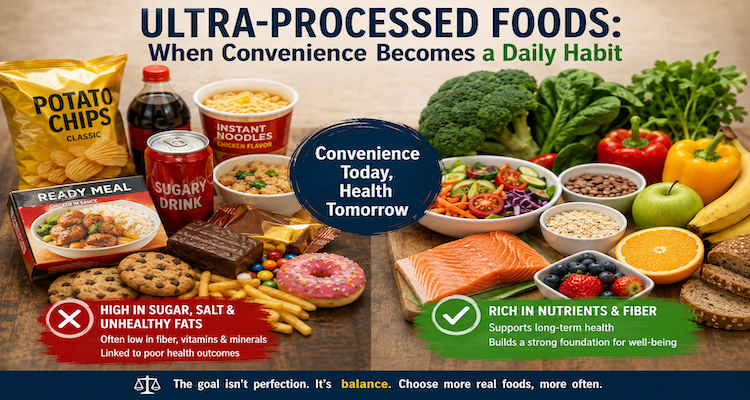
Convenience has quietly become one of the most powerful forces shaping what people eat. A packaged snack fills the gap between meetings. Instant noodles solve a late-night dinner problem. A ready-to-eat meal replaces cooking when time, energy or planning runs short.
None of those choices automatically makes a diet unhealthy. The more important question is what happens when convenience stops being occasional and becomes the default.
Research increasingly suggests that high consumption of ultra-processed foods is associated with a range of adverse health outcomes. At the same time, scientists are still working through an important question: how much of the risk comes from the nutritional profile of these foods, how much from the nature of industrial processing itself, and how much reflects the wider lifestyles and food environments in which they are consumed.
That distinction matters. The debate is not really about whether someone should feel guilty for eating a packaged food. It is about what happens when an entire eating pattern gradually shifts away from foods that require preparation and toward products designed for speed, convenience, shelf life and easy consumption.
Key Takeaways
- Ultra-processed foods are linked with poorer health outcomes, but many studies show association rather than direct causation.
- A daily convenience-food habit can gradually displace fibre-rich and nutrient-dense foods from the overall diet.
- Not all processed foods belong in the same category; processing exists on a spectrum.
- The strongest practical goal is usually to improve the overall dietary pattern rather than chase dietary perfection.
- Time, cost, availability and food environments make reducing reliance on ultra-processed foods more complicated than simply “making better choices.”
What Counts as an Ultra-Processed Food?
The word “processed” can be misleading because food processing itself is not inherently harmful. Washing, freezing, fermenting, pasteurizing and preserving food all involve processing in some form.
The widely used NOVA classification distinguishes between unprocessed or minimally processed foods, processed culinary ingredients, processed foods, and ultra-processed foods. Ultra-processed products generally involve industrial formulations and ingredients that are not typically used in ordinary home cooking, alongside processes designed to create convenient, ready-to-consume products. Common examples can include certain packaged snacks, sugary drinks, instant noodles and some ready-made meals.
This is why the simple instruction to “avoid processed food” is not especially useful. Canned beans, plain yoghurt, frozen vegetables and packaged whole-grain bread may be processed, yet they can still fit into a healthy diet. The more useful question is what role a product plays in the overall eating pattern and what it may be replacing.
That distinction is one of the most important parts of the conversation and one that often disappears when ultra-processed food becomes a cultural catch-all for anything sold in a packet.
What the Research Actually Shows
A major umbrella review published in The BMJ in 2024 examined 45 pooled analyses covering nearly 9.9 million participants. The researchers found that greater exposure to ultra-processed foods was associated with a higher risk across a broad range of health outcomes, including cardiometabolic conditions, some mental health outcomes and mortality measures.
The scale of the evidence is significant, but the wording is equally important: associated with does not always mean caused by.
Much of the evidence included in large reviews comes from observational research. Such studies can identify important patterns, but people who consume large amounts of ultra-processed food may also differ from lower consumers in other ways, including income, stress, sleep, physical activity and access to healthier food.
Researchers attempt to account for these factors, yet they cannot eliminate every source of uncertainty. The BMJ review itself assessed the certainty of evidence across outcomes and found substantial variation in evidence quality. That is a reason for careful interpretation not a reason to dismiss the findings.
A second umbrella review published in 2024 similarly reported moderate-certainty evidence for associations involving outcomes such as all-cause mortality, cardiovascular disease and type 2 diabetes, while also reflecting the continuing need to understand the mechanisms behind these relationships.
The broad direction of the evidence is increasingly difficult to ignore. The precise explanation, however, remains more complicated than a single slogan about “bad food.”
The Overlooked Problem: What Convenience Can Crowd Out
The health impact of a convenience-heavy diet may not come only from what ultra-processed products contain. It may also come from what repeated reliance on them gradually removes.
When packaged snacks replace fruit, instant meals replace meals built around vegetables and pulses, or sugary drinks replace water and other less sugary options, the diet can lose fibre, variety and nutritional quality.
The World Health Organization emphasizes that healthy diets are built around adequacy, balance, moderation and diversity, with a wide range of minimally processed or unprocessed foods forming an important foundation. WHO also notes that diets high in highly processed foods often containing elevated levels of unhealthy fats, free sugars or sodium are associated with negative health outcomes.
This leads to a useful shift in perspective.
Instead of asking only, “Is this product bad?”, a more revealing question may be:
“If this becomes a daily habit, what foods disappear from my diet?”
That is where occasional convenience can become a long-term dietary pattern.
Why Daily Habits Matter More Than Occasional Choices
A single fast-food meal is unlikely to define anyone’s health. Nutrition works over time.
Daily habits affect the cumulative pattern of energy intake, fibre consumption, sodium, free sugars, dietary variety and the types of foods that become normal within a household. Repetition also reduces decision-making. Once a person routinely buys the same snack, beverage or ready-to-eat meal, convenience becomes part of the food system surrounding them.
This is especially relevant because dietary habits established early in life can continue into adulthood. WHO notes that eating patterns and preferences developed during childhood and adolescence often extend later in life.
The practical implication is that ultra-processed food should not be viewed only as an individual willpower issue. Food choices are shaped by working hours, commuting, cooking facilities, prices, marketing, product availability and household routines.
For many people, convenience is not a luxury. It is a response to genuine constraints.
Why “Just Cook Everything From Scratch” Is Not a Serious Solution
Public discussion about ultra-processed foods can easily become unrealistic.
Telling busy workers, students, parents or people with limited cooking facilities to prepare every meal from basic ingredients ignores the conditions that made convenience attractive in the first place.
WHO has explicitly recognized that changing food systems, urbanization and lifestyles have shifted dietary patterns toward greater consumption of highly processed foods, while access, availability and everyday circumstances also influence what people eat.
A more practical strategy is substitution rather than purity.
For example:
- Keep convenient foods that still contribute useful nutrition, such as frozen vegetables or plain yoghurt.
- Make one regular meal each day more dependent on minimally processed ingredients.
- Replace some snack occasions with fruit, nuts or other accessible alternatives.
- Use convenience products as part of a meal rather than allowing them to become the entire meal.
- Pay attention to repetition: the same highly processed product eaten several times a day matters more than an occasional purchase.
The goal is not to create a perfect diet. It is to prevent convenience from becoming nutritional monotony.
The Bigger Issue Is the Food Environment
There is also a broader social question behind the ultra-processed food debate: why has convenience become so structurally attractive?
Highly convenient products fit modern retail systems. They can have long shelf lives, require little preparation and are easy to transport and market. Consumers, meanwhile, are often making food decisions under pressure from work schedules, family responsibilities, cost constraints and limited time.
This creates a mismatch between public health advice and everyday life. Knowing that a varied diet rich in minimally processed foods is desirable does not automatically make those foods the easiest option to obtain, prepare or afford.
That is why the policy debate is evolving. In 2025, WHO announced a process to develop a guideline on ultra-processed food consumption, citing a growing body of evidence linking diets rich in such foods with negative health outcomes. The development of a guideline also reflects the fact that the science and policy questions are still being actively examined rather than completely settled.
The long-term challenge may therefore be larger than individual education. If healthier choices consistently require more time, planning and preparation than less healthy alternatives, information alone will have limited power.
A Better Rule Than Fear
Ultra-processed food research is important, but it should not produce a new form of dietary anxiety.
People do not need to inspect every ingredient list with the assumption that every packaged product is dangerous. Nor does one meal determine long-term health.
A more useful approach is to examine the pattern:
What proportion of daily eating is built around foods that are minimally processed, varied and nutritionally useful and what proportion is dominated by products designed primarily for convenience and easy consumption?
That question leaves room for real life while still taking the evidence seriously.
The strongest dietary change may not be an ambitious attempt to eliminate every ultra-processed product. It may simply be restoring some foods that convenience gradually pushed aside: more fruit, vegetables, pulses, whole grains and other foods that bring variety and fibre back into the routine.
Conclusion
The concern about ultra-processed foods is not that convenience itself is a health hazard. Convenience can make food accessible and help people manage busy lives. The problem emerges when convenience repeatedly becomes the organizing principle of the entire diet.
The evidence increasingly links high exposure to ultra-processed foods with poorer health outcomes, although important questions about causation and underlying mechanisms remain.
For most readers, the practical lesson is less dramatic than the headlines surrounding the debate. There is no need to fear every packaged food. But it is worth noticing when quick, ready-to-consume products stop being occasional solutions and start replacing the variety of foods that a healthy diet depends on.
The most meaningful question may not be whether a single food is “good” or “bad.” It is whether convenience is slowly becoming the default and what that default is leaving out.
This content is published for informational or entertainment purposes. Facts, opinions, or references may evolve over time, and readers are encouraged to verify details from reliable sources.