










How the Bhagavad Gita Explains the Difference Between the Mind and the Self
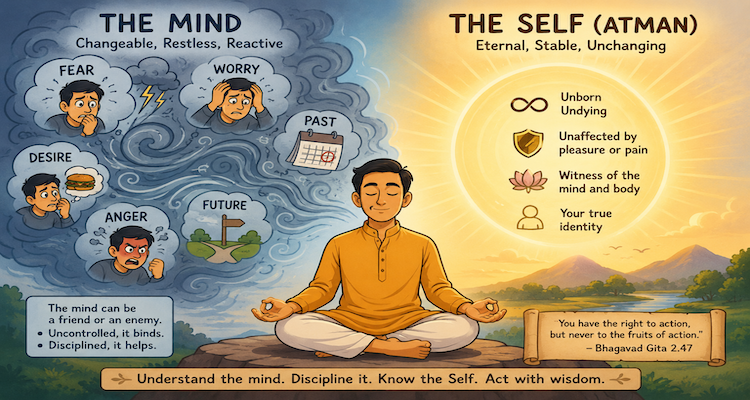
A central question in the Bhagavad Gita is deceptively simple: Who is the one experiencing fear, desire, grief and confusion and who, if anyone, can observe those experiences?
The Gita approaches this question by distinguishing between the changing activity of the mind and a deeper, enduring Self often translated from Atman. This distinction is not presented merely as abstract philosophy. It sits at the center of the dialogue between Arjuna and Krishna, where emotional turmoil, moral conflict and the problem of action all converge.
For a modern reader, the idea can be especially useful when separated from a common misunderstanding: the Gita does not simply say that a person should “stop thinking” or suppress emotion. Its teaching is more demanding. Thoughts, impulses and emotions belong to the field of inner experience, while the deeper Self is described as something that is not identical to those changing mental states. The practical challenge is learning not to mistake every movement of the mind for one’s entire identity.
Key Takeaways
- The Bhagavad Gita distinguishes the changing mind from the enduring Atman, or Self.
- Thoughts and emotions can influence judgment, but the Gita does not treat them as the whole of a person.
- The Gita presents the mind as powerful, trainable and capable of becoming either an ally or an obstacle.
- Its teaching connects self-knowledge with disciplined action rather than withdrawal from life.
- The distinction between mind and Self helps explain why inner stability is central to the Gita’s idea of wisdom.
The Mind Is Changeable; the Self Is Not
The Gita’s distinction begins with change.
The mind moves. It reacts to pleasure and pain, remembers the past, imagines the future, forms desires and generates fears. Arjuna himself becomes an example of this inner instability at the beginning of the Gita. Faced with the prospect of fighting people he knows and loves, he is overwhelmed by grief and moral confusion.
The Atman, by contrast, is described in fundamentally different terms. In Chapter 2, Verse 20, the Gita describes the Self as unborn and enduring, saying that it is not destroyed when the body is destroyed.
This creates the philosophical distinction at the heart of the teaching:
| The mind | The Self (Atman) |
|---|---|
| Changes from moment to moment | Is described as enduring |
| Experiences attraction and aversion | Is not defined by passing mental states |
| Can be disturbed, distracted or disciplined | Is presented as deeper than bodily and mental change |
| Interprets experience | Represents the enduring spiritual identity in the Gita’s teaching |
The comparison should not be mistaken for a modern scientific model of the brain. The Bhagavad Gita is a philosophical and spiritual text, not a work of neuroscience. Its distinction is about the nature of identity and consciousness within its own philosophical framework.
Why the Mind Can Become Both Friend and Enemy
One of the Gita’s most practical insights is that the mind is neither automatically trustworthy nor inherently harmful.
Chapter 6 presents the mind as capable of helping or hindering a person. The wording of Verse 6.5 has been interpreted differently by translators because the Sanskrit term atman can carry different meanings depending on context. One translation explicitly explains the relevant sense as the mind being capable of acting as a friend or foe.
That ambiguity matters. It prevents a simplistic reading in which every occurrence of “self” in English translation refers to exactly the same philosophical concept.
The practical idea, however, is clear across the passage: inner discipline matters because an uncontrolled mental life can work against a person’s deeper aims.
Arjuna then raises an objection that still feels recognizable. In Chapter 6, Verse 34, he describes the mind as restless, turbulent, powerful and difficult to restrain, comparing its control to controlling the wind.
The Gita therefore does not begin with the assumption that mental control is easy. Its teaching acknowledges the difficulty before proposing discipline.
The Gita Does Not Ask You to Destroy the Mind
This is an important distinction often lost in simplified spiritual interpretations.
The goal is not to become thoughtless, emotionless or indifferent to the world. The Gita’s larger conversation takes place precisely because action matters. Arjuna cannot solve his dilemma simply by refusing to think or feel.
Instead, the teaching repeatedly moves toward discernment the ability to see clearly enough to avoid being completely carried away by fear, desire, attachment or aversion.
In practical terms, the difference might be understood this way:
A thought says, “I am going to fail.”
The mind may produce that thought from memory, anxiety or imagination. The Gita’s distinction invites a further question: Must the deepest identity of the person become identical with that thought?
The answer, within the Gita’s philosophical framework, is no.
Likewise:
- Anger may arise without defining the whole person.
- Fear may influence a decision without becoming the final authority.
- Desire may be experienced without requiring immediate action.
- Grief may be real without exhausting the meaning of one’s identity.
This does not make emotions unreal. It changes the relationship to them.
The Overlooked Connection: Self-Knowledge Leads Back to Action
A generic explanation of the Bhagavad Gita can make its philosophy sound like an invitation to withdraw from ordinary life. But the dialogue’s structure points in another direction.
The question of the Self emerges in the middle of a crisis about action.
Arjuna wants to know what he should do. Krishna’s teaching does not simply tell him to escape the battlefield of human responsibility. Instead, the Gita links self-knowledge with karma yoga disciplined action performed without excessive attachment to personal outcomes.
That connection gives the distinction between mind and Self a practical consequence.
If a person identifies completely with every changing thought, decision-making can become unstable. Fear says one thing today, ambition another tomorrow, anger something else the next hour. The Gita’s proposed solution is not to wait until the mind becomes permanently silent before acting. It is to cultivate steadiness, discernment and a less possessive relationship with results.
This is one reason the Gita remains more than a text about meditation. Its central problem is how to live and act when the mind itself is uncertain.
A Useful Modern Reading Without Forcing Modern Psychology Into the Gita
There is a temptation to translate the Gita directly into contemporary psychological language and declare that Atman simply means the “observing self” or that the mind corresponds exactly to a particular scientific theory of cognition.
That goes too far.
Modern psychology, neuroscience and the Bhagavad Gita operate within different intellectual traditions and answer different questions. The Gita’s claims about the eternal Self are philosophical and spiritual claims, not findings established by modern laboratory science.
Yet a careful comparison can still be useful at the level of lived experience.
Many people recognize the difference between:
having a thought and being completely defined by a thought.
The Gita develops this intuition into a much broader account of human identity. Mental activity changes; bodily circumstances change; social roles change. The Atman, in the Gita’s teaching, belongs to a deeper level of identity that is not exhausted by those changes.
Whether a reader accepts that metaphysical claim is ultimately a matter of philosophical or religious belief. But understanding the distinction is essential to understanding what the Gita is actually trying to say.
What This Teaching Can Mean in Daily Life
The Gita’s framework can be approached as a discipline of pause and discernment.
Before reacting, a person can ask:
- Is this thought a fact, an interpretation or a temporary reaction?
- Is this emotion asking to be understood, or am I allowing it to control my judgment?
- What action is required, independent of my desire for a particular outcome?
- Am I confusing a passing mental state with my entire identity?
These questions do not reproduce the full philosophical system of the Bhagavad Gita. But they reflect one of its central practical tensions: the mind experiences the changing world, while wisdom requires a perspective that is not continually overwhelmed by every change.
The Mind Is a Tool, but Identity Runs Deeper
The most useful way to understand the Gita’s distinction may be to resist two extremes.
The first is to assume that every thought is true because it appears in the mind. The second is to assume that wisdom requires rejecting thought and emotion altogether.
The Gita offers another possibility: the mind must be understood, trained and directed, but it is not the final definition of who one is.
That is why Arjuna’s struggle remains central to the teaching. His confusion is not dismissed as meaningless. It is the starting point for inquiry. The mind can be restless, divided and overwhelmed as the Gita itself openly acknowledges.
But the text asks the reader to look beyond the movement of that inner turbulence.
The distinction between mind and Self is therefore not an invitation to escape experience. It is an invitation to stop treating every passing experience as the whole truth about oneself. In the Bhagavad Gita’s vision, inner freedom begins when the changing activity of the mind is no longer mistaken for the deepest identity of the Self.
Conclusion
The Bhagavad Gita’s distinction between the mind and the Self offers a powerful way of thinking about inner life: thoughts change, emotions change and circumstances change, but the Gita argues that the deepest Self is not reducible to those movements.
Its practical message is equally important. The mind is not something to hate or destroy. It is something to understand and discipline. When it is driven by attachment, fear or confusion, it can obstruct wise action. When cultivated, it can support clarity.
The deeper challenge posed by the Gita is therefore not simply, “How do I control my mind?” It is also: “Who am I when the mind is changing?” For the Gita, the search for that answer is inseparable from learning how to live, choose and act with greater steadiness.
This content is published for informational or entertainment purposes. Facts, opinions, or references may evolve over time, and readers are encouraged to verify details from reliable sources.