










Why Profitable Companies Are Choosing to Stay Private Longer
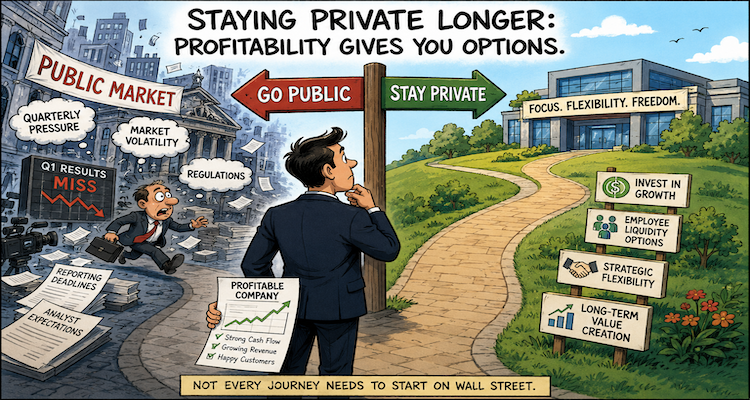
A profitable company once faced a relatively straightforward question: when growth accelerated, should it go public? Today, that assumption is increasingly outdated.
For a growing number of companies, profitability can make staying private easier rather than make an IPO inevitable. Strong cash generation reduces dependence on public markets, while private capital, secondary share sales and alternative liquidity mechanisms can give companies and employees options that previously required a stock-market listing. At the same time, becoming public brings reporting obligations, governance requirements and a permanent focus on quarterly results.
The result is a shift in the traditional relationship between business success and public ownership. Going public remains an important path for companies that need capital, liquidity, visibility or acquisition currency. But profitability increasingly gives management another strategic asset: the ability to wait.
Key Takeaways
- Profitable companies can use internally generated cash to reduce their dependence on public-market fundraising.
- Private companies now have more ways to provide liquidity without immediately launching an IPO.
- Higher interest rates and a more selective IPO market have increased the value of financial self-sufficiency.
- Remaining private can preserve strategic flexibility, but it also creates governance and liquidity challenges.
- The growing number of long-lived private companies is changing how employees, investors and public markets access corporate growth.
Why Profitable Companies Are Choosing to Stay Private Longer
A profitable company once faced a relatively straightforward question: when growth accelerated, should it go public? Today, that assumption is increasingly outdated.
For a growing number of companies, profitability can make staying private easier rather than make an IPO inevitable. Strong cash generation reduces dependence on public-market fundraising, while private capital, secondary share sales and alternative liquidity mechanisms can give companies and employees options that previously required a stock-market listing. At the same time, becoming public brings reporting obligations, governance requirements and a permanent focus on quarterly results.
The result is a shift in the traditional relationship between business success and public ownership. Going public remains an important path for companies that need capital, liquidity, visibility or acquisition currency. But profitability increasingly gives management another strategic asset: the ability to wait.
Profitability changes the IPO equation
An initial public offering has never been simply a celebration of success. It is a financing decision, a liquidity event and a major change in how a company is governed.
For companies that are still consuming large amounts of cash, access to public capital can be particularly attractive. But a profitable business occupies a different position. If operations generate enough cash to fund a meaningful share of growth, management has more freedom to choose when or whether to seek public investors.
That distinction matters because the central question is increasingly less about whether a company is ready to go public and more about whether an IPO would create enough additional strategic value to justify the transition.
Nasdaq’s recent analysis illustrates how far the market has moved from the earlier venture-backed model. It found that the median age of companies at IPO increased from about six years in 1980 to 12 years by 2025. Its analysis also found late-stage private companies had a median age of 12 years as of June 2026.
The important point is not that every successful company should remain private. Rather, the deadline has changed. A profitable company that can finance its operations, attract capital and provide at least some shareholder liquidity no longer faces the same pressure to list simply because it has reached a certain scale.
Private capital has become a substitute for part of the public-market function
Historically, public markets performed several functions at once: companies raised large amounts of capital, investors obtained liquidity and employees could eventually convert stock options into tradable shares.
Those functions are now increasingly being separated.
Late-stage venture funds, growth-equity investors, private equity firms and other institutional investors can provide large pools of capital without requiring a public listing. Structured secondary transactions and tender offers can also provide partial liquidity to founders, employees and early investors.
Nasdaq Private Market reported that company tender programs accounted for $35 billion in liquidity during 2025, compared with approximately $45 billion raised through IPOs in the same period. Its data also showed that nearly half of the tender programs it ran in 2025 involved companies from Seed through Series C, compared with 30% two years earlier.
That does not mean secondary markets are replacing IPOs. Public listings still provide broader, continuous liquidity and a transparent market price that private transactions generally cannot replicate.
But secondaries can solve a narrower and increasingly important problem: a company can give some shareholders liquidity without turning the entire company into a publicly traded business.
This changes the economics of waiting.
The IPO is becoming a later-stage event
The shift toward older, larger IPO candidates has broader consequences for public markets.
Companies that once might have listed while still in an earlier phase of expansion can now spend more of their growth cycle in private hands. Vanguard noted that more value creation is occurring before IPOs, while Nasdaq similarly found that today’s IPO candidates are generally older and larger than those of previous decades.
Morgan Stanley has also described the current IPO pipeline as increasingly populated by companies that have already reached greater operational maturity, often supported by venture, growth or private-equity capital.
This creates a subtle but important change for ordinary investors.
In an earlier model, public-market investors could potentially buy into successful companies at a relatively early stage. If more of the high-growth period occurs privately, a larger share of that appreciation may accrue to founders, employees and investors with access to private markets before public investors get an opportunity to participate.
That does not automatically make the system worse. Mature companies may enter public markets with more established businesses, stronger revenue bases and clearer operating histories.
The trade-off is that public investors may encounter companies after a larger portion of their most explosive growth has already occurred.
Why profitability makes waiting easier
A company does not need to be profitable to remain private. Many high-profile private companies continue to rely heavily on outside capital.
Profitability matters because it changes bargaining power.
A company that needs external funding to survive may have limited control over timing. If market conditions deteriorate or existing investors become reluctant to provide more capital, an IPO or sale can become less a strategic choice than a necessity.
A profitable company has more options.
It may be able to:
- Fund a larger portion of expansion through operating cash flow.
- Raise private capital selectively rather than under immediate financial pressure.
- Wait for more favorable public-market conditions.
- Conduct tender offers to address employee or investor liquidity.
- Pursue acquisitions or strategic investments without immediately restructuring for a public offering.
This flexibility is particularly valuable when public-market valuations are volatile. Management can avoid making a permanent ownership decision during a temporary period of weak market appetite provided the underlying business has sufficient financial resilience.
In that sense, profitability does not eliminate the need for outside capital. It can simply improve the company’s negotiating position with every potential source of it.
Staying private is also a way to avoid a different kind of pressure
Public ownership brings benefits, but it also changes corporate life.
Public companies face recurring disclosure obligations, investor scrutiny and regulatory requirements. The U.S. Securities and Exchange Commission provides scaled disclosure accommodations for qualifying emerging growth companies, but the existence of those accommodations underscores that public reporting carries meaningful compliance responsibilities.
The SEC itself is now examining ways to encourage more companies to enter and remain in public markets. In 2026, the Commission proposed changes intended to simplify aspects of the reporting framework, while SEC Chairman Paul Atkins argued that public markets provide liquidity, transparency, price discovery and accountability that private markets cannot fully replicate.
That perspective highlights an important counterargument to the private-longer trend.
Staying private can preserve strategic control, but it can also reduce transparency. Private-company shareholders generally have fewer opportunities to sell, and private valuations may be less continuously tested than public market prices. Employees with significant equity compensation can also face a practical problem: they may be wealthy on paper while having limited opportunities to convert that value into cash.
Morgan Stanley’s 2025 research found that private-company decision-makers were feeling significant pressure to facilitate liquidity events, with tender offers ranking ahead of IPOs as the most likely next liquidity event among surveyed companies.
So the private model has a built-in tension. The longer a company stays private, the more valuable structured liquidity mechanisms may become.
The hidden cost of waiting
The ability to remain private longer is not the same as an unlimited ability to postpone an exit.
Private ownership can become more complicated as a company grows. Early investors may want to realize returns. Employees may want to diversify their personal finances. New investors may demand different governance rights. The shareholder base can become increasingly complex.
Secondary markets help, but they are not identical to a stock exchange.
Access may be restricted. Transactions may occur only at specific times. Companies may tightly control who can buy shares. Prices can be based on negotiated transactions rather than continuous public trading.
The broader secondary market is also expanding partly because investors themselves need liquidity from assets being held for longer periods. Lazard estimated that the overall secondary market generated $233 billion in transaction volume in 2025, up from $152 billion in 2024, reflecting continued demand for mechanisms that create liquidity outside traditional exits.
This means that remaining private longer can shift not eliminate the problem of liquidity.
Instead of one large public-market event, companies and investors may rely on a series of smaller, structured transactions over many years.
A stronger company does not always make a better IPO candidate
One of the most overlooked aspects of this trend is that profitability and IPO readiness are not the same thing.
A company may be profitable yet still decide that public ownership offers too little additional capital, too much administrative burden or poor timing relative to its strategic objectives.
Conversely, a company may be unprofitable but still choose to go public because it needs capital, wants a liquid acquisition currency or believes public markets will support its growth strategy.
The decision is therefore increasingly situational.
A useful way to frame it is through three questions:
Does the company need public capital?
If internal cash flow and private financing can support the business, the urgency of an IPO may decline.
Does the company need broad liquidity?
A public listing remains difficult to match when a large and diverse shareholder base needs regular access to a market.
Does public ownership improve the strategy?
For some businesses, a public stock can support acquisitions, strengthen brand visibility or broaden access to capital. For others, those benefits may not yet outweigh the costs.
The strongest companies may therefore have the greatest freedom to delay an IPO precisely because they are successful enough to survive without one.
What the trend means for the future of public markets
The long-term consequence may be a continued division between where companies create value and where ordinary investors can access that value.
Nasdaq has argued that companies are increasingly reaching valuations once associated with mature public corporations before they ever list. Vanguard has similarly warned that delaying IPOs means more innovation-led growth can occur outside traditional public equity markets.
If that pattern continues, public markets may increasingly receive companies that are larger, more mature and further along in their business development.
That could have advantages. Later-stage companies may have more established products, customers and financial histories.
But it could also make private-market access more important for institutions seeking exposure to earlier phases of corporate growth an opportunity that remains far less accessible to most individual investors.
The trend also places pressure on regulators and exchanges to consider whether the costs and requirements of public ownership remain appropriately balanced. The SEC’s 2026 proposals to simplify aspects of public-company reporting reflect a recognition that the structure of capital markets is part of the policy debate. Those proposals, however, are not yet the same as established regulatory change.
Conclusion
Profitable companies are staying private longer not because IPOs have become irrelevant, but because an IPO is no longer the only practical answer to growth, capital needs and shareholder liquidity.
The most significant change is the expansion of choice. Deep private capital markets, structured secondary transactions and stronger internal cash generation allow some companies to postpone public ownership until its advantages clearly outweigh its costs.
That could make future IPOs larger and more mature. It could also mean that a growing share of corporate value creation happens before a company’s stock ever reaches the public market.
For founders and executives, profitability increasingly buys something more valuable than capital: time to choose the right market, rather than being forced into the next available one.
The information presented in this article is based on publicly available sources, reports, and factual material available at the time of publication. While efforts are made to ensure accuracy, details may change as new information emerges. The content is provided for general informational purposes only, and readers are advised to verify facts independently where necessary.