










The Subscription Economy: Are Consumers Finally Reaching Their Limit?
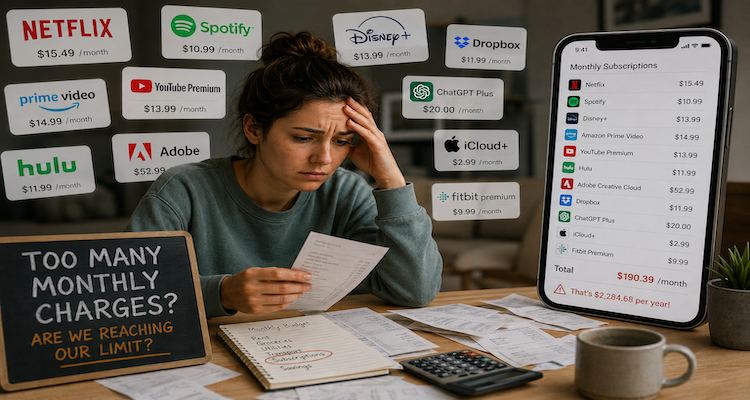
A subscription once promised convenience: one predictable monthly payment in exchange for continuous access. That logic helped transform software, entertainment, fitness, news, gaming and countless other industries. But the same model has created a new consumer problem. The modern household is no longer deciding whether to subscribe. It is deciding which recurring charges still deserve to survive.
The evidence suggests that consumers are becoming more selective rather than abandoning subscriptions altogether. In Deloitte’s 2025 Digital Media Trends survey, 47% of respondents said they pay too much for the streaming services they use, while 41% said the available content was not worth the price. The average subscribing household still had four paid streaming services, but reported spending rose from $61 to $69 per month in a year.
That distinction matters. The subscription economy may not be reaching a universal breaking point. It may instead be entering a tougher phase: consumers are learning to cancel, rotate, downgrade, bundle and question recurring payments that once escaped scrutiny.
Key Takeaways
- Consumers appear less willing to tolerate rising subscription prices when perceived value does not rise with them.
- Subscription fatigue is increasingly a management problem, not simply a spending problem.
- Cancellation and re-subscription behavior is weakening the idea that subscribers must remain permanently loyal.
- Bundles and lower-cost ad-supported plans are becoming responses to fragmented subscription spending.
- Easier cancellation is becoming both a consumer-protection issue and a test of whether businesses can retain customers on genuine value.
The problem is not one subscription it is the accumulation
A single monthly payment can appear harmless. The difficulty emerges when recurring billing spreads across categories.
A household may have several streaming services, music subscriptions, cloud storage, software tools, gaming memberships, news subscriptions, fitness apps and other recurring products. Each service can justify its own price. Together, however, they compete for the same budget.
That creates an important shift in consumer behavior. The question is increasingly comparative: Is this service worth keeping instead of something else?
Streaming offers a clear example because the market has become highly fragmented. Deloitte’s March 2025 data found that 90% of U.S. consumers had at least one paid streaming video service in their household, with an average of four services. Yet 35% said they were cutting back on entertainment subscriptions because of financial concerns.
The broader lesson extends beyond entertainment. Subscription businesses do not merely compete with direct rivals. A productivity app may be competing for space in the same consumer budget as a streaming platform, cloud service or digital publication.
The real constraint is not the number of companies capable of offering subscriptions. It is the amount of money and attention consumers are prepared to commit automatically every month.
Consumers are changing behavior, not simply saying no
One of the clearest signs of a more mature subscription market is the rise of what can be called rotational consumption.
Consumers increasingly subscribe for a particular purpose, cancel when that purpose has been fulfilled, and return later. A viewer may join a streaming service for a specific series and cancel afterward. A consumer may pay for software during an active project and downgrade when the work ends.
Deloitte’s 2025 research found substantial churn in streaming. Among consumers surveyed, 39% had canceled a paid streaming video service during the previous six months, while the rate reached 54% for Gen Z respondents.
This does not necessarily mean the subscription model is failing. It means the old assumption of permanent retention is becoming less reliable.
For consumers, cancellation has become a budgeting tool. For businesses, it creates a harder question: how can a company earn recurring revenue when customers increasingly view the ability to leave as part of the service?
That could reshape how subscription businesses measure success. Raw subscriber totals may matter less than engagement, retention quality, reactivation rates and the cost of repeatedly winning customers back.
Price increases are exposing the value equation
Subscription fatigue is often described as a reaction to having too many services. Price, however, appears to be a central part of the calculation.
Deloitte found that the reported cost of streaming subscriptions rose 13% in one year, from an average of $61 to $69 per month among surveyed consumers, while the average number of paid services remained at four. The same research found that 60% said a $5 increase would likely cause them to cancel their favorite streaming service.
The implication is straightforward: consumers are not evaluating price in isolation.
A price increase may be tolerated when a service has become deeply useful or difficult to replace. It may trigger cancellation when the service is used occasionally, has substitutes, or feels less valuable than when the customer originally subscribed.
This is a significant challenge for businesses that rely on the assumption that existing subscribers will absorb gradual price increases. The cumulative effect of multiple increases across a household can make each individual service easier to question.
In other words, subscription fatigue may be less about consumers suddenly discovering that subscriptions cost money and more about recurring costs becoming visible again.
The hidden burden is managing subscriptions
There is another dimension to subscription fatigue that is easy to overlook: cognitive effort.
Consumers must remember what they have signed up for, what each service costs, when introductory prices expire and how to cancel. A service that provides modest value may survive simply because the customer has not reviewed it recently.
That is one reason cancellation has become a regulatory issue.
The U.S. Federal Trade Commission announced a final rule in October 2024 aimed at recurring subscriptions and other “negative option” programs. The FTC said its framework addresses misleading marketing, inadequate disclosure, billing without informed consent and unnecessarily difficult cancellation practices. The agency noted that it had received thousands of complaints about recurring subscription practices and reported that complaints had increased over the preceding five years.
The FTC’s broader principle is simple: leaving should not be materially harder than joining.
That principle is important beyond consumer protection. A business that makes cancellation difficult may preserve revenue temporarily, but it risks confusing retention with satisfaction.
There is a growing difference between a subscriber who stays because leaving is inconvenient and a subscriber who stays because the service continues to be useful. The first may improve short-term metrics. The second is more likely to represent durable customer value.
Bundling is becoming a defensive strategy
If consumers are reaching a practical limit on how many separate subscriptions they want to manage, the industry’s response may be consolidation rather than endless expansion.
Media companies and other providers are increasingly experimenting with bundles, partnerships and lower-cost tiers. Deloitte notes that fragmentation has pushed companies toward aggregation, partly as a way to offer consumers more perceived value and simplify access.
The appeal is not difficult to understand.
A consumer may reject another standalone $15 monthly service but accept a package that combines several products at a lower effective price. The same logic has long existed in telecommunications and cable. The subscription economy may now be rediscovering it after years of fragmentation.
Ad-supported plans serve a similar purpose. They create a lower-priced alternative for consumers who are more sensitive to recurring costs than to advertising.
This does not mean consumers are automatically returning to large, expensive bundles. The challenge for companies will be to provide simplicity without recreating the very problems that originally made digital subscriptions attractive: inflexible packages, unnecessary channels and poor value.
The subscription model still works when recurring value is real
Predictions about the “end of subscriptions” are likely too broad.
Subscriptions remain highly effective for products and services that provide ongoing value. Cloud storage needs to remain available. Software may receive regular updates. Music and video libraries change. Professional tools can be essential to ongoing work.
The weakness appears when businesses attempt to convert occasional products or marginal conveniences into permanent monthly obligations.
The question is therefore not whether consumers have reached a numerical maximum for subscriptions. There may be no universal number. Different households have different incomes, priorities and usage patterns.
The more useful concept is a value threshold.
Every recurring charge must periodically justify itself against alternatives:
- Is the service still being used?
- Is there a cheaper plan?
- Can it be shared or bundled legitimately?
- Is the price still reasonable relative to the value received?
- Would the consumer notice if the service disappeared for a month?
The more often consumers ask those questions, the more competitive the subscription economy becomes.
The next phase may reward flexibility over lock-in
The strongest evidence does not suggest a sudden collapse of recurring revenue. It suggests a transition from passive subscription growth to active subscription management.
Consumers are becoming more accustomed to canceling and returning. Younger users, in particular, show high levels of streaming churn. At the same time, businesses are experimenting with bundles, advertising-supported tiers and other ways to reduce the perceived cost of staying.
That could produce a healthier, if more demanding, subscription market.
Companies may have to accept that some customers will leave temporarily. Retention strategies may need to focus less on making departure difficult and more on making return easy. A service that can be paused, downgraded or canceled without friction may lose a month’s revenue but retain long-term goodwill.
For consumers, the shift could mean greater control but only if pricing, renewal terms and cancellation processes remain transparent.
Conclusion
Consumers do not appear to be abandoning subscriptions. They are becoming less willing to treat them as permanent commitments.
That distinction may define the next stage of the subscription economy. The model is unlikely to disappear because recurring access remains useful for many products and services. But the era when companies could assume that convenience alone would keep customers paying is becoming harder to sustain.
The businesses most likely to prosper may not be those that build the highest walls around cancellation. They may be the ones that understand a more demanding reality: a subscription is no longer a one-time acquisition. It is a recurring decision, and consumers are increasingly prepared to revisit it.
The information presented in this article is based on publicly available sources, reports, and factual material available at the time of publication. While efforts are made to ensure accuracy, details may change as new information emerges. The content is provided for general informational purposes only, and readers are advised to verify facts independently where necessary.